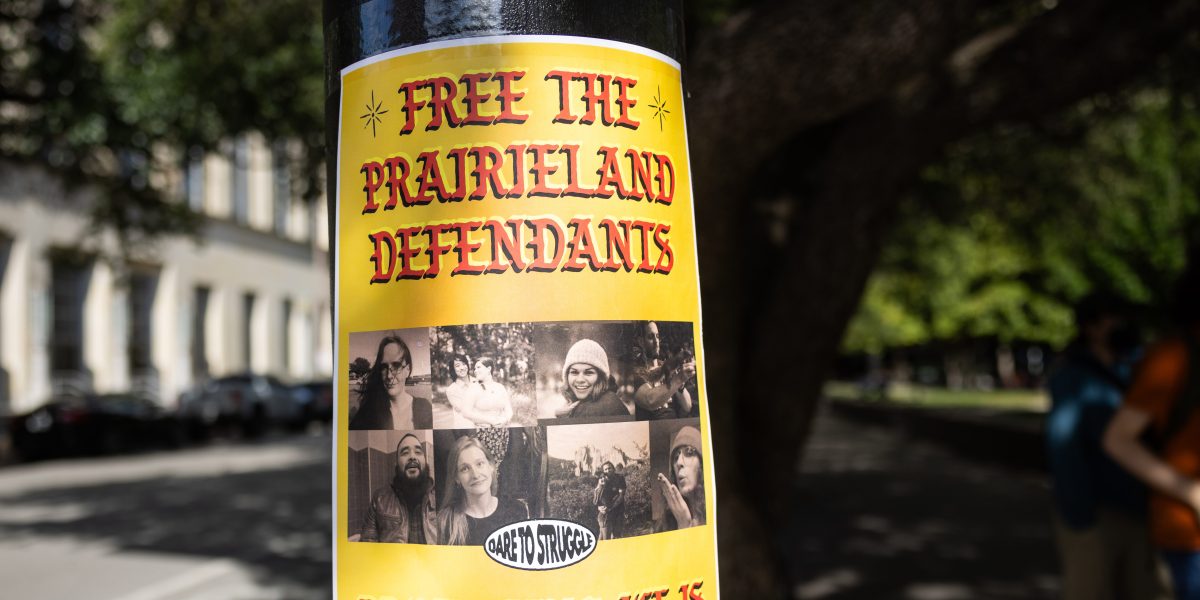
On the last day of the Prairieland trial, in which nine Texas protesters were accused of crimes including providing material support to terrorists, the attorney for activist Benjamin Song presented a novel argument that, if true, would have upended the federal government’s case.
asserted
that → accuse → case
Song had been charged with attempted murder for allegedly firing a gun at the first police officer who arrived on the scene after a noise demonstration outside U.S. Immigration and Customs Enforcement’s Prairieland Detention Center in Alvarado on July 4, 2025.
uncertain
who → charge → July
The defense — more than a dozen attorneys representing clients with varying degrees of involvement in the protest — had rested their argument without calling a single expert witness, owing to what they thought was the weakness of the government’s case.
asserted
they → represent → case
During closing arguments, however, Phillip Hayes, Song’s attorney, raised what he said was a major flaw in the government’s depiction of what happened: Song never aimed his weapon at the police officer.
asserted
Song → raise → officer
Relying on evidence introduced by the prosecution — a photograph of the bullet, witness testimony, and CCTV footage of the incident — Hayes said his client never intended to shoot Alvarado Police Department Lt. Thomas Gross.
asserted
client → rely → Gross
Rather, Hayes said, Song fired his weapon at the ground and the bullet ricocheted off a hard surface before striking the officer just below the neck.
asserted
bullet → say → neck
That would explain the plumes of dust that were visible in the video.
asserted
that → explain → video
According to Hayes, the only photo of the bullet, which appears severely bent and with several missing fragments, backs up the theory.
uncertain
which → accord → theory
“Attempted murder requires that you intend to kill,” Hayes, a lanky, soft-spoken criminal defense attorney, told the jury on March 11.
asserted
Hayes → attempt → March
“And if the government can’t prove that intent, that’s a not guilty — period.”
asserted
that → prove → intent
The jury didn’t bite.
asserted
jury → bite → ?
Instead of being acquitted, Song was convicted and sentenced to 100 years in prison.
asserted
Song → acquit → prison
One reason the ricochet theory didn’t play a bigger role in the trial was that the federal government prevented it from being fully aired.
asserted
government → play → it
Key details about the shooting, and the officer’s actions, were only revealed during the trial itself.
asserted
details → reveal → trial
Prosecution motions and favorable rulings by the judge, a Trump appointee, made it difficult for Song’s lawyers to fully vet the idea or argue that he had acted in self-defense.
asserted
he → make → defense
And an independent ballistics expert hired by Song’s defense team before the trial was denied access to the defendant in federal prison.
asserted
expert → hire → prison
, said Daryl Parker, the former Marine Corps officer and criminal defense investigator hired by Song’s team, a ballistics expert will meet with an alleged shooter to collect information.
asserted
expert → say → information
Nothing about the Prairieland case, however, was turning out to be routine.
asserted
Nothing → turn → case
In emails reviewed by The Intercept, Parker and Hayes repeatedly wrote to Federal Medical Center Fort Worth, the federal detention center where Song was held before and during the trial, asking to visit the defendant.
asserted
Song → review → defendant
All the requests went unanswered.
asserted
requests → go → ?
(FMC Fort Worth declined to respond to a request for comment.)
asserted
Worth → decline → comment
Parker never got a response from the jail official in charge of Song’s detention, let alone visitation rights.
asserted
Parker → get → detention
“We sent him everything he asked for,” Parker, speaking publicly for the first time about the case, told The Intercept.
asserted
Parker → send → Intercept
“But approval never came.”
asserted
approval → come → ?
It was the first time in his 25-year career that the forensics expert had been denied access to a client in a federal facility.
asserted
expert → deny → facility
In the end, members of the jury never received a full airing of the argument nor the multiple pieces of evidence that support it.
asserted
that → receive → it
The ricochet theory, though, may yet be part of Song’s appeal and the basis of a new trial, according to two lawyers on Song’s defense team in his state-level case.
uncertain
theory → accord → case
New evidence, including material revealed for the first time in this Intercept investigation, shows that Song, a former Marine reservist and expert marksman, may have never intended to shoot the police officer.
uncertain
Song → include → officer
The Prairieland case was touted by the Trump administration as the government’s first prosecution of an “antifa cell,” moving from indictment to trial in the Northern District of Texas in just a few months.
asserted
case → tout → months
And key pieces of information were hidden within or even omitted from discovery.
asserted
pieces → hide → discovery
Buried within the tens of thousands of pages of evidence provided to the defense team was a grainy photograph: the government’s only image of the bullet that struck the police officer.
asserted
that → bury → officer
According to two ballistics experts interviewed for this story, the photo is of such poor quality that it is difficult to conclude anything from the image alone.
uncertain
it → accord → image
Shaun Jaikissoon, a former firearms examiner with the New York City Police Department for 10 years who now has his own consulting firm, said the photo of the fragment provided by the prosecution tells us almost nothing and may even be deemed “unsuitable,” meaning it lacks value for a forensic analysis.
uncertain
it → have → analysis
Parker, the independent ballistics expert hired by the defense team, said he agreed the photo was of little value.
asserted
photo → hire → value
“It is sparse,” he said.
asserted
he → say → ?
“You should have images of the end of the bullet — 360 degrees — so you can properly evaluate it.”
asserted
you → have → it
Despite the photograph’s limitations, it does reveal that the bullet was severely deformed, indicating a possible ricochet.
asserted
bullet → reveal → ricochet
“It’s a copper banana,” said Parker.
asserted
Parker → ’ → ?
“It obviously struck something.”
asserted
It → strike → something
The opinion is shared by one of the government’s own witnesses.
asserted
opinion → share → witnesses
…and 95 more, not listed.
 The Aporia