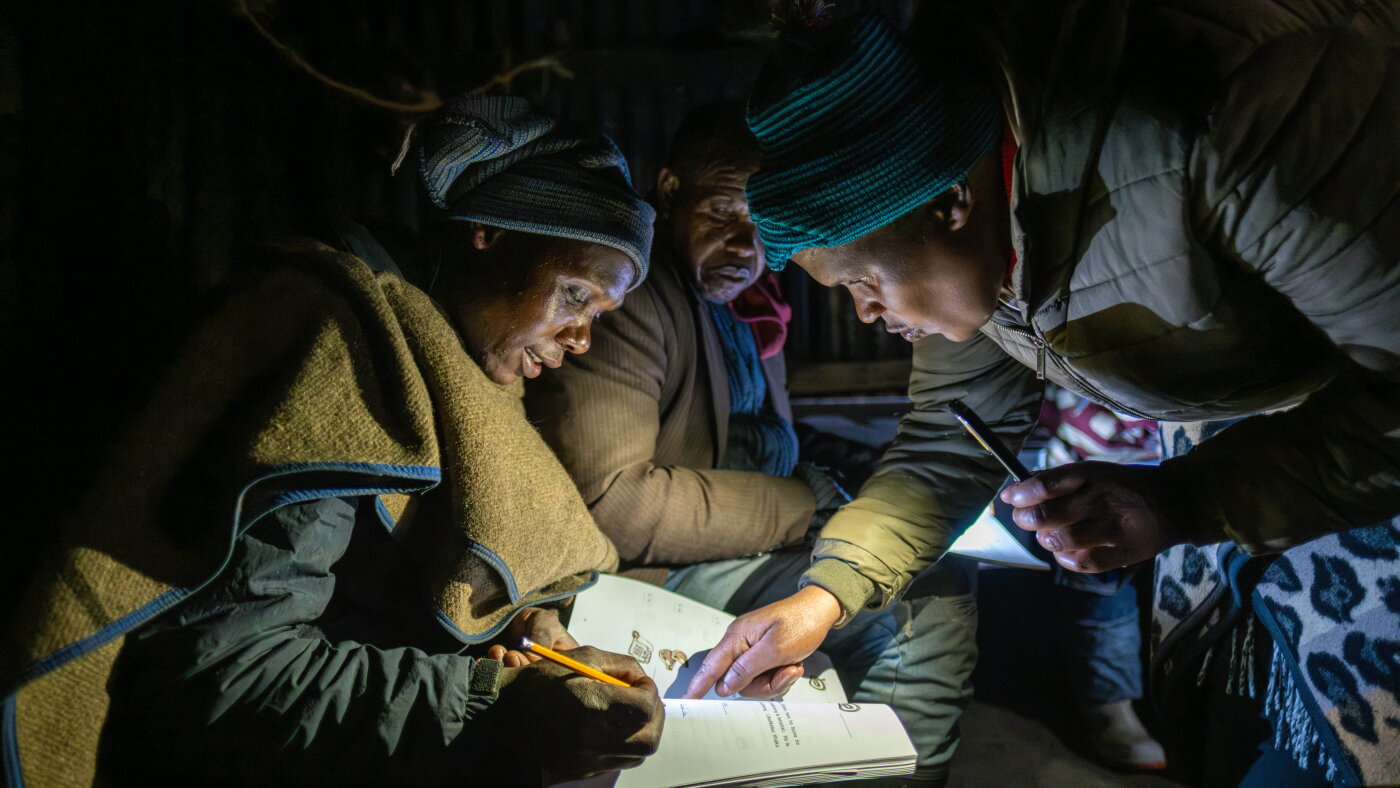
Photos: These shepherds climb down a mountain to go to night school
The sun has already started setting behind the towering peaks of central Lesotho when Kabelo Mohai and Lepeli Maapesa begin their long walk to school.
asserted
Mohai → climb → school
Wool blankets draped over their shoulders against the biting cold, the two young men scramble down rocky paths nearly 8,000 feet above sea level.
asserted
men → drape → level
Far below, scattered rural villages appear as tiny dots.
asserted
villages → scatter → dots
The moon is high in the sky, an hour and a half later, when they finally spot the lights of the small town of Semonkong in the distance.
asserted
they → spot → distance
In the pitch darkness, dozens of similar blanket-clad silhouettes make their way down the mountainsides, singing and chatting excitedly as they approach a building illuminated by fluorescent lights: the Good Shepherd School, where more than 40 herders gather every evening for night classes.
asserted
herders → clothe → classes
Mohai and Lepeli are among tens of thousands of boys and young men working as shepherds in this small, mountainous southern African country.
asserted
Mohai → work → country
Livestock is deeply woven into Lesotho's economy and culture: Wool and mohair account for nearly 60% of agricultural exports and support a quarter of the rural population.
asserted
Wool → weave → population
Driven by poverty and tradition, school-aged boys are often called to tend the flocks, spending months at a time herding alone in the mountains, cut off from society.
asserted
boys → drive → society
A World Bank analysis of 2018 data found that nearly half of all boys in the country were engaged in some form of herding.
asserted
half → find → herding
For many, like Mohai, the work comes at the expense of schooling.
asserted
work → come → schooling
"I started working with animals when I was 9.
asserted
I → start → animals
I only finished primary school," says the now 20-year-old, his youthful face peeking out from under a ski mask patched with colorful threads.
asserted
face → finish → threads
A second chance
To give these "herd boys" a second chance at education, dozens of dedicated schools have emerged across the country.
asserted
dozens → give → country
Mostly run by volunteers on shoestring budgets, they hold classes at night, once the flocks have been safely brought into their pens.
asserted
flocks → run → pens
And the schools constantly struggle financially to keep their doors open.
asserted
schools → struggle → doors
Yet for many, they offer the only chance to dream of a different future.
asserted
they → offer → future
At 15, when he started herding full-time, Mohai moved into a cattle post — a makeshift hut high up in the mountains — to live alongside his family's flock of 155 sheep and goats.
asserted
Mohai → start → sheep
Inside the shelter he built from rocks and branches, a water can and a cast-iron pot sit beside a rudimentary bed made of flat-surfaced stones and covered with a thin blanket.
asserted
can → build → blanket
A few shirts and bags hang on sticks protruding from the thatched roof.
asserted
shirts → hang → roof
Other young herders live in similar huts scattered across the mountainside, but most days, Mohai's main companion is his dog Balireng — meaning "enemy" in Sesotho.
asserted
companion → live → Sesotho
Nobody can tell me what to do," the young man says with a smile.
asserted
man → tell → smile
The tiny nation of Lesotho is the only country in the world to lie entirely more than 1,000 meters (3,281 feet) above sea level, earning it the nickname "Kingdom in the Sky."
asserted
nation → lie → Sky
Heavy snow is common in winter, and summers can be scorching.
asserted
summers → scorch → winter
"Day or night, raining or hot, we have to look after the animals.
asserted
we → have → animals
And sometimes, it's not good not to socialize," admits Mohai.
asserted
Mohai → socialize → ?
So when he heard about the Good Shepherd Night School three years ago, he seized the chance to return to the classroom.
asserted
he → hear → classroom
Now, every weekday after a long day of herding, he makes the trek down the mountain to attend his Grade 7 class before clambering back up to his hut a few hours later.
asserted
he → make → hut
"It's very important for us to have some knowledge and learn," he says.
asserted
he → have → knowledge
One day, he dreams of becoming a soldier.
asserted
he → dream → soldier
"I go to school so I can keep my ability to read and write.
asserted
I → go → ability
Maybe, in the future, I can be hired somewhere."
asserted
I → hire → future
By 8 p.m., the dimly lit classroom of the Good Shepherd Night School is crowded.
asserted
classroom → light → School
Mohai and Lepeli have settled at a desk in the corner shared with two other students.
asserted
Mohai → settle → students
Two dozen boys line the long tables, all dressed in the traditional attire of patterned blankets, hats and rubber boots.
asserted
all → line → blankets
They read aloud as their teacher, Sister Rosemary Mokebe, writes math equations on the blackboard.
asserted
teacher → read → blackboard
'They are sitting in the dark'
asserted
They → sit → dark
The night school was founded in 2003 on the grounds of a convent belonging to the Good Shepherd Sisters of Quebec congregation.
asserted
school → found → congregation
"We discovered that most boys in Semonkong could not read or write," recalls Mokebe, a 55-year-old nun who runs the school and teaches grades 6 and 7.
uncertain
who → discover → grades
Classes run for a couple of hours every weeknight and have more than 40 students, ranging in age from 15 to 55 and divided into three levels.
asserted
Classes → run → levels
The economy rests on their shoulders," Sister Mokebe says.
asserted
Mokebe → rest → shoulders
…and 68 more, not listed.
 The Aporia