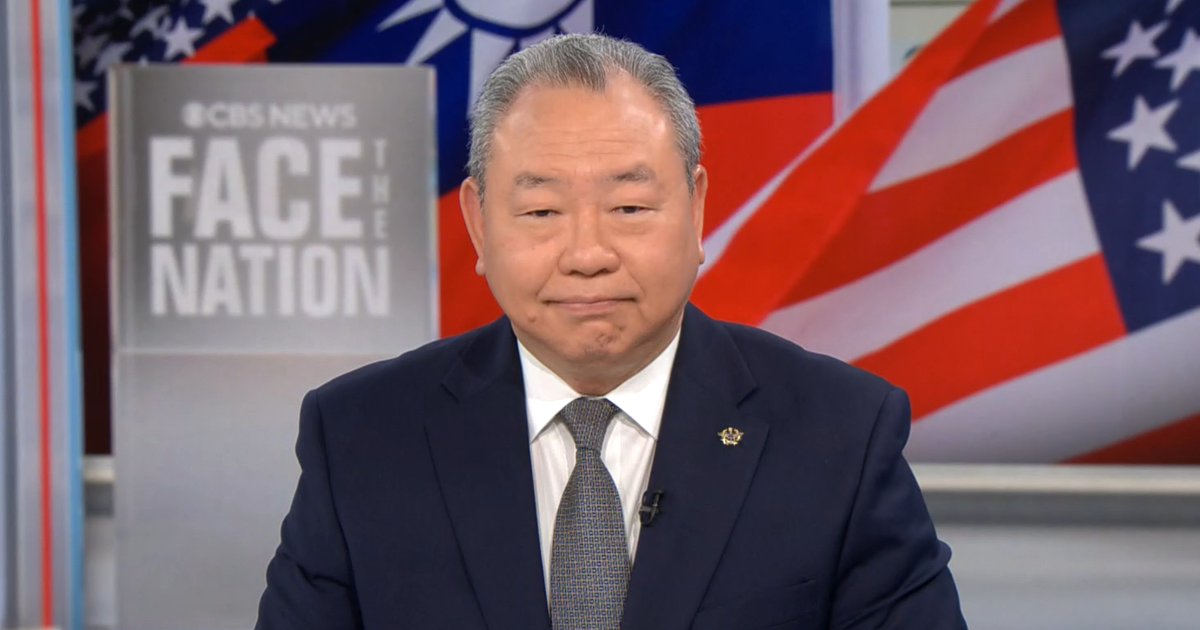
Photo via CBS News

Transcript: Alexander Yui, Taiwan's representative to the U.S., on "Face the Nation with Margaret Brennan," Sept. 27, 2026

Read the original at CBS News ↗
Cite

Transcript: Alexander Yui, Taiwan's representative to the U.S., on "Face the Nation with Margaret Brennan," Sept. 27, 2026. (2026, September 27). CBS News. https://www.cbsnews.com/news/alexander-yui-taiwan-representative-face-the-nation-transcript-09-27-2026/

Dated when The Aporia collected the article, usually within hours of publication. Check the original for its exact date and byline.

CBS News · collected 2026-09-27

Quick Summary

Alexander Yui, Taiwan's representative to the United States, appeared on "Face the Nation" on September 27, 2026, discussing recent interactions between President Trump and Chinese leader Xi Jinping regarding Taiwan. Yui noted that while Taiwan was mentioned during their meeting, it did not become a central topic of discussion, contrary to previous assertions by both leaders. He emphasized that the U.S. maintained its stance on Taiwan's security and international participation without changes following the summit, despite China’s foundational concerns over the issue.
Written by AI on 2026-09-27, from this article's own text only (the story summary below draws on all the coverage).

AI analysis

Story summary

As of October 2, 2026, Donald Trump rejected Iran's offer to reopen the Strait of Hormuz within seven days, deeming it "simply not enough." This proposal was made by Iranian President Masoud Pezeshkian in an effort to ease tensions and open dialogue. However, Trump warned that military action against Tehran could resume after the U.S. midterm elections, suggesting ongoing hostility despite Iran's willingness to negotiate. The offer came amidst international pressure for a resolution to the conflict; Russian President Vladimir Putin expressed hope that the strait would reopen, while also noting Russia’s proposal to receive enriched uranium from Iran remains on the table.

The U.S. has imposed new sanctions on Iranian carmakers and rail operators in response to Tehran's threats and actions. In parallel, Trump dismissed previous claims suggesting his administration was preparing to provide significant concessions to Iran, instead emphasizing a strategy focused on economic pressure through sanctions that have severely impacted Iran’s currency, with the rial trading at an unprecedented 2.5 million to the dollar.

The situation remains tense, with multiple international stakeholders advocating for dialogue and peace but facing resistance from both sides, particularly as the U.S. continues its aggressive stance towards Iran despite diplomatic efforts by other nations like Russia. Ed Miliband, UK Foreign Secretary, also met with his Iranian counterpart in New York during the UN General Assembly to discuss reopening the Strait of Hormuz and address threats posed by Iranian-linked groups on British soil. However, Miliband reiterated that Britain will not tolerate any form of intimidation or hostile activity linked to Iran. This complex diplomatic scenario underscores the challenges in achieving a peaceful resolution without further escalation.

Written for “Trump's Iran Policy And Pardons Talks” on 2026-10-31, grounded in this article and the 132 other(s) covering the same event.

Story

📰 Trump's Iran Policy And Pardons Talks
Politics · 133 article(s) covering the same event. See how they differ ↓

Compared with similar articles

This article reads unscored and hedges 7% of its claims. Each row says how that neighbour differs.
CBS News
Hedges 0 of 1 claims Outlet record 66/100
CBS News
Hedges 19 of 420 claims Outlet record 66/100
CBS News
Outlet record 66/100
“While both articles mention an interview involving Alexander Yui on 'Face the Nation with Margaret Brennan', Article B also includes a reference to an interview with Iranian President Masoud Pezeshkian, indicating that it covers more than just the same specific event.”
The Straits Times
⚖️ Leans right Hedges 3 of 14 claims Outlet record 66/100
“The articles describe different events: one is an interview with Alexander Yui on September 27, while the other reports a meeting between Senator Wicker and Alexander Yui on September 29.”
How this article was measured signals, leaning charts, publisher record, byline, topics and claims

Signals How these are calculated →

Claims extracted
58
sentences that state something as happening or true
Uncertain
7%
4 of 58 hedged ("reportedly", "may", "according to")
Leaning
not political
takes no side on a contested political question
Publisher signals
66/100
CBS News's corrections and hedging, across everything collected from it. Not a measure of accuracy.
Outlets on this story
133
Politics
Same framing elsewhere
1
articles that frame the event the way this one does
Analyzed 2026-09-27 · how these are computed

How this is being covered How these are calculated →

Article leaning vs. publisher reliability
Source leaning vs. consistency

Publisher

CBS News · 4280 article(s) · 6 correction(s) detected
Running correction rate · 6 correction(s)

Who wrote this

No reporter is named on this article.

Topics

Beijing Taiwan U.S. UNGA the United States

Subjects

Taiwan GPE · 15× YUI PERSON · 10× MARGARET BRENNAN PERSON · 9× Trump PERSON · 6× the United States GPE · 5× Beijing GPE · 4× U.S. GPE · 4× Alexander Yui PERSON · 3× China GPE · 3× Xi Jinping PERSON · 3×

Narrative

But also the perspective that that now because of that is making reference that China United States has to fight the new militarism implying Japan and other countries for example the Philippines-- MARGARET BRENNAN: Right. YUI: --or even Taiwan being aggressive that therefore there's we should- that United States shouldn't sell arms to Taiwan or-- MARGARET BRENNAN: Except-- YUI: --and that's- that's- that's- that's messing, you know, again twisting the facts because it is the People's Republic of China who is being the aggressor.
framing: assertive · carried by 1 article(s) · first seen 2026-09-27
🔮 You were here in May after President Trump-- YUI: Yeah. MARGARET BRENNAN: --visited Beijing, and we discussed that the two leaders did, at length, discuss Taiwan-- YUI: Yes, they did. MARGARET BRENNAN: --according to President Trump at that time.

Claims (58 extracted, 4 hedged)

The following is the transcript of the interview with Alexander Yui, Taiwan's representative to the U.S., that aired on "Face the Nation with Margaret Brennan" on Sept. 27, 2026. asserted
that → follow → Sept.
We're joined now by the Taiwan representative to the United States, Ambassador Alexander Yui. asserted
We → join → States
You were here in May after President Trump-- YUI: Yeah. MARGARET BRENNAN: --visited Beijing, and we discussed that the two leaders did, at length, discuss Taiwan-- YUI: Yes, they did. MARGARET BRENNAN: --according to President Trump at that time. uncertain
they → --visite → time
When it came to this meeting, this past week, President Trump said Taiwan did come up with Xi, but, quote, "We didn't spend a lot of time talking about Taiwan." asserted
We → come → Taiwan
Do you have any sense what context there was? asserted
you → have → sense
How Taiwan was discussed? asserted
Taiwan → discuss → ?
Have you been given any readout? asserted
you → give → readout
Well, I mean, you've heard many people comment, including President Trump, comment on the question of Taiwan. asserted
people → mean → Taiwan
He made it clear himself that it was mentioned, but it was not the main topic of discussion. asserted
it → make → discussion
As a matter of fact, during the released statements by both sides on the deliverables or the achievements, Taiwan does not figure neither side of- of- of the- of the papers, so-- MARGARET BRENNAN: asserted
Taiwan → release → papers
China did say this issue was foundational. asserted
issue → say → ?
Well, it was foundational, but there was no reaction from the U.S. side. asserted
it → be → side
Which, I think, again during May, President or General Secretary Xi gave an earful of Taiwan to President Trump when he was in Beijing. uncertain
he → think → Beijing
But during this- this trip, the United States made it very clear that no change in position towards Taiwan, and I think they made it clear during and before and after the visit. asserted
it → make → visit
Right before the visit, Secretary Rubio met with the foreign ministers of Japan and Korea in UNGA in New York, and they made it very clear that supported peace stability of the Taiwan Straits, no coercion, no status quo, and even supported Taiwan's meaningful participation in the- in the international organizations, as well as many other countries during UNGA, but so Taiwan is- there's no change in Taiwan's position for the United States. asserted
Taiwan → meet → States
In May, President Trump said he wanted to speak with your president, President Lai. uncertain
he → say → president
Did that call ever take place? asserted
call → take → place
Well, I'll say that the communications between the two sides, between Thai and the United States is open, is regular, and it's very, very close, at different levels, and I'll just leave it at that. asserted
I → say → that
Well, I'll just say that our communications are quite regular and quite open. asserted
communications → say → ?
I want to ask you about the state of play with Taiwan and the tension with Beijing. asserted
I → want → Beijing
The unclassified U.S. intelligence community assessment says Chinese leaders do not currently plan to execute an invasion of Taiwan in 2027. asserted
leaders → say → 2027
But it also says Beijing will continue setting the conditions for eventual unification short of conflict. asserted
Beijing → say → conflict
What do you need from the U.S. to deter Xi Jinping? asserted
you → need → Jinping
Well, this comes back all the way to the- the mentions of United States President Xi- Donald Trump and the Secretary General of China Xi Jinping during their visits, during his visit, where both mentioned the- the historical factors between World War II or the war of Japanese invasion of China during the late '30s. asserted
both → come → 30s
Which President Trump highlighted the historical actions, the heroic actions of United States flying tigers, but Secretary General Xi wanted to mention that it was- made a reference that it was the Chinese Communist Party that fought World War II or fought the Japanese-- MARGARET BRENNAN: asserted
that → highlight → Japanese--
Let me show you this. asserted
me → let → this
This is the Flying Tigers using our- our flag. asserted
This → use → flag
This is the bloodshed by which every American pilot, when they flew on missions on the Flying Tigers, they wore on their- the back of their- of their jacket to show if they're down that- that people- Chinese people can help them. asserted
people → fly → them
That's what that- those words say. asserted
words → say → what
Yeah, it says-- MARGARET BRENNAN: asserted
it → says-- → ?
If this pilot goes down-- YUI: It says this– MARGARET BRENNAN: --he is an American. asserted
--he → go → this
--foreigner is here to help us in the war effort, please help them. asserted
--foreigner → help → them
And the point you are making, as I understand it, is that the Chinese Communist Party was not running China during World War II. asserted
Party → make → II
It was actually the very same party that-- YUI: Exactly. MARGARET BRENNAN: --eventually left the mainland and set up a government in Taiwan. asserted
BRENNAN → leave → Taiwan
The communist regime did not exist until 1949. asserted
regime → exist → 1949
During the war, they were guerrillas, barely having any skirmishes against Japanese, if any. asserted
they → have → Japanese
But, and then after they became a People's Republic in '49, a few years afterwards they were fighting and killing American soldiers in the Korean War. asserted
they → become → War
So let's- let's- let's put that into perspective. asserted
's → let's- → perspective
Was that offensive to people in Taiwan when they heard the president of the United States not correct-- YUI: No, no-- MARGARET BRENNAN: --Xi Jinping, but accept that claim? uncertain
president → hear → claim
President Trump was correct in saying that the- the Chinese and the Americans fought valiantly in the war, but that was- in the context that it was the- the Republic of China-- MARGARET BRENNAN: Right. YUI: --government fighting alongside the-- MARGARET BRENNAN: --not the government led by-- YUI: Not the- not Xi Jinping. asserted
it → say → the--
…and 18 more, not listed.

💬Give feedback
🕘History 🎫Support