Photo via The Sydney Morning Herald

The 23-metre walk that cost a developer a $44m Mosman housing tower

Read the original at The Sydney Morning Herald ↗
Cite

Barwell, D. (2026, September 27). The 23-metre walk that cost a developer a $44m Mosman housing tower. The Sydney Morning Herald. https://www.smh.com.au/national/nsw/the-23-metre-walk-that-cost-a-developer-a-44m-mosman-housing-tower-20260928-p60z6a.html?ref=rss&utm_medium=rss&utm_source=rss_feed

Dated when The Aporia collected the article, usually within hours of publication. Check the original for its exact date and byline.

The Sydney Morning Herald · collected 2026-09-27 · by David Barwell

Quick Summary

A developer's plan to build a six-storey apartment block in Mosman, Sydney, worth $44 million, has been rejected after a 15-month legal battle over whether residents could safely walk within 400 meters of local shops. The dispute centered on a critical 23-meter difference in walking distance across an unsignalized four-lane road, with the court ultimately ruling that the proposed site fell outside the designated safe area due to pedestrian safety concerns. This decision may affect future housing developments under NSW’s low- and mid-rise housing reforms aimed at increasing density near eligible town centers.
Written by AI on 2026-09-27, from this article's own text only (the story summary below draws on all the coverage).

AI analysis

Story summary

In Mosman, the NSW Land and Environment Court rejected Metis Group’s appeal against Mosman Council's refusal of its plan to build a six-storey apartment block on a 29-unit project site. The project, estimated at $44 million, would have demolished five single- and two-story homes and faced over 100 written objections from residents. The critical issue was whether the site fell within the 400-metre "safe walking distance" of Spit Junction, a key threshold under NSW government reforms aimed at increasing housing density across Sydney. Metis Group argued that the site was only 383 metres away, but this was not enough to meet the criteria set by the reforms for greater building densities. The court's decision could influence future developments and the state’s push towards higher urban density in eligible town centers.

Written for “Mosman Housing Tower Controversy” on 2026-11-01, grounded in this article and the 0 other(s) covering the same event.

Story

📰 Mosman Housing Tower Controversy
Politics · 1 article(s) covering the same event.

Compared with similar articles

This article reads unscored and hedges 4% of its claims. Each row says how that neighbour differs.
The Sydney Morning Herald
Hedges 2 of 43 claims Outlet record 61/100
“The articles discuss different aspects of housing development along the NSW coast, with Article A providing a broader overview and Article B focusing on a specific legal case in Mosman.”
How this article was measured signals, leaning charts, publisher record, byline, topics and claims

Signals How these are calculated →

Claims extracted
25
sentences that state something as happening or true
Uncertain
4%
1 of 25 hedged ("reportedly", "may", "according to")
Leaning
withheld
no quote in the article backed the model's score
Publisher signals
61/100
The Sydney Morning Herald's corrections and hedging, across everything collected from it. Not a measure of accuracy.
Outlets on this story
1
Politics
Same framing elsewhere
1
articles that frame the event the way this one does
Analyzed 2026-09-27 · how these are computed

How this is being covered How these are calculated →

Article leaning vs. publisher reliability
Source leaning vs. consistency

Publisher

The Sydney Morning Herald · 5709 article(s) · 15 correction(s) detected
Running correction rate · 15 correction(s)

Who wrote this

David Barwell
7 article(s) here · 1 carrying a prediction
🔮 The plan, which includes an initial stage of 100 homes, three of which would be affordable dwellings, received initial support this month from the NSW government’s Housing Delivery Authority, a planning body established to boost housing supply through streamlined assessments that bypass local councils.
🔮 The shift will impact up to 600 occupants including active personnel, up to a dozen defence families including those with young children, along with public servants, reservists and cadets.
🔮 The proposed monument would shine a spotlight on the endangered Mount Kaputar pink slug, a land mollusc found exclusively in the high-altitude subalpine forests atop Mount Kaputar, an extinct volcano about 50 kilometres east of Narrabri.
2026-10-06 · assertive framing · NSW’s next big thing? A giant pink slug
🔮 The decision could have implications for the NSW government’s push to increase housing density across Sydney through its low- and mid-rise housing reforms, because the case turned on whether the site fell within a crucial 400-metre “safe walking distance” of Spit Junction.
🔮 But a Herald analysis of projects already moving through the planning system suggests the eventual number could be substantially higher.
🔮 It would be operated by Navarra Venues, which runs a string of other Sydney venues including Le Montage at Lilyfield, Curzon Hall at Marsfield and Oatlands Estate.
🔮 A dozen parking bays on the edge of the central business district are set to be transformed into an expansion of one of Sydney’s newest and most popular harbour swimming spots ahead of summer.
Also by David Barwell
NSW’s next big thing? A giant pink slug
2026-10-06 · The Sydney Morning Herald
Nothing else under this byline is closely related to this article, so these are simply their most recent.
All 7 articles by David Barwell →

Topics

Metis Metis Group Mosman NSW The NSW Land and Environment Court

Subjects

NSW GPE · 4× Metis Group ORG · 3× Metis NORP · 2× Land and Environment Court ORG · 1× Mosman GPE · 1× Mosman Council ORG · 1× Mosman Council’s ORG · 1× Sydney GPE · 1× The NSW Land and Environment Court ORG · 1× Transport for NSW ORG · 1×

Narrative

Metis Group argued the Awaba Street site was safely inside the crucial 400-metre LMR boundary, based on a 383-metre walking route to Spit Junction through residential streets and footpaths and across an unsignalised section of Ourimbah Road – a four-lane thoroughfare running through the lower North Shore.
framing: assertive · carried by 1 article(s) · first seen 2026-09-27
🔮 The decision could have implications for the NSW government’s push to increase housing density across Sydney through its low- and mid-rise housing reforms, because the case turned on whether the site fell within a crucial 400-metre “safe walking distance” of Spit Junction.
2026-09-27 · The Sydney Morning Herald
The 23-metre walk that cost a developer a $44m Mosman housing tower · assertive framing

Claims (25 extracted, 1 hedged)

A $44 million plan to bulldoze five single- and two-storey Mosman homes to make way for a six-storey apartment block has been rejected after a 15-month planning battle boiled down to a deceptively simple question: how far must a pedestrian safely walk to reach their local shops? asserted
pedestrian → bulldoze → shops
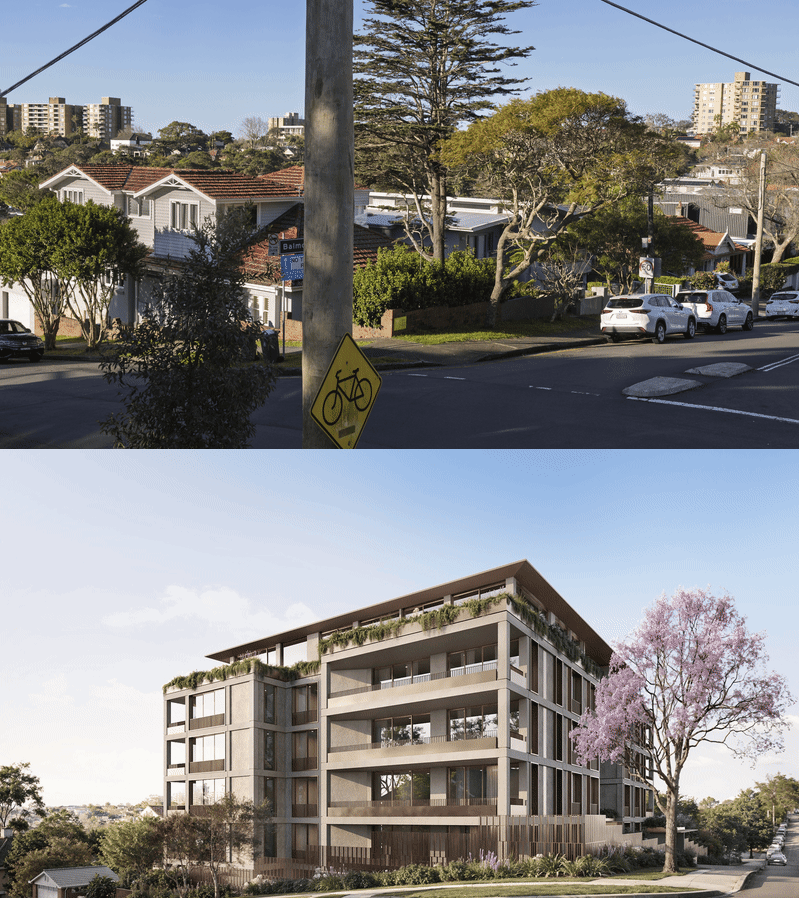
The NSW Land and Environment Court has dismissed developer Metis Group’s appeal against Mosman Council’s refusal of its 29-unit project on a 2000-square-metre site in Awaba Street, after the proposal generated more than 100 written objections from residents and prompted months of legal arguments. asserted
proposal → dismiss → arguments
The decision could have implications for the NSW government’s push to increase housing density across Sydney through its low- and mid-rise housing reforms, because the case turned on whether the site fell within a crucial 400-metre “safe walking distance” of Spit Junction. uncertain
site → have → Junction
Under the government’s low- and mid-rise housing (LMR) reforms, sites within 400 metres of 171 eligible town centres across NSW can qualify for greater density, floor space and building heights of up to six storeys – and up to eight if affordable housing is included. asserted
housing → qualify → storeys
But sites between 401 metres and 800 metres from a centre face a lower four-storey height limit – a two-storey difference that can have major consequences for a development project’s feasibility. asserted
that → face → feasibility
The LMR policy, introduced in 2024, is a key part of the government’s efforts to increase housing supply by allowing greater density on land previously restricted to low-rise housing. asserted
policy → introduce → housing
Metis Group argued the Awaba Street site was safely inside the crucial 400-metre LMR boundary, based on a 383-metre walking route to Spit Junction through residential streets and footpaths and across an unsignalised section of Ourimbah Road – a four-lane thoroughfare running through the lower North Shore. asserted
site → argue → Shore
To demonstrate that the route was safe, Metis presented evidence to the court including independent traffic engineering reports, video footage of 250 pedestrians crossing Ourimbah Road each day, and Transport for NSW data showing no crashes along the route over a decade. asserted
pedestrians → demonstrate → decade
However, Mosman Council contested the route, arguing that forcing pedestrians to negotiate four lanes of traffic across the unsignalised section of Ourimbah Road was inherently unsafe. asserted
forcing → contest → Road
It argued pedestrians would instead use a safer route via traffic lights further along Ourimbah Road – a journey adding 40 metres to the route, bringing the total walking distance to 423 metres and placing the Awaba Street site outside the critical 400-metre zone. asserted
pedestrians → argue → zone
In her ruling, Land and Environment Court Commissioner Nicola Targett sided with the council, finding pedestrians would “reasonably and practically” use the safer route, particularly given Ourimbah Road’s status as a regional arterial road, which she noted carries up to 1000 vehicles an hour. asserted
she → side → vehicles
Without the additional height and density permitted under the LMR reforms, the proposed development was non-compliant. asserted
development → permit → reforms
The court dismissed Metis’ appeal and ordered the developer to pay $15,000 towards the council’s legal costs. asserted
court → dismiss → costs
The ruling has raised questions about how sites across NSW will be assessed under the LMR reforms, which are intended to support 112,000 new homes by 2029 as part of the government’s goal of meeting the National Housing Accord target. asserted
which → raise → target
Metis Group co-founder Arian Galanis said the decision introduced unpredictability into a development sector already grappling with elevated construction costs and tight operating margins. asserted
decision → say → costs
“If whether a site qualifies can turn on a judgment about which walking route is deemed safest, that is a difficult basis on which to identify, validate, plan, and invest in housing in the state,” he said. asserted
he → qualify → state
“Developers are being asked to take substantial personal and financial risk without a clear baseline, and many other well-located properties across NSW will now face the same ambiguity.” asserted
properties → ask → ambiguity
University of Sydney urban planning professor Nicole Gurran said the case demonstrated the problems created by applying a fixed distance around town centres without considering how people actually move through an area. asserted
people → say → area
“Planners and local councils have been consistently saying that you can’t just draw a 400-metre circle around a town centre for greater density within it,” Professor Gurran said. asserted
Gurran → say → it
“A far more reasonable approach is site-based planning that takes into account the existing constraints and opportunities. asserted
that → base → constraints
“[The case] is a perfect example of how, in the rush to liberate sites for housing supply, you actually create uncertainty because you are creating false expectations for the development sector. asserted
you → liberate → sector
Mosman Council, in a statement, said it welcomed the decision as a “positive outcome” for a community that had “felt very strongly about what was proposed.” asserted
what → say → community
That included Peter Papilos, one of 105 residents who lodged submissions opposing the proposed development over its bulk, scale and traffic impacts. asserted
who → include → bulk
“As the crow flies, yes, the site is less than 400 metres from Spit Junction,” he said. asserted
he → fly → Junction
“But people are not crows, and they shouldn’t be expected to negotiate streams of traffic with buses and trucks just so a developer is eligible for major increases in building height. asserted
developer → expect → height

💬Give feedback
🕘History 🎫Support