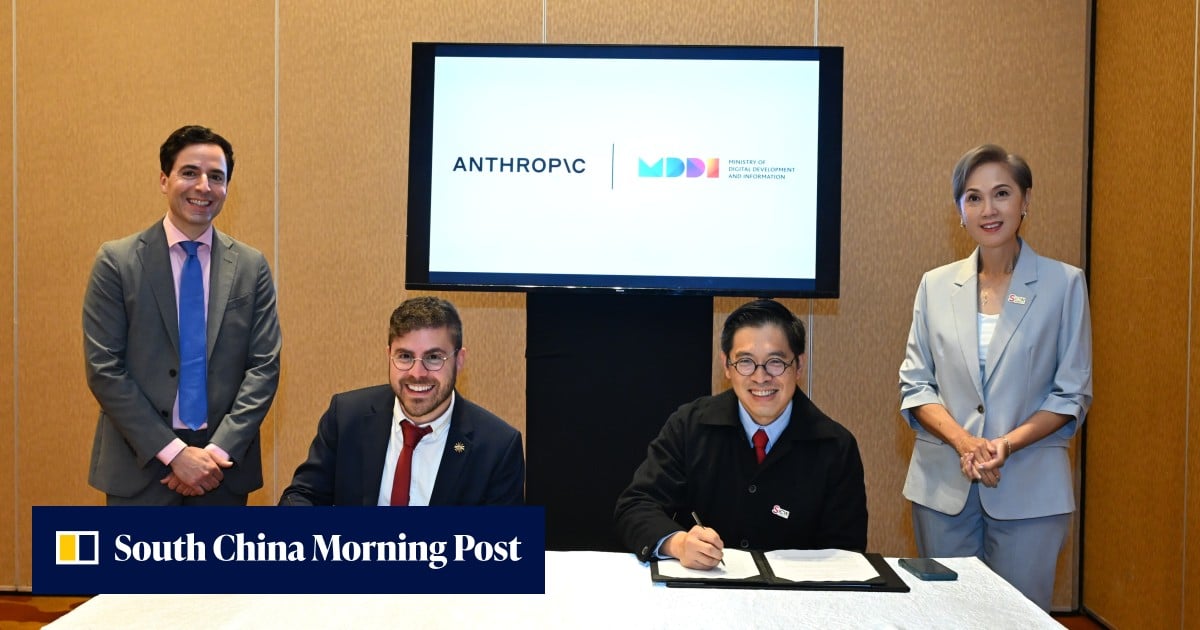
Photo via South China Morning Post

Southeast Asia’s falling literacy: can cash and gamification fix it?

Read the original at South China Morning Post ↗
Cite

Lim, K. (2026, September 28). Southeast Asia’s falling literacy: can cash and gamification fix it? South China Morning Post. https://www.scmp.com/week-asia/lifestyle-culture/article/3369039/southeast-asias-falling-literacy-can-cash-and-gamification-fix-it?utm_source=rss_feed

Dated when The Aporia collected the article, usually within hours of publication. Check the original for its exact date and byline.

South China Morning Post · collected 2026-09-28 · by Kolette Lim

Quick Summary

The article discusses declining literacy rates in Southeast Asia due to factors like increased screen time and busy lifestyles. To address this issue, governments are implementing unconventional methods such as offering financial incentives and gamifying reading activities. For example, Singapore recently introduced a program that rewards residents with cash for participating in reading programs.
Written by AI on 2026-09-28, from this article's own text only (the story summary below draws on all the coverage).

AI analysis

Story summary

Singapore has introduced an initiative to boost literacy by offering citizens cash incentives for reading, in response to declining reading habits across Southeast Asia. The program aims to combat issues like shrinking attention spans and excessive smartphone use, often referred to as "doomscrolling." A 35-year-old tutor explained that increasing work commitments made it difficult to find time for books, leading her to spend more time on her phone instead. Despite an initial enthusiasm for reading, she admitted, “Life got in the way – it was work, a lack of time, and eventually, the phone screen.” Other governments are also implementing similar measures, such as book drives and voucher programs, to encourage citizens to read more regularly.
Written for “Southeast Asia Literacy Issues” on 2026-10-31, grounded in this article and the 0 other(s) covering the same event.

Story

📰 Southeast Asia Literacy Issues
Education · 1 article(s) covering the same event.

Compared with similar articles

Nothing to compare against. No article is close enough to this one for the pipeline to have linked or judged the pair.
How this article was measured signals, leaning charts, publisher record, byline, topics and claims

Signals How these are calculated →

Claims extracted
7
sentences that state something as happening or true
Uncertain
0%
0 of 7 hedged ("reportedly", "may", "according to")
Leaning
not political
takes no side on a contested political question
Publisher signals
64/100
South China Morning Post's corrections and hedging, across everything collected from it. Not a measure of accuracy.
Outlets on this story
1
Education
Same framing elsewhere
1
articles that frame the event the way this one does
Analyzed 2026-09-28 · how these are computed

How this is being covered How these are calculated →

Article leaning vs. publisher reliability
Source leaning vs. consistency

Publisher

South China Morning Post · 3480 article(s) · 6 correction(s) detected
Running correction rate · 6 correction(s)

Who wrote this

Kolette Lim
14 article(s) here · 0 carrying a prediction
🔮 At a summit earlier this month, Singapore launched a refreshed cybersecurity strategy that would see it progressively deploy AI across its cyber defence operations and work with industry partners to accelerate adoption, as it seeks to bolster protection for its critical infrastructure.
🔮 On Monday, Singapore’s Coordinating Minister for National Security K Shanmugam told local media the country would use “every legal and regulatory lever” at its disposal to “exert pressure where it matters – including on [companies’] bottom lines, including on their access to financing, and including on their standing with investors”.
🔮 From public service to private romance FirstDate is being piloted among government employees aged 21 to 35 amid Singapore’s efforts to raise its fertility rate “It’s like ‘Why not?’, and I think it does have a few screening procedures so it might save you some trouble like having to deal with impersonators or people who do not match with their advertised profiles,” said Clare, who requested not to use her real name.
🔮 Singapore must be able to say ‘no’ to US, China to preserve trust: Foreign Minister Vivian Balakrishnan says Singapore must maintain trust with Washington and Beijing without becoming a proxy for either He also warned that the global landscape would remain unsettled if China and the United States failed to address their respective domestic issues.
🔮 With global acts also touring Asia, UK star Ed Sheeran’s concert fallout in the US raises the question of how the saga would play out regionally In Malaysia, where public support for the Palestinian cause runs deep, promoters must still weigh an artist’s politics against commercial considerations and concert rules.
🔮 Observers say that through resonating with the hosts, Chan managed to convey Singapore’s sterner message of a call for major powers to build trust instead of coercion, though there is a risk that linguistic bonds may raise the expectation for Singapore to sympathise with Beijing’s interests.
🔮 “I guessed that they might not have been doing that well since branches have been closing over the years, but I did not expect the whole chain to disappear just like that,” he said.
🔮 Only later would they realise the lessons were part of the trap.
Also by Kolette Lim
Nothing else under this byline is closely related to this article, so these are simply their most recent.
All 14 articles by Kolette Lim →

Topics

Singapore

Subjects

Singapore GPE · 1×

Narrative

Facing shrinking attention spans and ‘doomscrolling’, governments are using cash, vouchers and book drives to get citizens reading again But as work commitments grew, the pages of her books started yellowing.
framing: assertive · carried by 1 article(s) · first seen 2026-09-28
2026-09-28 · South China Morning Post
Southeast Asia’s falling literacy: can cash and gamification fix it? · assertive framing

Claims (7 extracted, 0 hedged)

Southeast Asia’s falling literacy: can cash and gamification fix it? asserted
cash → fall → it
Facing shrinking attention spans and ‘doomscrolling’, governments are using cash, vouchers and book drives to get citizens reading again But as work commitments grew, the pages of her books started yellowing. asserted
pages → face → books
Finding time to read became harder, and her smartphone screen eventually took over. asserted
screen → find → time
“I think I just fell out of reading,” the 35-year-old tutor said. asserted
tutor → think → reading
“Life got in the way – it was work, a lack of time, and eventually, the phone screen.” asserted
it → get → time
Singapore is one of those taking action. asserted
Singapore → take → action
Earlier this month, the city state launched an initiative that pays citizens to read. asserted
that → launch → citizens
💬Give feedback
🕘History 🎫Support