Photo via Times of India

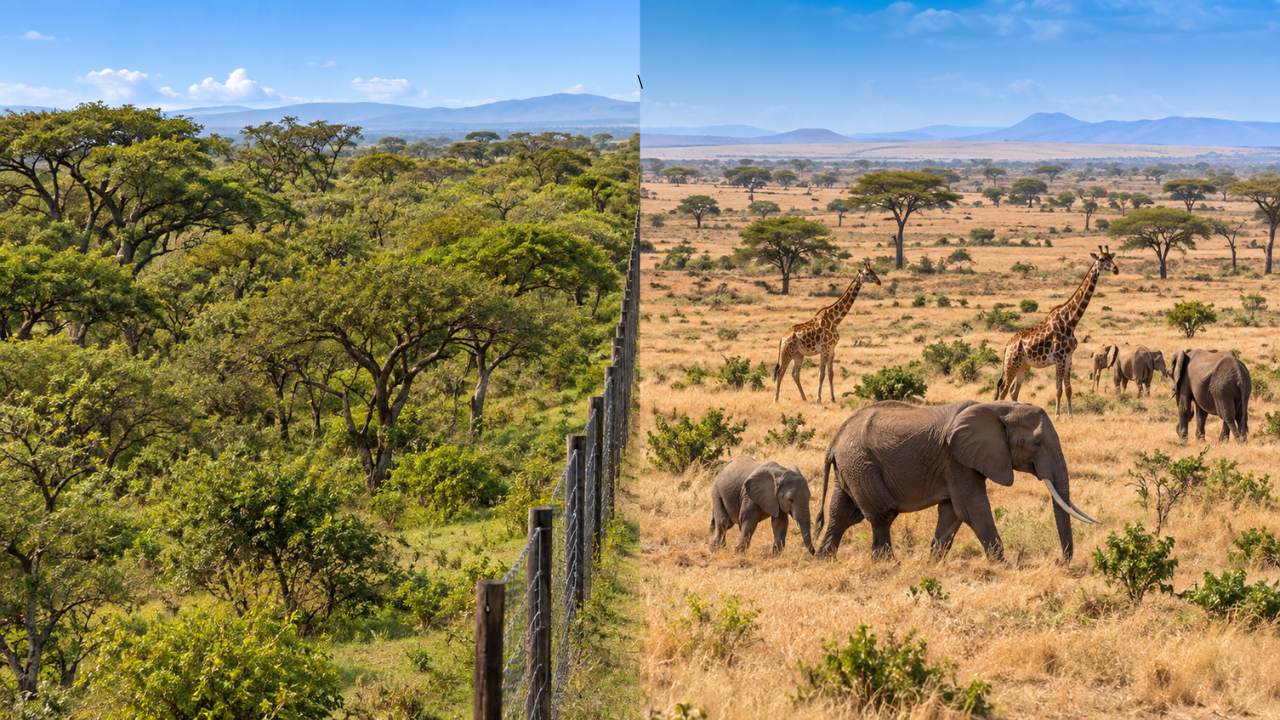
Kenyan savanna tree cover falls after elephants and giraffes return following 18-year exclusion

Read the original at Times of India ↗
Cite

TOI Science Desk. (2026, September 28). Kenyan savanna tree cover falls after elephants and giraffes return following 18-year exclusion. Times of India. https://timesofindia.indiatimes.com/science/wildlife/scientists-kept-large-herbivores-out-of-a-kenyan-savanna-for-18-years-after-elephants-and-giraffes-returned-tree-cover-fell-to-earlier-levels/articleshow/134538133.cms

Dated when The Aporia collected the article, usually within hours of publication. Check the original for its exact date and byline.

Times of India · collected 2026-09-28 · by TOI Science Desk

Quick Summary

Researchers in Kenya conducted a 19-year study where they excluded large herbivores from plots in a savanna area for 18 years. During this time, tree cover increased significantly—from below 32% to over 60%—and the trees grew taller and denser. In 2017, when the fences were removed and elephants, giraffes, and other herbivores returned, tree cover rapidly declined back towards original levels by 2025. The study, published in Ecology Letters, highlights how these large animals affect tree growth and density in African savannas.
Written by AI on 2026-09-28, from this article's own text only (the story summary below draws on all the coverage).

AI analysis

Story summary

In a Kenyan savanna, researchers conducted an experiment from 2000 to 2017 where they excluded large herbivores like elephants and giraffes from certain fenced areas to observe changes in tree cover. During this exclusion period, tree cover rapidly increased, reaching over 60% on average by 2009, while control plots outside the fences remained between 21% and 32% throughout. When herbivores were reintroduced in 2017, tree cover began to decline again, returning to levels close to those before exclusion by 2025. However, despite this decrease, tree density remained higher than pre-exclusion levels through a 2019 survey, while mortality increased after the animals returned. The study, published in *Ecology Letters*, suggests that some vegetation changes caused by the absence of herbivores may be "resistant to rewilding," indicating potential challenges for restoring ecosystems naturally.

Written for “Savanna Tree Cover Decrease” on 2026-11-02, grounded in this article and the 0 other(s) covering the same event.

Story

📰 Savanna Tree Cover Decrease
Environment · 1 article(s) covering the same event.

Compared with similar articles

Nothing to compare against. No article is close enough to this one for the pipeline to have linked or judged the pair.
How this article was measured signals, leaning charts, publisher record, byline, topics and claims

Signals How these are calculated →

Claims extracted
33
sentences that state something as happening or true
Uncertain
12%
4 of 33 hedged ("reportedly", "may", "according to")
Leaning
not political
takes no side on a contested political question
Publisher signals
59/100
Times of India's corrections and hedging, across everything collected from it. Not a measure of accuracy.
Outlets on this story
1
Environment
Same framing elsewhere
1
articles that frame the event the way this one does
Analyzed 2026-09-28 · how these are computed

How this is being covered How these are calculated →

Article leaning vs. publisher reliability
Source leaning vs. consistency

Publisher

Times of India · 3890 article(s) · 2 correction(s) detected
Running correction rate · 2 correction(s)

Who wrote this

TOI Science Desk
299 article(s) here · 1 carrying a prediction
🔮 The work will be carried out by the West Tennessee River Basin Authority, which is preparing a plan to restore the river and the land around it.
🔮 Cornell University scientists have developed genetically engineered tomato plants that turn red-purple when nitrogen becomes scarce, giving farmers a visible warning that crops may need fertiliser.
🔮 By studying these crystals and other mineral grains, scientists could establish the meteorite's age and identify later changes caused by water.
🔮 Centuries later, bronze objects found in Scandinavia would preserve chemical signatures consistent with the metals produced at this Spanish site, offering evidence of connections that may have crossed much of Europe.
🔮 She explored whether an inexpensive device could capture airborne genetic material and support the detection of bacterial pathogens.
🔮 This control may help it maintain its orientation and move along a narrow path without losing its bearings.
🔮 The university says the sculpture will subsequently go on permanent display at its Turner Museum of Glass.
🔮 By bringing together nature, wellness facilities and educational spaces, Winter Garden aimed to create a setting where visitors could exercise, learn about nutrition and gardening, and spend time outdoors.
🔮 Also discovered was a 4,500-year-old humanoid idol, which archaeologists hope will help shed light on the cultural traditions of the region.
🔮 When garlic mustard spreads across the forest floor, other plants may struggle to obtain the resources they need to survive.
Wire or desk byline, not an individual reporter.
Also by TOI Science Desk
Nothing else under this byline is closely related to this article, so these are simply their most recent.
All 299 articles by TOI Science Desk →

Topics

African Ecology Letters Kenyan

Subjects

African NORP · 1× Ecology Letters ORG · 1× Kenyan NORP · 1×

Narrative

The study reported that Grewia tenax and Acacia mellifera, which had generally shown positive canopy growth in the exclosures during the exclusion period, experienced negative canopy growth after herbivore reintroduction.
framing: assertive · carried by 1 article(s) · first seen 2026-09-28
🔮 The study concluded that some vegetation changes caused by the absence of herbivores could remain after their return, describing these shifts as potentially “resistant to rewilding”.

Claims (33 extracted, 4 hedged)

For 18 years, researchers kept large herbivores out of fenced plots in a Kenyan savanna to study what happened to the trees in their absence. asserted
what → keep → absence
During that period, tree cover increased rapidly, trees became taller, and tree numbers rose. asserted
numbers → increase → period
The fences were removed in 2017, allowing elephants, giraffes and other large herbivores to return to the plots. asserted
elephants → remove → plots
Tree cover then fell over the following years and, by 2025, had returned to levels close to those recorded when the experiment began. asserted
experiment → fall → those
Tree density, however, was still higher than before at the last field survey in 2019, while tree mortality increased after the animals returned to the previously fenced plots. asserted
animals → increase → plots
How did large herbivore exclusion change African savanna trees asserted
exclusion → change → trees
According to the study published in Ecology Letters, titled ‘ Responses of African Savanna Trees to Large Herbivore Extinction and Rewilding’, the absence of large herbivores was followed by a marked increase in tree cover. uncertain
absence → accord → cover
In the unfenced control plots, tree cover remained between 21% and 32% throughout the study period. asserted
cover → remain → period
In the exclosure plots, however, tree cover increased rapidly during the first 10 years of herbivore exclusion and exceeded 60% on average by 2009. asserted
cover → increase → 2009
It then remained at that level through 2016. asserted
It → remain → 2016
The researchers reported that tree cover was greater in the exclosures than in the controls in every year from 1999 to 2016. asserted
cover → report → 2016
The change was also reflected in the trees themselves. asserted
change → reflect → trees
By 2016, trees inside the exclosures had reached a mean height of 2.37 metres, compared with 1.49 metres in the unfenced control plots. asserted
trees → reach → plots
Tree density also increased: the mean density in exclosures rose from 1,544 trees per hectare in 1999 to 3,285 trees per hectare in 2009, while density in the control plots remained essentially unchanged. asserted
density → increase → plots
The researchers found that recruitment was greater in the exclosures during the first 10 years of exclusion. asserted
recruitment → find → exclusion
What happened when the herbivores returned The fences were removed in 2017, allowing the large herbivore community to return to the previously protected plots. asserted
community → happen → plots
The researchers recorded substantial changes after reintroduction. asserted
researchers → record → reintroduction
During the first three years after fence removal, trees in the formerly fenced plots experienced the most negative height growth recorded during any phase of the experiment. asserted
trees → fence → experiment
Two years after herbivores returned, there was no longer a difference in mean tree height between the formerly fenced and control plots. asserted
herbivores → return → plots
Canopy growth also changed after the animals returned. asserted
animals → change → ?
During the first two years of reintroduction, trees in the newly unfenced plots experienced negative canopy growth on average. asserted
trees → experience → growth
The study reported that Grewia tenax and Acacia mellifera, which had generally shown positive canopy growth in the exclosures during the exclusion period, experienced negative canopy growth after herbivore reintroduction. asserted
which → report → reintroduction
According to the study, the quick return of tree height and recruitment to pre-exclusion levels was consistent with heavy browsing by elephants on adult trees, and with smaller browsers such as impala and dik-dik moving back into the plots. uncertain
browsers → accord → plots
Image AI generated How did tree cover change after rewilding asserted
cover → generate → rewilding
Tree cover declined after the return of the herbivores. asserted
cover → decline → herbivores
According to the study, the decline occurred at a rate comparable to the earlier increase during the first decade without herbivores. uncertain
decline → accord → herbivores
By 2025, tree cover in the formerly fenced plots was nearly identical to the levels recorded at the beginning of the experiment, although it remained slightly higher than in the control plots. asserted
it → fence → plots
The researchers reported an average cover of 36.2% in the exclosures at the beginning of the experiment and 36.5% in the formerly fenced plots in 2025. asserted
researchers → report → 2025
Tree density, however, did not return in the same way. asserted
density → return → way
The researchers found that density had become elevated in the exclosure plots within three years and remained high after herbivore reintroduction. asserted
density → find → reintroduction
Mortality in the fenced plots had already risen to 19.2 trees per year between 2009 and 2016. asserted
Mortality → fence → 2009
It increased further after the animals returned, reaching an average of 30.5 trees per year between 2016 and 2019, compared with 14.0 in the control plots over the same period. asserted
animals → increase → period
The study concluded that some vegetation changes caused by the absence of herbivores could remain after their return, describing these shifts as potentially “resistant to rewilding”. uncertain
changes → conclude → rewilding

💬Give feedback
🕘History 🎫Support