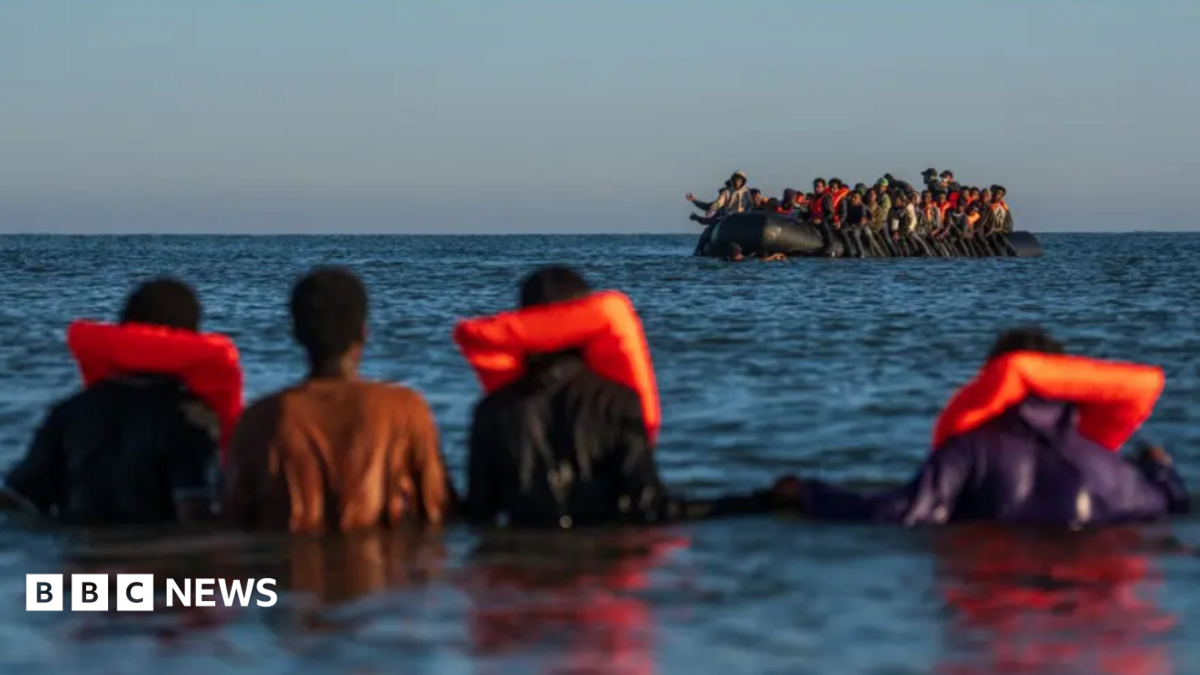
Photo via BBC News

Migrants using longer, more dangerous routes across Channel

Read the original at BBC News ↗
Cite

Bish, A. (2026, September 29). Migrants using longer, more dangerous routes across Channel. BBC News. https://www.bbc.co.uk/news/articles/c6y8zzdjmrgvo?at_medium=RSS&at_campaign=rss

Dated when The Aporia collected the article, usually within hours of publication. Check the original for its exact date and byline.

BBC News · collected 2026-09-29 · by Alex Bish

Quick Summary

French authorities report an increase in migrants attempting longer and more dangerous sea crossings from southern and western beaches of France rather than traditional departure points near Calais and Dunkirk. Last week, one boat departed from Normandy for a 30-hour journey to Dover; while overall Channel crossing numbers have dropped (19,135 so far in 2026 compared to 32,188 in the same period of 2025), attempts from new coastal areas like Seine-Maritime are on the rise. Experts suggest these new routes are likely a response to increased police presence along conventional departure points, significantly extending travel times and raising safety concerns for those aboard.
Written by AI on 2026-09-29, from this article's own text only (the story summary below draws on all the coverage).

AI analysis

Story summary

French authorities report an increasing trend among migrants using longer and more dangerous routes across the English Channel from beaches south and west of Calais and Dunkirk, such as Normandy. Last week, one boat set off from Normandy and spent over 30 hours at sea before being intercepted by British Border Force; this was part of a growing trend with 58 attempts in Seine-Maritime alone so far this year compared to 30 last year. The locations used for these crossings are nearly 80 miles (128 km) from traditional crossing points, significantly increasing the danger and time spent at sea. Despite an overall decrease in Channel crossings, the areas being utilized for smuggling are expanding, prompting concerns about heightened risks faced by migrants attempting to reach the UK via small boats.

Written for “Channel Migration Crises” on 2026-11-02, grounded in this article and the 0 other(s) covering the same event.

Story

📰 Channel Migration Crises
World · 1 article(s) covering the same event.

Compared with similar articles

This article reads unscored and hedges 3% of its claims. Each row says how that neighbour differs.
Evening Standard
Hedges 3 of 38 claims Outlet record 64/100
“Article A reports on a single day's record-high migration numbers and government response, while Article B discusses longer-term trends in crossing routes used by migrants.”
Daily Mail
⚖️ Centre Hedges 0 of 5 claims Outlet record 68/100
“Article A discusses the number of migrants arriving in Britain and the Government's claim that its strategy is working, while Article B talks about migrants using longer routes from different locations, indicating a change in behavior rather than describing the same specific incident.”
BBC News
Hedges 0 of 4 claims Outlet record 68/100
“Article A describes a specific incident where three people died in a Channel crossing attempt off the northern coast of France. Article B discusses broader trends and longer routes used by migrants attempting to cross the Channel from different locations.”
Daily Mail
Hedges 0 of 23 claims Outlet record 68/100
“Article A describes a specific incident involving French charity workers helping child migrants attempt to cross the Channel from northern France, while Article B discusses broader trends of migrants using longer and more dangerous routes across the Channel from various locations.”
Al Jazeera
⚖️ Leans right Hedges 3 of 16 claims Outlet record 60/100
“Article A discusses an increase in dangerous routes used by migrants crossing the Channel, while Article B reports on a court sentencing related to a specific deadly boat incident. They cover different but related events.”
Daily Mail
Hedges 0 of 22 claims Outlet record 68/100
“Article A discusses broader trends in migration routes across the Channel, while Article B reports on a specific court case involving an individual who pled guilty to piloting a small boat with migrants.”
Daily Mail
Hedges 3 of 36 claims Outlet record 68/100
“Article A focuses on a specific photo of migrants being assisted by French lifeguards in Normandy, while Article B discusses broader trends and statistics about longer routes used by migrants for crossing the Channel.”
How this article was measured signals, leaning charts, publisher record, byline, topics and claims

Signals How these are calculated →

Claims extracted
30
sentences that state something as happening or true
Uncertain
3%
1 of 30 hedged ("reportedly", "may", "according to")
Leaning
not political
takes no side on a contested political question
Publisher signals
68/100
BBC News's corrections and hedging, across everything collected from it. Not a measure of accuracy.
Outlets on this story
1
World
Same framing elsewhere
1
articles that frame the event the way this one does
Analyzed 2026-09-29 · how these are computed

How this is being covered How these are calculated →

Article leaning vs. publisher reliability
Source leaning vs. consistency

Publisher

BBC News · 4864 article(s) · 6 correction(s) detected
Running correction rate · 6 correction(s)

Who wrote this

Alex Bish
1 article(s) here · 1 carrying a prediction
🔮 "Some of these journeys would not be 20 miles (32km) but 50 miles (80km) or even more, which substantially increases the danger of course on board the boats.
The only article under this byline in the corpus.

Topics

Calais Dieppe Dunkirk France Normandy

Subjects

France GPE · 3× Normandy GPE · 3× Border Force ORG · 2× Dieppe GPE · 2× French NORP · 2× Home Office ORG · 2× Calais GPE · 1× Dover GPE · 1× Dunkirk GPE · 1× the Isle of Wight GPE · 1×

Narrative

"But we must go further, which is why we have signed a payment-by-results deal with the French to put 40% more boots on the ground on French beaches, along with a surge unit of 45 additional officers to bolster action in Western coastal areas.
framing: assertive · carried by 1 article(s) · first seen 2026-09-29
🔮 "Some of these journeys would not be 20 miles (32km) but 50 miles (80km) or even more, which substantially increases the danger of course on board the boats.
2026-09-29 · BBC News
Migrants using longer, more dangerous routes across Channel · assertive framing

Claims (30 extracted, 1 hedged)

- Published A growing number of migrants are trying to cross the Channel on small boats using longer routes from beaches further south and west of Calais and Dunkirk, French authorities say. asserted
authorities → publish → Calais
Last week one boat set off from Normandy and spent more than 30 hours at sea, before being intercepted and taken to Dover by Border Force. asserted
boat → set → Force
Although attempts from Normandy have been rare, authorities in neighbouring Seine-Maritime say there have already been 58 attempts this year, up from 30 last year. asserted
authorities → neighbour → 30
The government says it is bearing down on dangerous small boat crossings, with figures showing a sharp drop in arrivals this year. asserted
figures → say → arrivals
Despite overall crossings dropping, the stretch of coastline used for smuggling appears to be widening. asserted
stretch → drop → smuggling
Earlier this month another migrant boat was met by lifeboats from the Isle of Wight having set off from the Cherbourg area. asserted
boat → meet → area
These locations are nearly 80 miles (128 km) from the beaches where many of the small boats have crossed in recent years, with those on board spending longer at sea. asserted
those → cross → sea
Audrey Baconnais-Rosez, the local government representative in Seine-Maritime, said: "The number of attempts to cross the Channel has increased in number and it is getting further and further from the north of France." asserted
it → say → France
She added that authorities were "managing to stop half of them". asserted
authorities → add → them
The number of gendarmes patrolling the coast within Dieppe and further to nearly the Le Havre area have been increased, she said. asserted
she → patrol → area
"Nowadays it's about 50 gendarmes on the coast and we have nearly 20 police officers in Dieppe and the surrounding [area] to try to stop them," she said. asserted
she → have → them
Baconnais-Rosez also said some smugglers were still attempting to use ferries to Newhaven in Sussex. asserted
smugglers → say → Sussex
"We are still intercepting them and we are bringing them to justice as well," she added. asserted
she → intercept → justice
Dr Peter Walsh, a senior researcher at the University of Oxford's Migration Observatory, says it is highly plausible that the new routes are due to police disrupting boat launches in northern France. asserted
police → say → France
"It's not at all optimal for these boats to set off so far away from their intended destination," he said. asserted
he → set → destination
"Some of these journeys would not be 20 miles (32km) but 50 miles (80km) or even more, which substantially increases the danger of course on board the boats. asserted
which → increase → boats
" 'Increased risk' David McFarlane, a marine safety consultant, said the longer the voyage, the more risk of encountering hazardous sea conditions. asserted
McFarlane → say → conditions
"If a low pressure system is developing over the Atlantic, it can mean that in advance of the winds picking up, a swell will start to increase, with the increased likelihood of sea sickness for some, which can lead to dehydration," he said. asserted
he → develop → dehydration
"The wind of course can pick up very quickly and waves can get up to 3.5m (11ft) in height in the Channel. asserted
waves → pick → Channel
"This increases the risk of the boat being swamped by sea water, with the obvious danger to human life by drowning or exposure. asserted
boat → increase → drowning
" So far, 2026 has seen 19,135 people make the Channel crossing, compared to 32,188 during the same period in 2025. asserted
people → see → 2025
However, the Home Secretary ordered a review last week after two migrant vessels reached the Kent coast unintercepted. asserted
vessels → order → coast
A total of 781 migrants arrived in 10 small boats on Wednesday, the highest number for a single day this year, according to Home Office figures. uncertain
total → arrive → figures
Tony Smith, the former director general of Border Force, said the smugglers would continue to adapt. asserted
smugglers → say → Force
"We've seen the Normandy crossings and the undetected crossings," he said. asserted
he → see → crossings
"They're not going to give up as long as the business model continues to exist and there's a market to bring migrants over from France. asserted
model → go → France
"Every successful landing is a message to the next migrant waiting on a French beach that it's worth a try." asserted
it → wait → beach
A Home Office spokesperson said joint efforts had seen more than 48,000 crossing attempts prevented and 1,100 boats and engines seized since the election. asserted
boats → say → election
"Our efforts are having an impact, with the number of small boat crossings down significantly this year and the lowest number recorded for the month of July since 2020," they added. asserted
they → have → 2020
"But we must go further, which is why we have signed a payment-by-results deal with the French to put 40% more boots on the ground on French beaches, along with a surge unit of 45 additional officers to bolster action in Western coastal areas. asserted
we → go → areas

💬Give feedback
🕘History 🎫Support