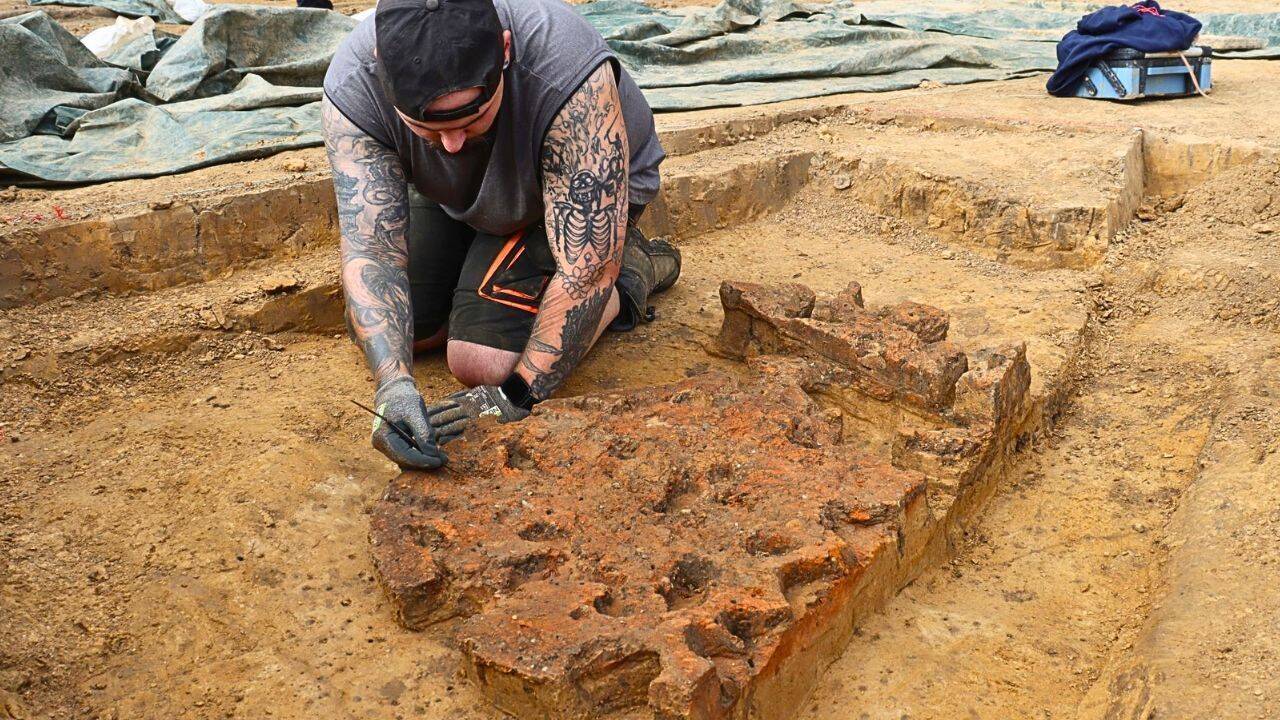
Photo via Times of India

Archaeologists uncover rare Roman-era workshop in Germany with pottery kiln and furnaces

Read the original at Times of India ↗
Cite

TOI World Desk. (2026, September 29). Archaeologists uncover rare Roman-era workshop in Germany with pottery kiln and furnaces. Times of India. https://timesofindia.indiatimes.com/world/europe/archaeologists-uncover-rare-roman-era-workshop-in-germany-with-pottery-kiln-and-furnaces-used-to-recycle-roman-metal/articleshow/134544021.cms

Dated when The Aporia collected the article, usually within hours of publication. Check the original for its exact date and byline.

Times of India · collected 2026-09-29 · by TOI World Desk

Quick Summary

Archaeologists in Dortmund, Germany, have discovered a rare Roman-era workshop dating from the 1st to 5th centuries AD. The site includes a pottery kiln and well-preserved furnaces used for metalworking, marking it as unique in western Germanic settlements. Dr. Eva Cichy highlights that this is the first such find of its kind, providing insights into how Roman scrap metal was melted by local tribes using specialized clay-walled kilns with bellows to regulate heat. The excavation, led by LWL Archaeology for Westphalia and Dortmund City Archaeology Department, offers crucial evidence of metalworking practices during the Roman Imperial Period.
Written by AI on 2026-09-29, from this article's own text only (the story summary below draws on all the coverage).

AI analysis

Story summary

Archaeologists in Dortmund, Germany, have unearthed an extremely rare Roman-era workshop dating from the 1st to 5th centuries AD. The site includes several pits, furnaces, and hearths that provide evidence of various activities. Notably, it features the first pottery kiln discovered at this settlement. Prof. Dr. Michael Baales of LWL Archaeology for Westphalia stated, "It has been known for some time that the Germanic tribes recycled large quantities of Roman metal objects." The excavation team from the Landschaftsverband Westfalen-Lippe (LWL) and the Dortmund City Archaeology Department began their work in mid-August. This discovery is significant as it provides unique insights into the interaction between Roman and Germanic cultures during that period.

Written for “Roman Workshop Discovery Germany” on 2026-10-31, grounded in this article and the 0 other(s) covering the same event.

Story

📰 Roman Workshop Discovery Germany
World · 1 article(s) covering the same event.

Compared with similar articles

Nothing to compare against. No article is close enough to this one for the pipeline to have linked or judged the pair.
How this article was measured signals, leaning charts, publisher record, byline, topics and claims

Signals How these are calculated →

Claims extracted
26
sentences that state something as happening or true
Uncertain
0%
0 of 26 hedged ("reportedly", "may", "according to")
Leaning
not political
takes no side on a contested political question
Publisher signals
59/100
Times of India's corrections and hedging, across everything collected from it. Not a measure of accuracy.
Outlets on this story
1
World
Same framing elsewhere
1
articles that frame the event the way this one does
Analyzed 2026-09-29 · how these are computed

How this is being covered How these are calculated →

Article leaning vs. publisher reliability
Source leaning vs. consistency

Publisher

Times of India · 3737 article(s) · 2 correction(s) detected
Running correction rate · 2 correction(s)

Who wrote this

TOI World Desk
1245 article(s) here · 0 carrying a prediction
🔮 Prince William and Kate Middleton may have been made aware of serious allegations against Meghan Markle’s father, Thomas Markle Sr., after a letter detailing the claims was reportedly sent to the joint office shared by the two royal couples at Kensington Palace in 2019.
🔮 The money will support nearly 7,000 children.
🔮 Within two months, Conard identified a property in a Denver strip mall that could be used for a haunted house.
🔮 They allege that Meta could combine this information with activity tracked on Eyemart’s website to identify them and deliver targeted advertisements.
🔮 People from outside Indiana University had also contacted Brian Williams, a professor at the Kelley School of Business who helped develop the programme, expressing interest in taking the course.
🔮 On October 31, the family will take the experience further by welcoming relatives from out of town to help bring the display to life with live actors.
🔮 Thus, a decade ago, he began collecting Halloween costumes for kids who couldn't afford them.
🔮 He expressed concern that the confrontation could cost him his job.
🔮 They said the celebrity's "suicide risk" could be lowered through treatment.
🔮 In one recording, Higby explained that they wanted to find out whether people could vote without showing identification.
Wire or desk byline, not an individual reporter.
Also by TOI World Desk
Nothing else under this byline is closely related to this article, so these are simply their most recent.
All 1245 articles by TOI World Desk →

Topics

Dortmund Germanic LWL Roman the Dortmund City Archaeology Department

Subjects

Germanic NORP · 6× the Dortmund City Archaeology Department ORG · 4× LWL ORG · 3× Roman NORP · 3× Dortmund GPE · 2× LWL Archaeology for Westphalia ORG · 2× Eva Cichy PERSON · 1× Germany GPE · 1× Olpe GPE · 1× the Landschaftsverband Westfalen-Lippe ORG · 1×

Narrative

Prof. Dr. Michael Baales of LWL Archaeology for Westphalia said, "It has been known for some time that the Germanic tribes, particularly in the late Imperial period, recycled large quantities of Roman metal objects acquired through trade or plunder."
framing: assertive · carried by 1 article(s) · first seen 2026-09-29

Claims (26 extracted, 0 hedged)

Archaeologists have uncovered a rare Roman-era workshop area in western Dortmund, Germany, during an excavation of a settlement dating from the 1st to 5th centuries AD. asserted
Archaeologists → uncover → AD
The site contains several areas with pits, furnaces, and hearths. asserted
site → contain → pits
It also has the first pottery kiln found at the site and exceptionally well-preserved workshops used for metalworking. asserted
It → have → metalworking
The excavation team from the Landschaftsverband Westfalen-Lippe (LWL) and the Dortmund City Archaeology Department began examining the settlement in mid-August. asserted
team → begin → August
Archaeologists uncover a rare workshop area in western Dortmund The excavation team has uncovered several areas used for craft work at the settlement. asserted
team → uncover → settlement
The remains include pits, furnaces and hearths that provide evidence of different activities carried out at the site. asserted
that → include → site
The excavation team also identified the first pottery kiln discovered at the site. asserted
team → identify → site
The team also identified workshops used for metalworking. asserted
team → identify → metalworking
These areas are described as exceptionally well preserved. asserted
areas → describe → ?
Dr Eva Cichy, excavation director at the Olpe branch of LWL Archaeology for Westphalia, said, "This is a first in this form in the western part of the Germanic settlement area. asserted
This → say → area
In addition to the first pottery kiln, we found metalworking workshops, which were exceptionally well preserved." asserted
which → find → workshops
PC: Landschaftsverband Westfalen-Lippe (LWL) What do the furnaces reveal about ancient metalworking The excavated furnaces provide details about how the metal was processed. asserted
metal → reveal → details
Jan Rosbeck of the Dortmund City Archaeology Department said, "The Germanic tribes melted Roman scrap metal here in crucibles that they placed in kilns. asserted
they → say → kilns
These were round to oval structures with clay walls, into which air was pumped from the sides using bellows to regulate the temperature." asserted
air → pump → temperature
These remains provide physical evidence of the facilities used to process Roman metal scrap. asserted
remains → provide → scrap
The LWL identified them as part of the metalworking area uncovered during the excavation. asserted
LWL → identify → excavation
The structures provide further archaeological evidence of Germanic metalworking during the Roman Imperial Period. asserted
structures → provide → Period
More clues remain to be uncovered at the ancient workshop The excavation is now nearly complete, although some questions about the site remain unanswered. asserted
questions → remain → site
The archaeologists do not yet know what type of pottery was produced in the kiln. asserted
type → know → kiln
The team plans to completely recover the best-preserved furnace so that the unique archaeological remains can be put on display in the future. asserted
remains → plan → future
The excavation began in mid-August and is being carried out by LWL Archaeology for Westphalia together with the Dortmund City Archaeology Department. asserted
excavation → begin → Department
The workshop area includes the pottery kiln and metalworking facilities, along with pits, furnaces and hearths. asserted
area → include → pits
Why is the discovery important beyond the region The metalworking remains are especially important because they provide evidence for Germanic metal processing outside the Roman Empire. asserted
they → provide → Empire
Prof. Dr. Michael Baales of LWL Archaeology for Westphalia said, "It has been known for some time that the Germanic tribes, particularly in the late Imperial period, recycled large quantities of Roman metal objects acquired through trade or plunder." asserted
tribes → say → trade
Tobias Zacharias of the Dortmund City Archaeology Department said such work had not previously been documented through archaeological remains. asserted
work → say → remains
He said the discovery makes the site significant beyond the region and gives the excavation wider archaeological importance. asserted
site → say → importance

💬Give feedback
🕘History 🎫Support