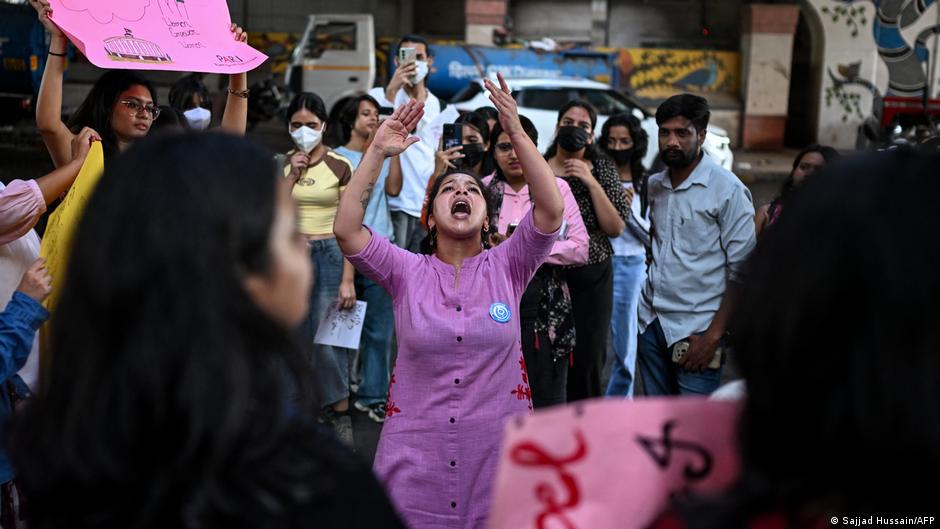
Photo via The Guardian

From Jamui to Delhi, the burden of safety from sexual assault cannot fall on women

Read the original at The Guardian ↗
Cite

Masih, N. (2026, September 29). From Jamui to Delhi, the burden of safety from sexual assault cannot fall on women. The Guardian. https://www.theguardian.com/world/2026/sep/28/this-is-india-violence-against-women

Dated when The Aporia collected the article, usually within hours of publication. Check the original for its exact date and byline.

The Guardian · collected 2026-09-29 · by Niha Masih
Content note This article describes sexual violence.

Quick Summary

An Indian woman describes her daily anxiety and anger regarding personal safety from sexual assault in India. Two recent incidents—one involving harassment of teenagers in Bihar's Jamui district and another where a 17-year-old was allegedly gang-raped in Delhi—have drawn national attention, leading to increased restrictions on women’s movement. These measures include curfews on public park access and online classes at Lady Shri Ram College in Delhi. Feminist activist Kavita Krishnan argues that such responses place an unfair burden on women to ensure their own safety rather than addressing systemic issues of sexual violence. The article critiques the societal and state-level strategies that limit women's freedoms instead of tackling the root causes of harassment and assault.
Written by AI on 2026-09-29, from this article's own text only (the story summary below draws on all the coverage).

AI analysis

Story summary

In late 2023, two cases of sexual assault in India highlighted the ongoing struggle for women's safety. In Bihar, a video circulated showing men harassing and molesting teenagers at night, leading to increased pressure on local women to restrict their movements. Meanwhile, in Delhi, a 17-year-old was gang-raped by men posing as police officers in a park. As a result, authorities restricted access to public parks across the city, while Lady Shri Ram College briefly shifted classes online to ensure student safety. These incidents underscore the societal expectation that women bear the brunt of preventive measures against sexual violence rather than addressing systemic issues. Feminist author Meena Kandasamy comments on how such responses do not tackle the root causes of gender-based violence and merely shift responsibility onto women, reinforcing patriarchal norms.

Written for “Safety For Women In India” on 2026-11-04, grounded in this article and the 0 other(s) covering the same event.

Story

📰 Safety For Women In India
Crime & Law · 1 article(s) covering the same event.

Compared with similar articles

This article reads leans strongly left and hedges 7% of its claims. Each row says how that neighbour differs.
Education for society Different event
Dawn
⚖️ Leans left further right than this Hedges 3 of 41 claims Outlet record 72/100
“The articles discuss violence against women but describe different incidents and contexts.”
Dawn
Hedges 3 of 29 claims Outlet record 72/100
“The articles describe different incidents: one involving a gang rape of a 17-year-old girl in Delhi and another involving harassment and molestation of teenagers in Jamui, Bihar.”
New York Post
⚖️ Leans left further right than this Hedges 2 of 29 claims Outlet record 66/100
“The articles describe different incidents occurring in distinct locations and involving separate issues of sexual violence.”
Al Jazeera
Hedges 1 of 3 claims Outlet record 60/100
“The articles describe different incidents involving sexual violence; Article A focuses on a violent protest sparked by an alleged rape at Lovely Professional University, while Article B mentions two separate events in Jamui and another not fully detailed incident.”
Al Jazeera
⚖️ Leans left further right than this Hedges 0 of 3 claims Outlet record 60/100
“The articles describe different events: one about harassment and molestation incidents in Jamui, Bihar, and another about rape cases triggering a safety campaign in Delhi.”
Daily Mail
Hedges 0 of 15 claims Outlet record 69/100
“The articles discuss different issues related to sexual violence and domestic abuse but describe distinct events in different locations.”
Deutsche Welle
Hedges 3 of 40 claims Outlet record 95/100
“The articles describe different incidents: one involving harassment and molestation of teenagers in Jamui, Bihar, while the other details a gang rape of a 17-year-old girl in New Delhi.”
The Guardian
⚖️ Leans strongly left Hedges 6 of 67 claims Outlet record 66/100
“The articles discuss different aspects of sexual violence but do not describe the same specific incident.”
BBC News
⚖️ Leans left further right than this Hedges 0 of 3 claims Outlet record 66/100
“The articles describe different incidents: one is about protests in Delhi after sexual assaults, while the other mentions specific incidents including harassment and molestation in Jamui.”
How this article was measured signals, leaning charts, publisher record, byline, topics and claims

Signals How these are calculated →

Claims extracted
58
sentences that state something as happening or true
Uncertain
7%
4 of 58 hedged ("reportedly", "may", "according to")
Leaning
Leans strongly left
of the writing, not the subject · beta estimate
Publisher signals
66/100
The Guardian's corrections and hedging, across everything collected from it. Not a measure of accuracy.
Outlets on this story
1
Crime & Law
Same framing elsewhere
1
articles that frame the event the way this one does
Analyzed 2026-09-29 · how these are computed

How this is being covered How these are calculated →

Article leaning vs. publisher reliability
Source leaning vs. consistency

Publisher

The Guardian · 2937 article(s) · 6 correction(s) detected
Running correction rate · 6 correction(s)

Who wrote this

Niha Masih
5 article(s) here · 1 carrying a prediction
🔮 Two, the country will be governed by parliament, not by the streets,” he said at a news briefing.
🔮 Coming from a village in Maharashtra’s Ahilyanagar, he worked odd jobs – from cleaning washrooms to working in the fields – so he could spend evenings training.
🔮 Instead of figuring out why sexual violence remains entrenched in our society, how patriarchal agency perpetuates such violence or what kind of social conditioning is needed for men, women are instead expected to take up less public space.
🔮 Last week, India released glowing GDP numbers for the latest quarter – 7.8% growth – higher than the forecast 7%.
🔮 Recently, I may have saved a woman’s life on the road.
Also by Niha Masih
Nothing else under this byline is closely related to this article, so these are simply their most recent.

Topics

Bihar Delhi Indian Lady Shri Ram College Outlook

Subjects

Bengaluru GPE · 2× Bihar GPE · 2× Delhi GPE · 2× LSR ORG · 2× Lady Shri Ram College ORG · 2× New Delhi GPE · 2× India GPE · 1× Indian NORP · 1× Kavita Krishnan PERSON · 1× Outlook ORG · 1×

Narrative

Regulating women is easy because “it does not require any institutional cost and, most of all, it sends the signal to concerned parents that the problem is being handled”, says Meena Kandasamy, a feminist author, whose latest novel, Fieldwork As a Sex Object, is about a woman’s life being upturned when a deepfake video using her face goes viral.
framing: assertive · carried by 1 article(s) · first seen 2026-09-29
🔮 Instead of figuring out why sexual violence remains entrenched in our society, how patriarchal agency perpetuates such violence or what kind of social conditioning is needed for men, women are instead expected to take up less public space.

Claims (58 extracted, 4 hedged)

As an Indian woman, I often feel myself oscillating between states of anxiety or anger. asserted
myself → feel → anxiety
The anxiety is about doing the mental maths of how to stay safe – thinking about what I’m wearing, where I am going and how I’ll get there, and so on. asserted
I → do → wearing
The anger is at the sheer absurdity of this, and the stories of of sexual violence and harassment I read about every day. asserted
I → read → violence
Last week, two particularly enraging incidents captured national attention. asserted
incidents → capture → attention
First, a video showing a group of men accused of harassing and molesting two teenagers at night in Bihar’s Jamui went viral. asserted
video → show → Jamui
Then, a 17-year-old, out with a friend in Delhi, was allegedly gang-raped in a park by men posing as police. uncertain
old → rap → police
After, women in Bihar told Outlook how the incident in Jamui triggers greater controls and pressure on them. asserted
incident → tell → them
In Delhi, authorities curbed access to public parks and a premier women’s college, Lady Shri Ram College (LSR), briefly moved classes online. asserted
college → curb → classes
I have noticed this pattern repeatedly: after incidents of sexual violence go viral on social media, the fallout further ensnares women. asserted
fallout → notice → women
We are the ones who get told to avoid certain places, regulate our behaviour, dress modestly or be home earlier, thereby placing the burden of escaping this menace on us. asserted
who → tell → us
Feminist activist Kavita Krishnan has described this phenomenon as “perhaps the most widespread form of gender-based violence in India”. asserted
Krishnan → describe → India
Instead of figuring out why sexual violence remains entrenched in our society, how patriarchal agency perpetuates such violence or what kind of social conditioning is needed for men, women are instead expected to take up less public space. asserted
women → figure → space
Regulating women is easy because “it does not require any institutional cost and, most of all, it sends the signal to concerned parents that the problem is being handled”, says Meena Kandasamy, a feminist author, whose latest novel, Fieldwork As a Sex Object, is about a woman’s life being upturned when a deepfake video using her face goes viral. asserted
video → regulate → face
“Their target audience is not the young women who feel unsafe but the rest of society. asserted
who → feel → society
In my experience, this repression happens at three levels: first in the realm of family, then in broader society, and ultimately by the state. asserted
repression → happen → state
It begins at home, under the guise of protection, with arbitrary curfews or dress codes. asserted
It → begin → curfews
It gets reinforced at a community level with institutions and social groups through moral policing, victim-blaming and the expectation that women should not put themselves in “unsafe” situations. asserted
women → reinforce → situations
Restricting access to parks after sunset can surely reduce the number of people in those places, but it doesn’t address why women are unsafe there. asserted
women → restrict → places
Harassment and sexual violence are, unfortunately, not tied to timings or daylight. asserted
Harassment → tie → timings
And further restricting women’s lives is not the solution to injustices foisted on them. asserted
restricting → restrict → them
All three, Kandasamy says, consider women as a “problem to be handled”. asserted
Kandasamy → say → problem
“She’s not a citizen (for the state), a member (for the community), or an adult (for the family). asserted
She → ’ → family
She is treated like an inanimate but precious object – like a diamond that has to be locked up to prevent theft,” she said. asserted
she → treat → theft
In recent days, students from Delhi University have come out on the streets demanding safer public spaces including more street lighting, usable public toilets, more housing and scholarships for female students. asserted
students → come → students
Vedayana, 20, a student at Lady Shri Ram College (LSR), says locking up parks is not the solution: “If you are not putting up safety measures to make it accessible to women, then it is as good as saying that the park is only for men. asserted
park → say → men
A recently published survey of more than 4,000 women in New Delhi and Bengaluru, found that 65% of women in New Delhi and 29% in Bengaluru experienced harassment in public spaces in the past year. asserted
% → publish → year
Another 2024 study from India and Pakistan found that women’s overall mobility remains abysmally low, and what freedom they do have is almost entirely tied to education, employment or unpaid care work. asserted
they → find → education
Despite how widespread and urgent the problem is, the political response can further shake public confidence. asserted
response → shake → confidence
A female minister from Bihar, commenting on the molestation video said: “Moral policing can be done in a more decent and elegant fashion.” asserted
policing → comment → fashion
Another minister from the state drew fire for describing it as an “isolated” incident”. asserted
minister → draw → incident
Minimising crimes against women reflects a political culture in which accountability becomes optional. asserted
accountability → minimise → which
Students such as Vedayana want this to change. asserted
this → want → Vedayana
Political parties, she tells me, should pledge to not give tickets or positions to anyone accused of sexual harassment. asserted
she → tell → harassment
“We don’t want the leaders sitting at the top to perpetrate and preach rape culture,” she adds. asserted
she → want → culture
Parliament is not immune to accusations, either: the BJP politician Brij Bhushan Singh, who formerly headed the Wrestling Federation of India, was recently accused of sexual harassment by six female wrestlers – he denies the allegations, and was acquitted by a magistrate, in a case that is undergoing appeal. asserted
that → head → appeal
According to an analysis of 2024 parliamentarians by the Association for Democratic Reforms, 15 winning candidates declared cases related to crimes against women. uncertain
candidates → accord → women
For Vedayana, changing the mentality has to begin early with families and the way boys are raised. asserted
boys → change → families
“If you are in a position of authority, use it to influence people by speaking out against patriarchy and groom your sons first.” What else we’re reading about asserted
reading → use → What
Indian women’s cricket team beat Sri Lanka by 147 runs to win gold at the Asian Games last week. asserted
team → beat → Games
Smriti Mandhana’s smashing 79 off 45 deliveries helped India reach a formidable 216 in 20 overs. asserted
India → smash → overs
…and 18 more, not listed.

💬Give feedback
🕘History 🎫Support