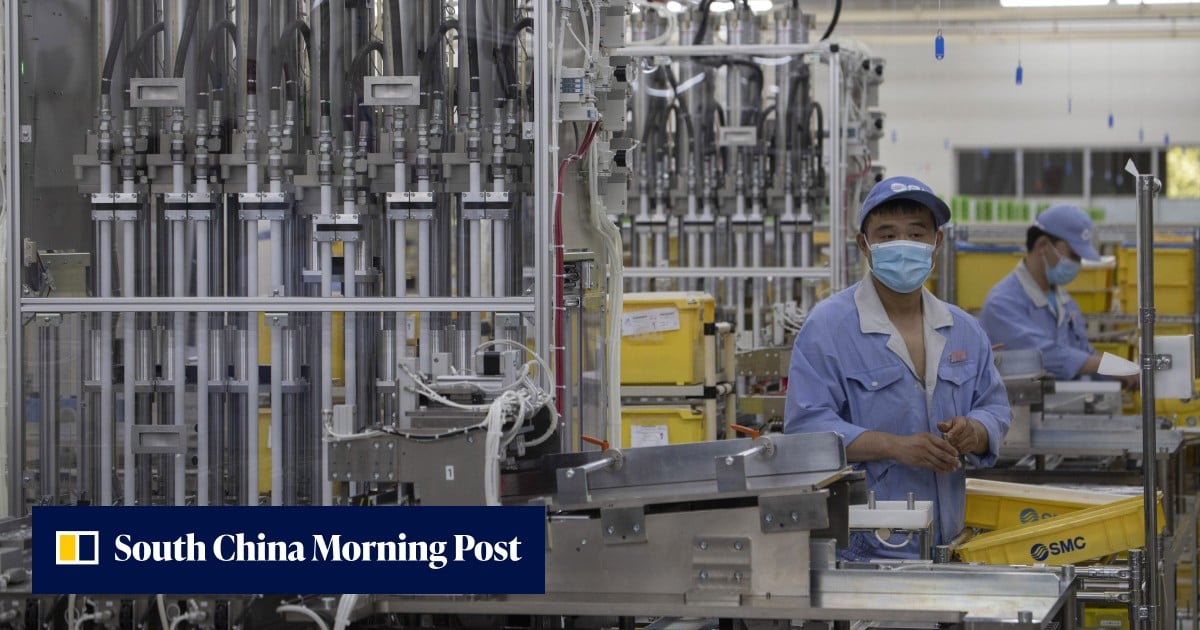
Photo via South China Morning Post

Japanese firms pull back from China amid geopolitical tensions, supply chain shifts

Read the original at South China Morning Post ↗
Cite

Jennings, R. (2026, September 29). Japanese firms pull back from China amid geopolitical tensions, supply chain shifts. South China Morning Post. https://www.scmp.com/economy/china-economy/article/3369164/japanese-firms-pull-back-china-amid-geopolitical-tensions-supply-chains-shifts?utm_source=rss_feed

Dated when The Aporia collected the article, usually within hours of publication. Check the original for its exact date and byline.

South China Morning Post · collected 2026-09-29 · by Ralph Jennings

Quick Summary

Japanese firms are reducing their presence in China due to geopolitical tensions and supply chain changes, as reported by Teikoku Databank's latest survey. As of June, there were 10,118 Japanese enterprises operating in China, the lowest number since 2010. The research identified 4,137 companies that had either withdrawn from or could not be accounted for in China compared to previous surveys, while noting only 1,221 new entrants since the last survey in 2024.
Written by AI on 2026-09-29, from this article's own text only (the story summary below draws on all the coverage).

AI analysis

Story summary

In June 2024, Teikoku Databank released a survey revealing that the number of Japanese enterprises in China dropped to 10,118, the lowest since 2010. The research identified 4,137 companies as having withdrawn from or disappeared from the Chinese market since the last survey. Despite this decline, there were still 1,221 new Japanese entrants in China, which is less than the number during the pandemic years of 2020 to 2022. The firm’s findings are based on a database of about 1.51 million companies, a credit investigation report file with some 2 million companies, and publicly available information. This trend reflects growing geopolitical tensions and shifts in supply chains between Japan and China.


Written for “China Japan Geopolitical Tensions” on 2026-10-31, grounded in this article and the 0 other(s) covering the same event.

Story

📰 China Japan Geopolitical Tensions
World · 1 article(s) covering the same event.

Compared with similar articles

This article reads unscored and hedges 40% of its claims. Each row says how that neighbour differs.
The Straits Times
Hedges 4 of 40 claims Outlet record 66/100
“The articles describe different economic trends and situations involving Chinese brands in Washington versus Japanese firms' presence in China.”
South China Morning Post
⚖️ Leans left Hedges 0 of 1 claims Outlet record 64/100
“The articles discuss different economic trends related to Chinese and Japanese firms but do not describe the same specific incident or occurrence.”
South China Morning Post
Hedges 0 of 4 claims Outlet record 64/100
“The articles discuss different regions (China and Hong Kong) and involve distinct sets of firms (Japanese vs US, UK).”
How this article was measured signals, leaning charts, publisher record, byline, topics and claims

Signals How these are calculated →

Claims extracted
5
sentences that state something as happening or true
Uncertain
40%
2 of 5 hedged ("reportedly", "may", "according to")
Leaning
not political
takes no side on a contested political question
Publisher signals
64/100
South China Morning Post's corrections and hedging, across everything collected from it. Not a measure of accuracy.
Outlets on this story
1
World
Same framing elsewhere
1
articles that frame the event the way this one does
Analyzed 2026-09-29 · how these are computed

How this is being covered How these are calculated →

Article leaning vs. publisher reliability
Source leaning vs. consistency

Publisher

South China Morning Post · 3480 article(s) · 6 correction(s) detected
Running correction rate · 6 correction(s)

Who wrote this

Ralph Jennings
13 article(s) here · 1 carrying a prediction
🔮 AI glasses were slowly catching on with travellers as the technology improved and more devices entered the market, analysts said, but technical hitches were slowing mass adoption of the smartphone-linked gear that could be worn like ordinary spectacles.
🔮 Indonesian officials, looking to alleviate poverty in their country and eyeing the rise of rural economies in China, are turning to Beijing for help that may include stoking the exports of a potentially lucrative durian crop.
🔮 C919 set to lead way as Chinese aircraft forecast to secure 5% of world market in 20 years
🔮 Could Thai durian export duty mean higher prices, higher quality in China?
🔮 Chinese nickel investors brace for headwinds as Indonesia weighs smelter freeze Jakarta's proposed restrictions could reshape the foreign-backed supply chains feeding critical sectors, from stainless steel to electric vehicle batteries Chinese investors could face significant disruption if Indonesia imposes a moratorium on new nickel smelters to curb global overproduction and protect local industries across its vast minerals sector, analysts said.
🔮 A consortium of Chinese companies is set to construct much of the Salvador-Itaparica Bridge, which is due to become the region’s biggest cross-sea project supported by cables once completed in 2031, Chinese and Brazilian media said.
🔮 At peak periods that day, trains departed every 40 seconds, an interval the publicity department said was “faster than people could scroll through short videos”.
🔮 It identified 4,137 companies that had withdrawn from China or could not be accounted for since the last survey.
🔮 As Jakarta explores foreign backing for the Trans-Kalimantan railway, analysts say costly past ventures could shape any coming negotiations Indonesia is considering Chinese investment to help build a massive 2,772km (1,722 mile) railway network through the vast, resource-rich region of Kalimantan, following the completion of Southeast Asia’s first high-speed line between Jakarta and Bandung, state media and analysts said.
🔮 The trade group Airlines for America, which represents major US airlines, filed an objection to Air China’sbid for additional Beijing-New York and Beijing-Washington flights for September 19 and 25, saying it was unfair that American counterparts could not fly over Russian airspace, according to a department document.
Also by Ralph Jennings
Nothing else under this byline is closely related to this article, so these are simply their most recent.
All 13 articles by Ralph Jennings →

Topics

China Japanese Teikoku Databank Tokyo

Subjects

China GPE · 4× Japanese NORP · 4× Teikoku Databank ORG · 1× Tokyo GPE · 1×

Narrative

The Tokyo-based firm drew its findings from a database of about 1.51 million companies, a credit investigation report file containing some 2 million companies and publicly available information.
framing: mixed · carried by 1 article(s) · first seen 2026-09-29
🔮 It identified 4,137 companies that had withdrawn from China or could not be accounted for since the last survey.
2026-09-29 · South China Morning Post
Japanese firms pull back from China amid geopolitical tensions, supply chain shifts · mixed framing

Claims (5 extracted, 2 hedged)

Japanese firms pull back from China amid geopolitical tensions, supply chain shifts asserted
firms → pull → tensions
The research found 1,221 new Japanese entrants in China since the last survey in 2024, but that was still less than during Covid-19 As of June, 10,118 Japanese enterprises were identified as having a presence in China, the lowest number since 2010, according to a survey and analysis released on Monday by the corporate credit research and business intelligence firm Teikoku Databank. uncertain
enterprises → find → firm
The research also turned up 1,221 new Japanese entrants in China since the last survey in 2024, less than the total during the depressed Covid-19 pandemic years between 2020 and 2022. asserted
research → turn → 2020
It identified 4,137 companies that had withdrawn from China or could not be accounted for since the last survey. uncertain
that → identify → survey
The Tokyo-based firm drew its findings from a database of about 1.51 million companies, a credit investigation report file containing some 2 million companies and publicly available information. asserted
firm → base → companies
💬Give feedback
🕘History 🎫Support