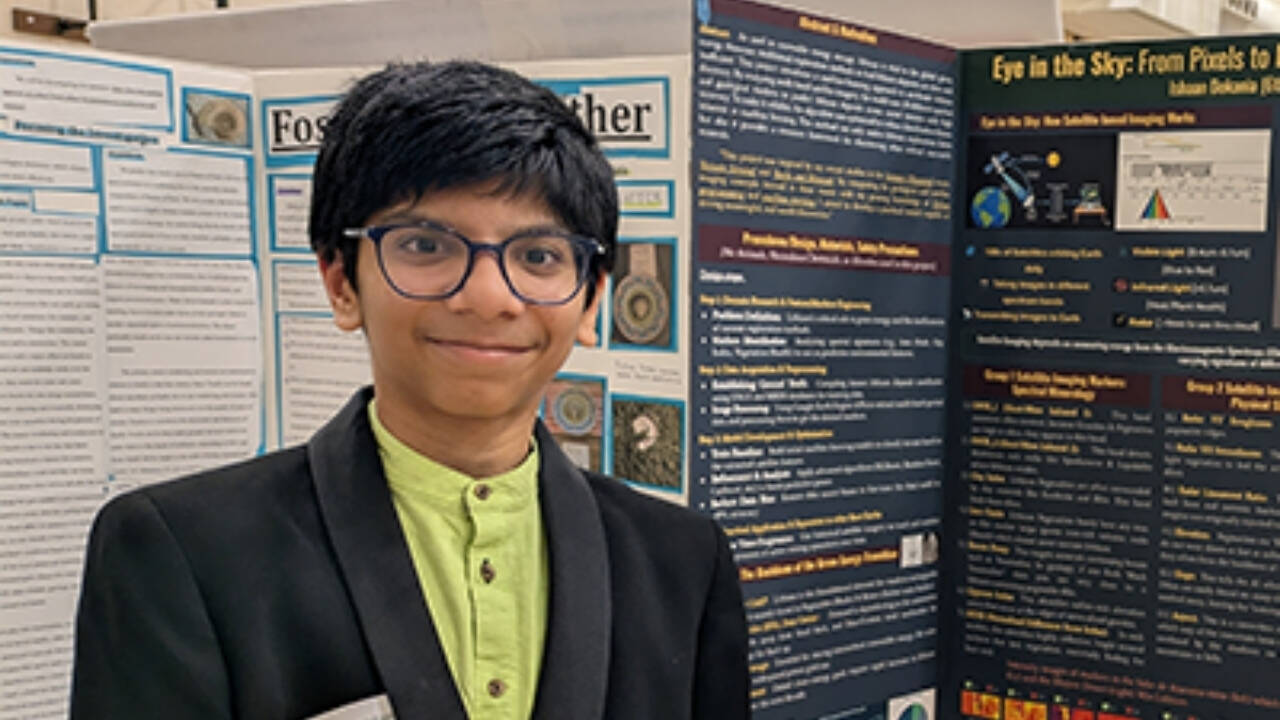
A sixth-grade student from Oregon is using satellite images and machine learning to explore a problem that is becoming increasingly important as demand for lithium grows.
asserted
demand → use → lithium
According to the Society for Science, Ishaan developed a project called “Eye in the Sky: From Pixels to Predictions for Lithium and Beyond”, using satellite imagery and geological data to train a machine-learning model that could identify potential lithium deposits.
uncertain
that → accord → deposits
After addressing sources of noise in the data, his model detected lithium deposits with 89% accuracy.
asserted
model → address → accuracy
How Ishaan connected satellite images with mineral exploration
Ishaan's project began with two interests that might initially seem unrelated: remote sensing and rocks and minerals.
uncertain
that → connect → interests
While participating in a Science Olympiad competition, he studied both subjects and began thinking about whether they could be combined to solve a practical problem.
uncertain
they → participate → problem
That question led him to lithium exploration.
asserted
question → lead → exploration
Lithium is an important component in many modern technologies, particularly batteries used in electronics and energy-storage systems.
asserted
Lithium → use → electronics
Ishaan became interested in the difficulties involved in finding new lithium resources and wondered whether satellite imagery could make the search more efficient.
uncertain
search → become → resources
Rather than examining geological locations one by one, he explored whether computers could identify visual and environmental patterns associated with known lithium deposits.
uncertain
computers → examine → deposits
His project was titled “Eye in the Sky: From Pixels to Predictions for Lithium and Beyond.”
asserted
project → title → Lithium
The title reflects the central idea behind his work: using information captured from above the Earth's surface and processing it through an artificial intelligence model to identify locations that may warrant further investigation.
uncertain
that → reflect → investigation
Training the model with satellite and geological data
To build the system, Ishaan used satellite-image information from Google Earth Engine along with data from the U.S. Geological Survey's Mineral Resources Data System.
asserted
Ishaan → train → System
The Society for Science states that he identified features that could help his machine-learning model predict where lithium deposits might occur.
uncertain
deposits → state → features
He then tested several different machine-learning algorithms rather than relying on a single approach.
asserted
He → test → approach
This was an important part of the project because satellite imagery contains enormous amounts of information.
asserted
imagery → contain → information
Not every pattern visible in an image is necessarily connected to the mineral a researcher is trying to locate.
asserted
researcher → connect → mineral
A model can therefore produce misleading results if it learns to associate lithium deposits with something else that happens to appear in the same locations.
asserted
that → produce → locations
Ishaan encountered exactly that problem during his testing.
asserted
Ishaan → encounter → testing
Why plants and heat could confuse the AI
uncertain
plants → confuse → AI
One of the challenges he discovered involved plants experiencing heat stress.
asserted
he → discover → stress
According to the Society for Science, some models produced biased readings when they detected vegetation under heat stress.
uncertain
they → accord → stress
The system could interpret a hot region as an indication of lithium, even when lithium was not actually present.
uncertain
lithium → interpret → lithium
That created what researchers would describe as noise in the data.
asserted
researchers → create → data
If those misleading signals remained in the model, they could reduce its ability to distinguish genuine geological patterns from unrelated features.
uncertain
they → mislead → features
Ishaan therefore worked on identifying and removing those sources of noise.
asserted
Ishaan → work → noise
He used a test called Leave One Feature Out, which allowed him to examine the contribution of individual features and determine whether particular inputs were contributing to inaccurate predictions.
asserted
inputs → use → predictions
Society for Science also reports that he discovered another complication: using different satellites could produce overlapping maps.
uncertain
using → report → maps
These problems meant that building the model was not simply a matter of feeding satellite images into an AI system and waiting for an answer.
asserted
building → mean → answer
Ishaan had to examine why the model was making particular predictions and adjust the information being used.
asserted
model → have → information
The model reached 89% accuracy
asserted
model → reach → accuracy
After addressing the sources of noise he identified, Ishaan's model was able to detect lithium deposits with 89% accuracy, according to Society for Science.
uncertain
model → address → Science
The figure represents the result of his project rather than evidence that the system can independently confirm an undiscovered lithium deposit.
asserted
system → represent → deposit
A satellite-based prediction would still need geological investigation and other forms of verification before a location could be established as a lithium resource.
uncertain
location → base → resource
The value of the project lies in the approach: using existing satellite and geological datasets to narrow down locations that could potentially deserve closer examination.
uncertain
that → lie → examination
That could make remote sensing a useful tool for mineral exploration, particularly when researchers need to analyse large geographic areas.
uncertain
researchers → make → areas
From a school project to a national STEM competition
Ishaan's research has now taken him beyond the school-level competition where the idea began.
asserted
idea → take → competition
He was selected as one of 30 finalists in the 2026 Thermo Fisher Scientific Junior Innovators Challenge, run by Society for Science and sponsored by Thermo Fisher Scientific.
asserted
He → select → Scientific
The finalists were selected from the competition's Top 300 Junior Innovators.
asserted
finalists → select → Innovators
The competition is designed for students in grades six through eight.
asserted
competition → design → eight
Society for Science describes it as a national STEM research competition for middle-school students.
asserted
Society → describe → students
…and 7 more, not listed.
 The Aporia