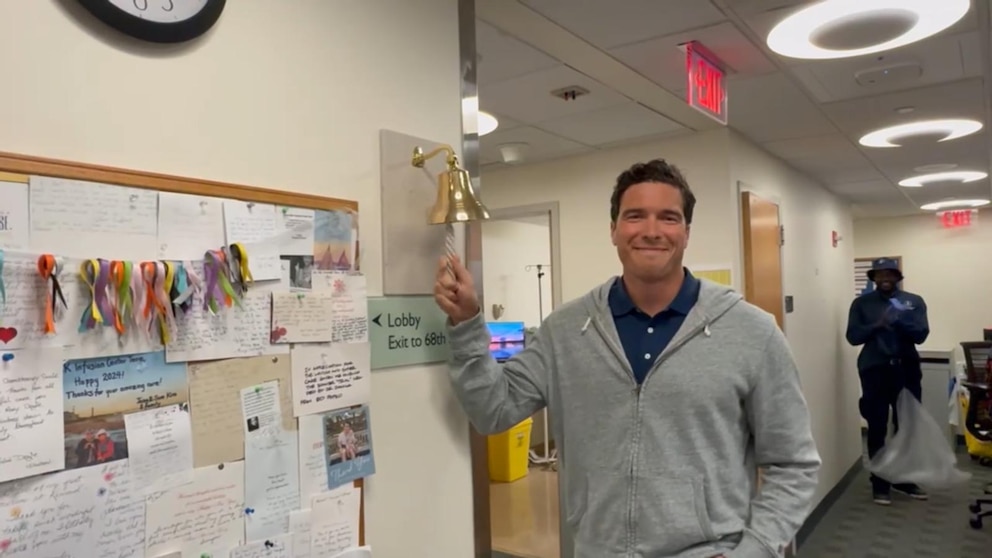
Photo via New York Post

ABC News’ Will Reeve reveals testicular cancer diagnosis: what to know about the rare disease

Read the original at New York Post ↗
Cite

Peck, P. (2026, September 29). ABC News’ Will Reeve reveals testicular cancer diagnosis: what to know about the rare disease. New York Post. https://nypost.com/health/what-is-testicular-cancer/

Dated when The Aporia collected the article, usually within hours of publication. Check the original for its exact date and byline.

New York Post · collected 2026-09-29 · by Patrice Peck

Quick Summary

Will Reeve, an ABC News correspondent and son of Christopher Reeve, announced he was diagnosed with testicular cancer but is now cancer-free after undergoing surgery and chemotherapy. The diagnosis came when Reeve discovered a lump in his left testicle shortly after getting married; doctors confirmed it as embryonal carcinoma, a type that usually affects younger adults, which required an orchiectomy followed by lymph node clearance surgery and chemotherapy at Memorial Sloan Kettering Cancer Center.
Written by AI on 2026-09-29, from this article's own text only (the story summary below draws on all the coverage).

AI analysis

Story summary

Will Reeve, son of late actor Christopher Reeve, revealed on ABC News and Page Six Daily that he was diagnosed with testicular cancer. Four months after his January wedding to Amanda Dubin, Will found a hard lump in his left testicle during a shower in April, prompting him to undergo an ultrasound at Amanda's urging. The ultrasound confirmed the presence of a mass, leading to an orchiectomy where his affected testicle was removed. He received a diagnosis of embryonal carcinoma, an aggressive form of testicular cancer common among younger adults.

Will underwent chemotherapy and another surgery to remove lymph nodes. His treatment caused severe side effects including bone pain, ringing ears, night sweats, blood clots, and headaches. Will is now cancer-free but wants to raise awareness about the disease, noting it can be shocking and awkward to discuss due to its nature. He dedicates his time to raising funds for those impacted by paralysis through the Christopher & Dana Reeve Foundation.

Written for “Will Reeve Cancer Diagnosis” on 2026-10-30, grounded in this article and the 2 other(s) covering the same event.

Story

📰 Will Reeve Cancer Diagnosis
Health · 3 article(s) covering the same event. See how they differ ↓

Compared with similar articles

This article reads unscored and hedges 9% of its claims. Each row says how that neighbour differs.
Daily Mail
Hedges 2 of 34 claims Outlet record 68/100
New York Post
Hedges 1 of 7 claims Outlet record 66/100
ABC News (US)
Hedges 0 of 2 claims Outlet record 70/100
“While both articles discuss Will Reeve's testicular cancer diagnosis and treatment, they appear to describe different stages of his health journey or separate communications about it.”
How this article was measured signals, leaning charts, publisher record, byline, topics and claims

Signals How these are calculated →

Claims extracted
23
sentences that state something as happening or true
Uncertain
9%
2 of 23 hedged ("reportedly", "may", "according to")
Leaning
not political
takes no side on a contested political question
Publisher signals
66/100
New York Post's corrections and hedging, across everything collected from it. Not a measure of accuracy.
Outlets on this story
3
Health
Same framing elsewhere
1
articles that frame the event the way this one does
Analyzed 2026-09-29 · how these are computed

How this is being covered How these are calculated →

Article leaning vs. publisher reliability
Source leaning vs. consistency

Publisher

New York Post · 15208 article(s) · 35 correction(s) detected
Running correction rate · 35 correction(s)

Who wrote this

Patrice Peck
9 article(s) here · 1 carrying a prediction
🔮 The clock is falling back — and your health might, too.
🔮 Following the dank data Cannabis may affect cardiovascular health through several physiological mechanisms, including increases in heart rate, fluctuations in blood pressure, blood clot formation and chest pain.
🔮 In fact, she revealed in a recent TikTok, she had spent four months hospitalized after developing sudden episodes of psychosis — and doctors may not have found the unlikely cause if not for her father’s pushing.
🔮 Hyrox offered plenty of opportunities to find out whether those feelings would endure.
🔮 ABC News correspondent Will Reeve, the son of Superman actor Christopher Reeve, has revealed that he was diagnosed with testicular cancer.
🔮 As it turns out, when it comes to our nose and throats, there are plenty of other medical no-nos you might be committing without even realizing it.
🔮 Home is where the heart is — but it could also be where your health troubles start.
🔮 And the revelation could be huge for researching treatment for serious diseases including ALS.
🔮 He says he would like to quit eventually.
Also by Patrice Peck
Nothing else under this byline is closely related to this article, so these are simply their most recent.
All 9 articles by Patrice Peck →

Topics

ABC News Black Manhattan Memorial Sloan Kettering Cancer Center People

Subjects

Reeves PERSON · 3× ABC News ORG · 2× Black NORP · 1× Christopher Reeve PERSON · 1× Manhattan GPE · 1× Memorial Sloan Kettering Cancer Center ORG · 1× People ORG · 1× Reeve PERSON · 1× Superman PERSON · 1× Will Reeve PERSON · 1×

Narrative

Reeves shared that he had his affected testicle removed in a surgery called an orchiectomy, which led to a diagnosis of embryonal carcinoma — an aggressive testicular cancer common in younger to middle-aged adults.
framing: assertive · carried by 1 article(s) · first seen 2026-09-29
🔮 ABC News correspondent Will Reeve, the son of Superman actor Christopher Reeve, has revealed that he was diagnosed with testicular cancer.

Claims (23 extracted, 2 hedged)

ABC News correspondent Will Reeve, the son of Superman actor Christopher Reeve, has revealed that he was diagnosed with testicular cancer. asserted
he → reveal → cancer
“I was raised to share one’s struggles if, in doing so, that might help others,” Reeve, 34, told People. uncertain
Reeve → raise → People
Not long after getting married, Reeves discovered a lump in his left testicle, and an ultrasound confirmed it was testicular cancer. asserted
it → marry → testicle
Reeves shared that he had his affected testicle removed in a surgery called an orchiectomy, which led to a diagnosis of embryonal carcinoma — an aggressive testicular cancer common in younger to middle-aged adults. asserted
which → share → adults
To stop the cancer from spreading, he had a second surgery to clear out dozens of lymph nodes through a retroperitoneal lymph node dissection. asserted
he → stop → dissection
He also recounted his month of chemotherapy at Memorial Sloan Kettering Cancer Center in Manhattan, detailing rough recovery side effects like bone pain, ringing ears, night sweats, blood clots and headaches. asserted
He → recount → pain
“I want folks to know that this is a thing that can happen,” Reeves told ABC News. asserted
Reeves → want → News
“It’s shocking. asserted
It → ’ → ?
It’s weird It’s slightly awkward to talk about just because of what we’re really discussing here, but that you end up okay, almost always. asserted
you → ’ → what
How is testicular cancer diagnosed? asserted
cancer → diagnose → ?
To diagnose testicular cancer, doctors perform a physical exam, imaging scans, blood tests and a biopsy. asserted
doctors → diagnose → exam
After confirming the cancer, they test the cells to identify the specific type, which guides the treatment plan. asserted
which → confirm → plan
The two main types of testicular cancer are: Seminoma: This type tends to develop in older adults. asserted
type → tend → adults
Nonseminoma: This group includes choriocarcinoma, embryonal carcinoma, teratoma and yolk sac tumor. asserted
group → include → choriocarcinoma
It typically affects younger individuals and grows and spreads faster than seminoma. asserted
It → affect → seminoma
While any male can develop testicular cancer, several risk factors can increase this likelihood. asserted
factors → develop → likelihood
Age plays a major role, as most cases affect teenagers and young adults aged 15 to 44, with about half of all diagnoses occurring in men in their 20s and 30s. asserted
half → play → 20s
Having an undescended testicle — known as cryptorchidism — keeps the risk elevated even after corrective surgery. asserted
Having → have → surgery
A family history of the disease, a prior history of testicular cancer in one testicle and certain medical conditions such as an HIV infection or Klinefelter Syndrome further raise the risk. asserted
history → raise → risk
Additionally, white men face a notably higher chance of developing testicular cancer compared to Black, Asian or Hispanic men. asserted
men → face → men
Testicular cancer is rarely fatal and exceptionally treatable, boasting an overall five-year survival rate of about 95%, according to Cleveland Clinic. uncertain
cancer → boast → Clinic
Because more than 95% of people are cured, it stands as one of the most manageable types of cancer to overcome. asserted
it → cure → cancer
Detecting the disease early — often by noticing a painless lump right away — makes the treatment process much simpler and significantly more successful. asserted
process → detect → lump

💬Give feedback
🕘History 🎫Support