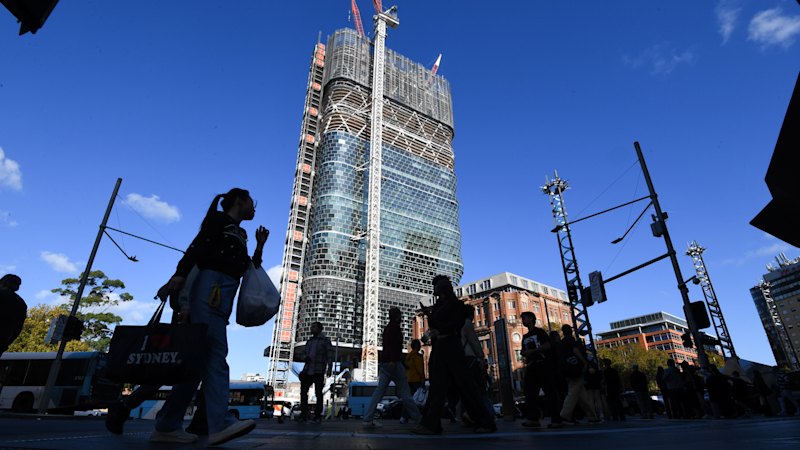
Photo via The Sydney Morning Herald

Big banks expected to follow Macquarie and sting home owners with rate rise

Read the original at The Sydney Morning Herald ↗
Cite

Bonyhady, N. (2026, September 30). Big banks expected to follow Macquarie and sting home owners with rate rise. The Sydney Morning Herald. https://www.smh.com.au/business/banking-and-finance/big-banks-expected-to-follow-macquarie-and-sting-home-owners-with-rate-rise-20260930-p611mn.html?ref=rss&utm_medium=rss&utm_source=rss_feed

Dated when The Aporia collected the article, usually within hours of publication. Check the original for its exact date and byline.

The Sydney Morning Herald · collected 2026-09-30 · by Nick Bonyhady

Quick Summary

Australia's major banks are anticipated to raise home loan interest rates following Macquarie Bank's lead, reflecting the Reserve Bank of Australia’s recent quarter-point increase. This move would add approximately $122 to monthly repayments for a typical $800,000 mortgage. Despite concerns over borrower stress, data shows low overdue repayment rates and record-high offset account balances, suggesting some financial resilience among homeowners. However, analysts warn that further rate hikes could exacerbate economic strain in certain sectors.
Written by AI on 2026-09-30, from this article's own text only (the story summary below draws on all the coverage).

AI analysis

Story summary

The Reserve Bank of Australia (RBA) has raised interest rates to their highest level in 15 years, increasing the cash rate target from 4.35% to 4.60%. This is the fourth increase this year and reflects the RBA's ongoing efforts to combat high inflation.

On a $700,000 loan with a 25-year term at an interest rate of 6.50%, monthly mortgage repayments will increase by approximately $93 following the latest rise. Over four increases this year, borrowers would see their monthly payments increase by about $364 on a $600,000 loan and roughly $7,300 annually.

The impact extends beyond mortgages: higher interest rates attract foreign investment to Australia due to better returns, potentially strengthening the Australian dollar. However, increased borrowing costs will likely slow down spending in other sectors such as dining out and retail shopping, which could affect businesses reliant on consumer spending.

Despite the hikes, housing remains unaffordable for many, with further rate increases forecasted by some analysts up to 5.1% by mid-2027, posing significant challenges for household finances already strained by rising costs like petrol prices nearing $2.40 per liter. The Bureau of Statistics is set to release September's inflation data soon, which will provide more insight into the effectiveness of these measures and future policy directions.

Written for “RBA Interest Rate Hikes” on 2026-10-31, grounded in this article and the 17 other(s) covering the same event.

Story

📰 RBA Interest Rate Hikes
Economy/Business · 18 article(s) covering the same event. Compare every outlet's account →

Compared with similar articles

This article reads leans left and hedges 14% of its claims. Each row says how that neighbour differs.
ABC News (AU)
Hedges 1 of 10 claims Outlet record 68/100
Daily Mail
Hedges 4 of 38 claims Outlet record 68/100
“The articles describe different banks (Macquarie and Australia's big four vs. Barclays) responding to separate central bank decisions in distinct regions (Australia vs. UK).”
Al Jazeera
Hedges 1 of 15 claims Outlet record 60/100
Evening Standard
Hedges 2 of 10 claims Outlet record 65/100
“The articles discuss different aspects of the housing and mortgage markets in separate countries (UK vs. Australia) and do not describe a single, identical event.”
ABC News (AU)
Hedges 0 of 25 claims Outlet record 68/100
“The articles discuss related topics (interest rate hikes) but describe different aspects of them; Article A focuses on Taylor's blame for inflation, while Article B discusses banks following through with the rate hike.”
The Guardian
Hedges 3 of 12 claims Outlet record 66/100
“The articles discuss different aspects of financial stability and interest rates in Australia but do not describe the same specific incident.”
The Guardian
Hedges 1 of 20 claims Outlet record 66/100
“The articles discuss different aspects of the Australian housing market and economy, not a single specific incident.”
The Sydney Morning Herald
Hedges 0 of 7 claims Outlet record 61/100
“The articles refer to different dates: Article A is about the interest rate rise announced on September 29, while Article B discusses expectations for banks' actions after the rise on September 30.”
ABC News (AU)
Hedges 0 of 3 claims Outlet record 68/100
“Article A describes the RBA lifting interest rates, while Article B discusses how banks are expected to follow this rate rise by increasing mortgage repayments for home owners.”
The Sydney Morning Herald
Hedges 3 of 10 claims Outlet record 61/100
“Article A mentions multiple news items including a rate hike, while Article B focuses specifically on banks expected to follow the Reserve Bank's rate rise, indicating different specific events or aspects.”
How this article was measured signals, leaning charts, publisher record, byline, topics and claims

Signals How these are calculated →

Claims extracted
22
sentences that state something as happening or true
Uncertain
14%
3 of 22 hedged ("reportedly", "may", "according to")
Leaning
Leans left
of the writing, not the subject · beta estimate
Publisher signals
61/100
The Sydney Morning Herald's corrections and hedging, across everything collected from it. Not a measure of accuracy.
Outlets on this story
18
Economy/Business
Same framing elsewhere
1
articles that frame the event the way this one does
Analyzed 2026-09-30 · how these are computed

How this is being covered How these are calculated →

Article leaning vs. publisher reliability
Source leaning vs. consistency

Publisher

The Sydney Morning Herald · 5658 article(s) · 15 correction(s) detected
Running correction rate · 15 correction(s)

Who wrote this

Nick Bonyhady
13 article(s) here · 1 carrying a prediction
🔮 The question is: will the market, and the ASX that operates it, adopt the same attitude?
🔮 Zohran Mamdani may be the exception that proves the rule.
🔮 But the man, who was not represented by a lawyer in contrast to Atlassian’s use of external solicitors at K&L Gates and an employment-law barrister, did not provide any medical evidence about how his ADHD caused him to act at work. “The absence of medical evidence before the court was acknowledged by the applicant who said that he could only speak to his lived experience,” Stellios noted.
🔮 Had the Firmus listing gone ahead as planned, the float would have raised $US5 billion ($7.1 billion).
🔮 Had the AI data centre company he co-founded, Firmus, gone public at a $43.7 billion valuation this month, Curtis’ corporate apotheosis would have been complete.
🔮 Australia’s banks are seeking an exemption from competition laws to set up regional banking hubs, where several institutions would share one physical facility, against the long-term backdrop of declining access to branches in regional towns.
🔮 He told the court that he had spoken out about trading malpractice in the early 2010s and claimed a colleague had said he would “slaughter” a rate used to set the interest on vast amounts of short-term loans, thereby manipulating the market and making money.
🔮 “KPMG International will consider any funding request in accordance with its governance arrangements.”
🔮 The spokesman said the tender process would be done by the end of April 2027, with the new auditor in place by the 2029 financial year.
🔮 The force’s anti-corruption division chief, Andrea Quinn, said the result showed that companies would still face significant financial consequences following foreign bribery investigations, even if there was no prosecution.
Also by Nick Bonyhady
Nothing else under this byline is closely related to this article, so these are simply their most recent.
All 13 articles by Nick Bonyhady →

Topics

Australia Australian Macquarie UBS the Reserve Bank’s

Subjects

Australian NORP · 3× Storey PERSON · 3× Macquarie ORG · 2× UBS ORG · 2× the Reserve Bank’s ORG · 2× , John Storey PERSON · 1× Australia GPE · 1× Ben Perham PERSON · 1× Macquarie Bank ORG · 1× the Australian Prudential Regulation Authority ORG · 1×

Narrative

Cassandra Goldie, chief executive of the Australian Council of Social Services, said while the organisation was concerned about the consequences of rate rises for mortgage holders, renters deserved protection. “We’re very worried about renters because if we see a further increase there, people on low and modest incomes are going to be facing homelessness at this point,” Goldie said on ABC radio.
framing: assertive · carried by 1 article(s) · first seen 2026-09-30
🔮 Australia’s big four banks are expected to follow Macquarie and pass on the Reserve Bank’s quarter-percentage-point rate rise to home owners, adding $122 in monthly repayments on a standard $800,000 mortgage, and increasing borrowers’ pain following three rate rises earlier this year.
2026-09-30 · The Sydney Morning Herald
Big banks expected to follow Macquarie and sting home owners with rate rise · assertive framing

Claims (22 extracted, 3 hedged)

Australia’s big four banks are expected to follow Macquarie and pass on the Reserve Bank’s quarter-percentage-point rate rise to home owners, adding $122 in monthly repayments on a standard $800,000 mortgage, and increasing borrowers’ pain following three rate rises earlier this year. asserted
banks → expect → rises
While the rise to 4.6 per cent will bite for mortgage holders, federal data shows the nation’s total offset account balances are still near record highs, and overdue home loan repayment rates are still very low. asserted
rates → bite → highs
Spending and labour market resilience has played into the Reserve Bank’s thinking on rates to date and, some analysts expect, could support the case for further rate rises that could exacerbate early signs of stress in parts of the economy. uncertain
that → play → economy
Head of Australian bank research at UBS, John Storey, said it was all but inevitable that the big banks would pass on the rate rise. asserted
banks → say → rise
“I think it’s a fait accompli, unfortunately,” Storey said. asserted
Storey → think → ?
Macquarie Bank, the nation’s fifth-largest home lender, said on Tuesday it will pass on the central bank’s 25-basis-point increase in full, with the change taking effect from October 15. asserted
change → say → October
Savers with deposits in many of the bank’s accounts will get the same increase. asserted
Savers → get → increase
“For any customers concerned about making their home loan repayments, we encourage them to get in touch, as financial assistance may be available,” said Macquarie personal banking chief Ben Perham. uncertain
Perham → concern → touch
Data released by the Australian Prudential Regulation Authority on September 17 shows that for the quarter ending in June this year, Australian offset balances stood at a total of $340 billion. asserted
balances → release → billion
That is up about $39 billion on the same period a year before, but down from the staggering $349 billion recorded in the March quarter of 2026. asserted
That → record → 2026
Those accounts help cushion the consequences of interest rises by reducing the portion of an outstanding loan that is carrying interest and giving households a financial pool to draw on for repayments if needed. asserted
that → help → repayments
Despite recent rate rises, data from the banks isn’t showing a large jump in people struggling with their mortgages. asserted
data → show → mortgages
ANZ figures from August show, as of June 30, it had a 0.86 per cent exposure to home loans that were more than 90 days past due in its Australian portfolio, up three basis points compared with March. asserted
that → show → March
“We continue to watch the external environment closely across our network,” chief executive Nuno Matos said at the time. asserted
Matos → continue → time
“Our balance sheet and capital position remain strong, and we are staying close to our customers should they need support.” asserted
they → remain → support
Storey, the UBS analyst, said that coupled with falling house prices, the offset data showed “there’s a bit of strain, with consumers that aren’t as cashed up as they used to be”. asserted
they → say → consumers
But he cautioned that the consequences were uneven, depending on factors such as when people bought their homes. asserted
people → caution → homes
Older Australians who owned their homes outright could benefit from rising interest rates on their savings accounts, Storey noted. uncertain
Storey → own → accounts
Overall, he said, banks and mortgage holders were protected by the fact that many had large equity in their homes and were ahead on their payments, but flagged issues in the private credit industry and the ongoing conflict in the Middle East as risks. asserted
many → say → risks
Cassandra Goldie, chief executive of the Australian Council of Social Services, said while the organisation was concerned about the consequences of rate rises for mortgage holders, renters deserved protection. “We’re very worried about renters because if we see a further increase there, people on low and modest incomes are going to be facing homelessness at this point,” Goldie said on ABC radio. asserted
Goldie → say → radio
The big four banks were contacted for comment. asserted
banks → contact → comment
The Business Briefing newsletter delivers major stories, exclusive coverage and expert opinion. asserted
newsletter → deliver → stories
💬Give feedback
🕘History 🎫Support