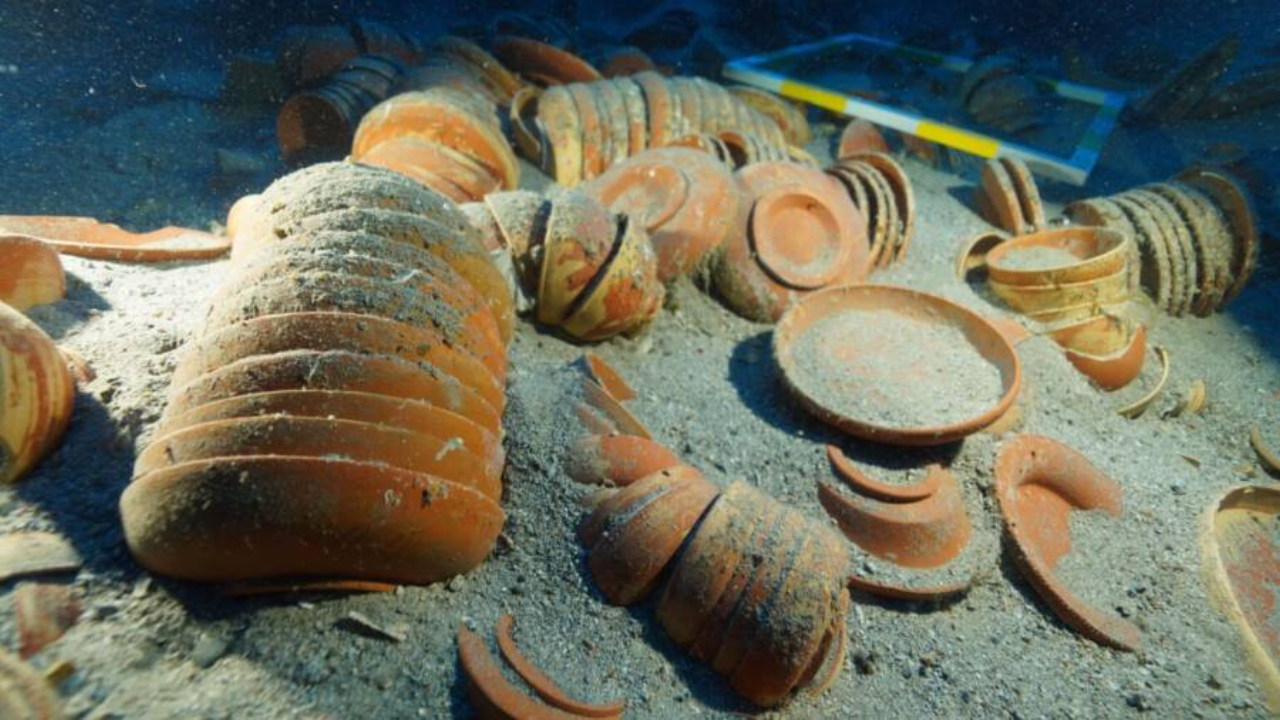
Off the Turkish coast near Adrasan, marine archaeologists recently discovered the remains of an ancient cargo ship bound for Rome and loaded with thousands of pieces of tableware in 122 different varieties, most famous and in demand at the time.
asserted
archaeologists → discover → time
The vessel had been carrying ceramic plates, bowls and serving dishes when it sank some 2,100 years ago, as per a report by All Things Interesting.
asserted
it → carry → Things
Researchers believe the cargo originated from the region around the ancient port city of Rhosus, in modern-day Arsuz, Turkey, which served as a hub for elite tableware production at the time.
asserted
which → believe → time
Rhosus tableware was so well known and in demand that the Roman statesman Marcus Tullius Cicero famously mentioned ordering it in a letter from 50 B.C.E.
A shocking shipwreck
According to an announcement about the discovery made by Turkey's Minister of Culture and Tourism, Mehmet Nuri Ersoy, excavations on the shipwreck began in 2025.
uncertain
excavations → know → 2025
Since then, marine archaeologists have recovered thousands of ceramic pieces, which have been transferred either to the Antalya Museum or to conservation labs.
asserted
which → recover → labs
The wreck, sitting at depths between 140 and 18 feet, revealed 122 distinct types of tableware of different forms and sizes.
asserted
wreck → sit → forms
Due to the wreck's deep location, the team had to use underwater robotic systems to support the marine archaeologists' work on the ocean floor.
asserted
team → have → floor
The ship dates back 2,100 years and was transporting thousands of ceramics, packed together for shipment across the Mediterranean.
asserted
ship → date → Mediterranean
The 122 distinct dish types also provide a detailed window into the variety of tableware available in the ancient world.
asserted
types → provide → world
Moreover, it reveals how ceramics were packed and distributed at the time.
asserted
ceramics → reveal → time
For instance, the ceramic pieces found in the shipwreck were packed with clay between them before being placed inside crates, in order to reduce the risk of them breaking while at sea.
asserted
them → find → sea
For the researchers, this packing method also aided in preserving the tableware for years after the ship sank, allowing modern experts to get insights from it that they might not otherwise be able to.
uncertain
they → aid → it
During the Late Hellenistic and Early Roman period, much of the Mediterranean's fine tableware was produced in the port of Rhosus in present-day Turkey.
asserted
much → produce → Turkey
Historians are aware of this due to the various written records left behind by the Romans.
asserted
Historians → write → Romans
Rhosus was mentioned, for instance, in a letter from the famous orator Cicero to his close friend Titus Pomponius Atticus, which he wrote while he was governor of Cilicia in about 50 B.C.E.
asserted
he → mention → B.C.E.
In the note, Cicero wrote that he had ordered Rhosica vasa, which means vessels or dishes from Rhosus.
asserted
which → write → Rhosus
In the centuries following the discovery of that short reference to these ceramics, archaeologists and scholars have debated the exact production site of Cicero’s tableware.
asserted
archaeologists → follow → tableware
Some scholars have suggested that Cicero’s ceramics may have been what’s known as Eastern Sigillata A, popular ancient clay tableware originating somewhere along the Gulf of İskenderun in southeastern Turkey, but the debate has continued.
uncertain
debate → suggest → Turkey
Although it remains unknown who ordered the newly found tableware shipment, the recent shipwreck discovery provides important physical evidence of the region's thriving maritime economy in ancient times.
asserted
discovery → remain → times
A similar shipwreck was also found filled with hundreds of well-preserved ceramics.
asserted
shipwreck → find → ceramics
Other marine archaeologists diving elsewhere in Turkey’s waters have also discovered a 1,500-year-old wreck carrying 10,000 ceramic plates, as well as a 1,100-year-old ship that sank with jugs of olive oil aboard.
asserted
that → dive → oil
 The Aporia