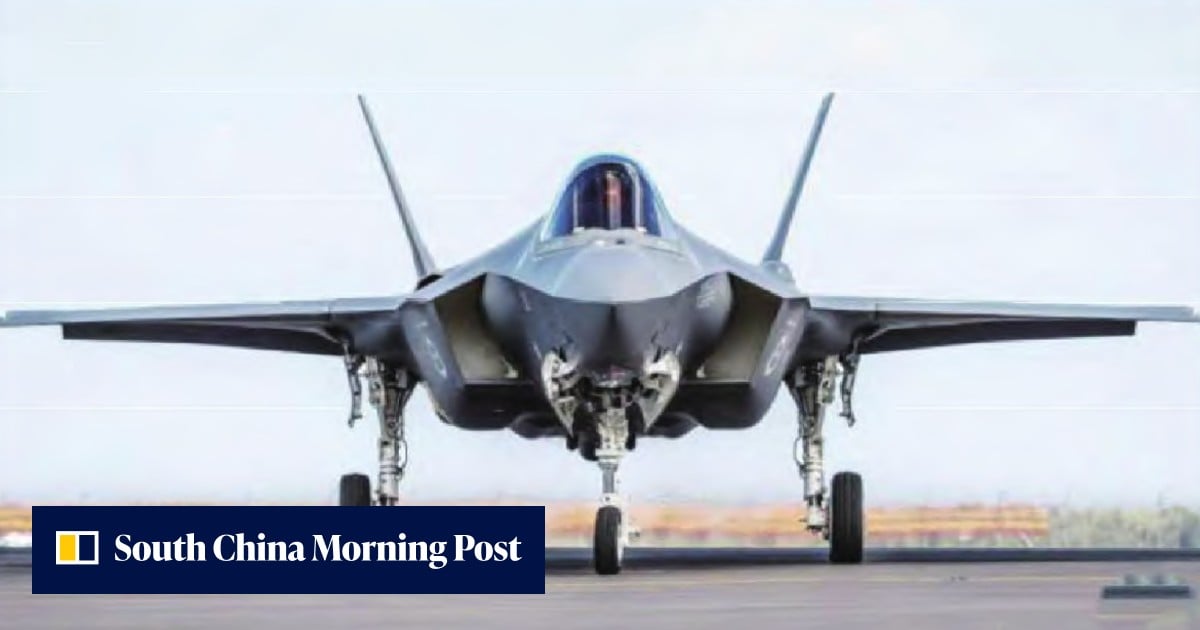
Photo via South China Morning Post

Chinese researchers say missile lidar model can spot US F-35 at up to 61.5km

Read the original at South China Morning Post ↗
Cite

Kong, C. (2026, September 30). Chinese researchers say missile lidar model can spot US F-35 at up to 61.5km. South China Morning Post. https://www.scmp.com/news/china/science/article/3369347/chinese-researchers-say-missile-lidar-model-can-spot-us-f-35-615km?utm_source=rss_feed

Dated when The Aporia collected the article, usually within hours of publication. Check the original for its exact date and byline.

South China Morning Post · collected 2026-09-30 · by Chao Kong

Quick Summary

Chinese researchers claim that their missile-borne single-photon lidar system could detect US F-35 stealth fighters from up to 61.5 kilometers away at night. This theoretical model, developed by a Chinese air force supplier, suggests the potential impact on the F-35’s combat effectiveness against advanced Chinese weapons. However, an analyst questions whether this narrow laser beam would be effective in locating a stealth target among vast sky areas.
Written by AI on 2026-09-30, from this article's own text only (the story summary below draws on all the coverage).

AI analysis

Story summary

Chinese researchers have developed a computer simulation indicating that a missile-borne lidar system could detect and track the F-35 stealth fighter at distances up to 61.5 km (38 miles), especially in nighttime conditions. This system operates without triggering radar or heat sensors, potentially undermining the F-35's stealth capabilities. The theoretical model was created by a major Chinese air force missile supplier and suggests significant implications for the survivability of the F-35 when facing advanced Chinese aircraft. However, some analysts are skeptical about the practicality of finding a small target like an F-35 in a vast sky using such technology. In contrast, the F-35 is known to carry short-range missiles, such as the AIM-9X Sidewinder with a range of 16km to 32km, which relies on infrared seekers for detection.
Written for “Chinese Missile Technology Advances” on 2026-11-02, grounded in this article and the 0 other(s) covering the same event.

Story

📰 Chinese Missile Technology Advances
Technology · 1 article(s) covering the same event.

Compared with similar articles

Nothing to compare against. No article is close enough to this one for the pipeline to have linked or judged the pair.
How this article was measured signals, leaning charts, publisher record, byline, topics and claims

Signals How these are calculated →

Claims extracted
3
sentences that state something as happening or true
Uncertain
67%
2 of 3 hedged ("reportedly", "may", "according to")
Leaning
not political
takes no side on a contested political question
Publisher signals
63/100
South China Morning Post's corrections and hedging, across everything collected from it. Not a measure of accuracy.
Outlets on this story
1
Technology
Same framing elsewhere
1
articles that frame the event the way this one does
Analyzed 2026-09-30 · how these are computed

How this is being covered How these are calculated →

Article leaning vs. publisher reliability
Source leaning vs. consistency

Publisher

South China Morning Post · 3580 article(s) · 7 correction(s) detected
Running correction rate · 7 correction(s)

Who wrote this

Chao Kong
12 article(s) here · 1 carrying a prediction
🔮 The study by researchers at Singaporean and Chinese institutions was published in Nature on October 7, with Cheng Zheyu and Zhang Xiuhai, both affiliated with Nanyang Technological University in Singapore, as co-first authors. Cheng and his colleagues set out to investigate whether doughnut-like topological properties could exist at critical points – the thresholds at which physical systems change their behaviour.
🔮 Chinese scientists use open-source data to spot suspected Israeli electronic warfare units PLA scientists publish algorithm used to estimate sources of GPS spoofing around Israel using flight data Chinese military scientists claim they have developed an algorithm that could help identify electronic warfare units using civil aviation flight data.
🔮 It will bring together eight leading institutions and aims to create a network of more than 1,000 scientists.
🔮 Peking University scientist says solar-activated mineral water improves photosynthetic efficiency across major crops Large-scale field trials across China show that irrigation water treated with natural minerals radiated by sunlight could dramatically increase the yields of several crops, according to Chinese scientists behind the experiments. The team said the trials, including on rice, wheat, soybeans, peanuts, sweet potatoes, sugar cane and vegetables, improved photosynthetic efficiency.
🔮 Chinese researchers say missile lidar model can spot US F-35 at up to 61.5km Chinese air force supplier models airborne single-photon lidar to spot stealth fighters without triggering radar or heat sensors A computer simulation developed by Chinese researchers suggests that a missile-borne system with the latest light detection and ranging system, or lidar, could detect and track an F-35 stealth fighter at up to 61.5km (38 miles) at night.
🔮 Offshore wind farm could create radar blind spots and ‘ghost’ targets, Chinese study warns As China rapidly expands its wind projects near coastal areas, researchers find the turbines can complicate marine vessel detection at sea Offshore wind farms can reduce the coverage of shore-based radar systems and create areas where targets become harder to detect, according to a new study.
🔮 China mulls building nuclear-powered tank with 450km-range railgun in 2 decades Further multi-physics simulations and vehicle-level testing needed before proposed systems could move towards practical deployment
🔮 Could China sanction US for illegal international seabed mining?
Also by Chao Kong
Nothing else under this byline is closely related to this article, so these are simply their most recent.
All 12 articles by Chao Kong →

Topics

China Chinese F-35 an F-35 stealth fighter the F-35’s

Subjects

Chinese NORP · 4× China GPE · 1×

Narrative

In air-to-air combat, the F-35 can carry short-range missiles, such as the AIM-9X Sidewinder, which has a reported range of about 16km to 32km and uses an imaging infrared seeker.
framing: speculative · carried by 1 article(s) · first seen 2026-09-30
🔮 Chinese researchers say missile lidar model can spot US F-35 at up to 61.5km Chinese air force supplier models airborne single-photon lidar to spot stealth fighters without triggering radar or heat sensors A computer simulation developed by Chinese researchers suggests that a missile-borne system with the latest light detection and ranging system, or lidar, could detect and track an F-35 stealth fighter at up to 61.5km (38 miles) at night.
2026-09-30 · South China Morning Post
Chinese researchers say missile lidar model can spot US F-35 at up to 61.5km · speculative framing

Claims (3 extracted, 2 hedged)

Chinese researchers say missile lidar model can spot US F-35 at up to 61.5km Chinese air force supplier models airborne single-photon lidar to spot stealth fighters without triggering radar or heat sensors A computer simulation developed by Chinese researchers suggests that a missile-borne system with the latest light detection and ranging system, or lidar, could detect and track an F-35 stealth fighter at up to 61.5km (38 miles) at night. uncertain
system → say → night
The theoretical model developed by a leading Chinese air force missile supplier says that under ideal conditions, the claimed range could have implications for the F-35’s ability to survive while facing China’s stealth fighters. But one analyst is sceptical that the development would allow the user to find a stealth target in a vast sky with a narrow laser beam. uncertain
user → develop → beam
In air-to-air combat, the F-35 can carry short-range missiles, such as the AIM-9X Sidewinder, which has a reported range of about 16km to 32km and uses an imaging infrared seeker. asserted
which → carry → seeker
💬Give feedback
🕘History 🎫Support