Most visitors to a natural history museum see only a sliver of what it holds.
asserted
it → see → what
At the Harvard Museum of Natural History in Cambridge, Massachusetts, the objects on display are a tiny percentage of the total collection, with experts caring behind the scenes for 26 million specimens.
asserted
experts → care → specimens
A new exhibition called ‘Collecting Wonders: Tomorrow's Discoveries,’ brings some of the rarest, oldest and most beautiful of them into public view, many for the first time.
asserted
exhibition → call → time
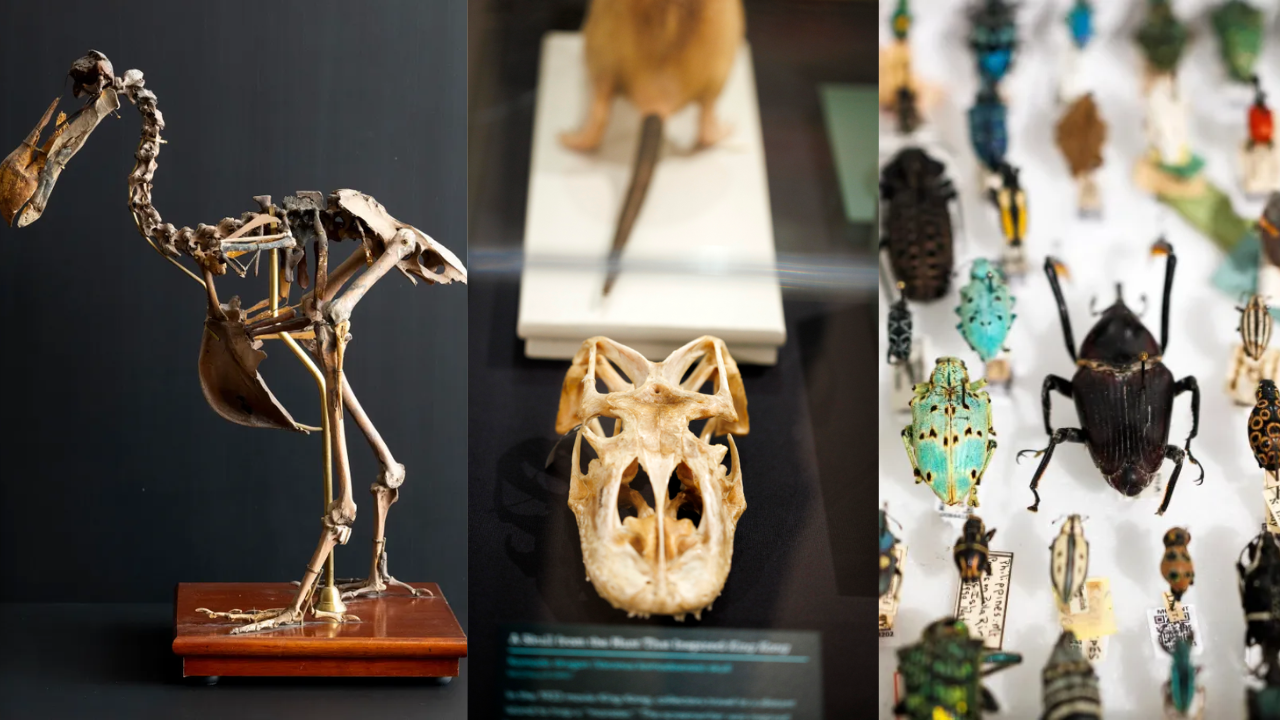
From a dodo skeleton to jewel-like beetles, the objects span billions of years and show how scientists still use these old collections to study life on Earth.
asserted
scientists → span → Earth
What the exhibition at the Harvard Museum of Natural History shows and when you can visit
The exhibition, ‘Collecting Wonders: Tomorrow's Discoveries’ opened on 27 June 2026 and runs through April 2027 in the museum's main gallery space.
asserted
exhibition → show → space
The show draws on a collection of more than 26 million individual objects, and the Harvard Gazette reports that it is open daily from nine in the morning to five in the afternoon.
asserted
it → draw → afternoon
Specimens range from stone and bone to plant, animal, feather, fish and fossil, from a massive polar bear to tiny beetles.
asserted
Specimens → range → beetles
The dodo skeleton, the extinct golden toad and a 300-million-year-old fern at Harvard
Several specimens no longer exist in the wild.
asserted
specimens → exist → wild
The dodo, whose last widely accepted sighting was in 1662, appears as a whole articulated skeleton; it was last displayed nearly twenty years ago, alongside a feathered model.
asserted
it → accept → model
Visitors can also see the golden toad, discovered in 1964 in Costa Rica's Monteverde Cloud Forest Preserve and declared extinct in 2004.
asserted
Visitors → see → 2004
Ornithology collection manager Jeremiah Trimble explains that such specimens preserve a snapshot of a species and its location, letting researchers trace how its genetics changed over time.
asserted
genetics → explain → time
A 300-million-year-old fern tells another story, ferns and other prehistoric plants were buried and pressed over millions of years into the coal that fuelled the Industrial Revolution.
asserted
that → tell → Revolution
Some objects arrive with extraordinary stories.
asserted
objects → arrive → stories
George Washington's golden pheasants once lived in the aviary of Louis XVI before the Marquis de Lafayette sent them to Washington in November 1786; after they died, he gave them to Charles Wilson Peale, who ran a Philadelphia museum.
asserted
who → live → museum
A Komodo dragon skull is said to come from the 1926 expedition that inspired the film, King Kong.
asserted
that → say → film
An oyster from around 1856 holds a pearlfish mummified in mother of pearl.
asserted
oyster → hold → pearl
A blue morpho butterfly shows male markings on one wing and female markings on the other, a trait said to occur in only one in 10,000 butterflies.
asserted
butterfly → show → butterflies
How scientists still study life across billions of years with old specimens
Beauty and research often overlap, as in this case, a rare form of crystalline gold looks like metallic coral, and a fossil slab from Morocco's Atlas Mountains preserves swirling patterns left by cephalopods that swam in a shallow sea around 370 million years ago.
asserted
that → study → sea
Beetles and weevils owe their metallic shine to crystalline scales, which society women of the mid-1800s used like sequins.
asserted
women → owe → sequins
Notably, a fully articulated polar bear, in the collection since at least 1878, is still used as a research tool.
asserted
bear → articulate → tool
Genetic material from its skin informs scientists about population diversity, while stable isotopes in its fur reveal ecological conditions during its life.
asserted
isotopes → inform → life
Michaela Schmull, curator of ferns, says, "Discovering the stories is one of the best jobs."
asserted
Discovering → say → jobs
 The Aporia