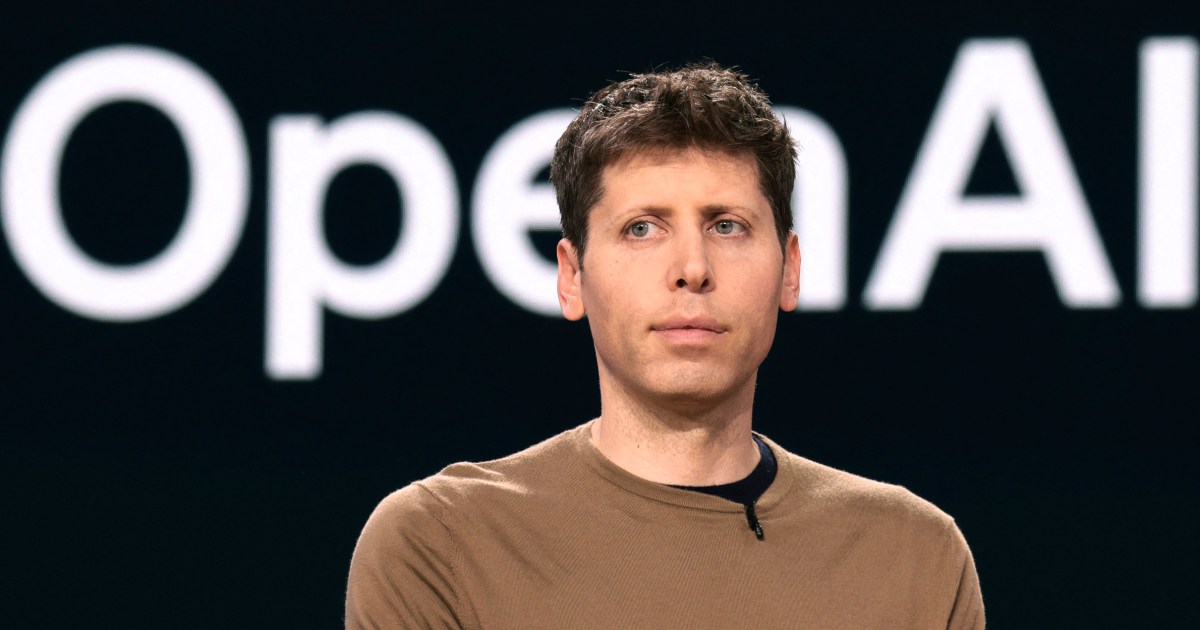
Photo via Semafor

OpenAI's new pricing tiers highlight compute bottleneck

Read the original at Semafor ↗
Cite

Albergotti, R. (2026, September 30). OpenAI's new pricing tiers highlight compute bottleneck. Semafor. https://www.semafor.com/article/09/30/2026/openais-new-pricing-tiers-highlight-compute-bottleneck

Dated when The Aporia collected the article, usually within hours of publication. Check the original for its exact date and byline.

Semafor · collected 2026-09-30 · by Reed Albergotti

Quick Summary

Reed discusses OpenAI's recent changes in pricing tiers at their annual developer event, noting that higher usage now incurs significantly greater costs due to resource limitations. The new $500-per-month tier exemplifies the increasing expenses associated with AI compute power. This cost increase reflects a critical shortage of computational resources necessary for advanced AI capabilities, suggesting that the ambitious goals set by companies like OpenAI and Meta may be overpromising given current technological constraints.
Written by AI on 2026-09-30, from this article's own text only (the story summary below draws on all the coverage).

AI analysis

Story summary

OpenAI recently announced new pricing tiers at its annual developer event, indicating a significant increase in costs for users accessing its AI services. The $200-per-month plan now includes half the number of tokens compared to previous offerings, while an additional tier priced at $500 per month has been introduced. This price hike reflects a critical shortage of computational resources within the industry, making it prohibitively expensive for companies like OpenAI and Meta (which recently launched its own AI assistant named Muse) to provide always-on, highly capable AI services.

The higher costs suggest that AI products often overpromise on their capabilities due to limited availability and affordability of necessary computing power. Users are experiencing issues with both dots and Muse, such as running into paywalls or needing to solve CAPTCHAs frequently, which detracts from the seamless user experience promised by these tools. Consequently, it remains unclear whether these new AI assistants will deliver on their promises without substantial improvements in computational efficiency and cost reduction.

Written for “OpenAI Pricing Tiers” on 2026-11-02, grounded in this article and the 0 other(s) covering the same event.

Story

📰 OpenAI Pricing Tiers
Technology · 1 article(s) covering the same event.

Compared with similar articles

This article reads leans left and hedges 0% of its claims. Each row says how that neighbour differs.
Toronto Star
⚖️ Leans left Hedges 0 of 3 claims Outlet record 64/100
“The articles discuss different aspects of OpenAI's activities - one about delaying a model release due to security concerns, and another about pricing tier changes indicating a compute bottleneck.”
BBC News
Hedges 1 of 19 claims Outlet record 68/100
“The articles discuss different aspects of OpenAI's developer day: one focuses on renaming AI tools to 'dots', while the other discusses changes in pricing tiers.”
NBC News
Hedges 1 of 40 claims Outlet record 60/100
“While both articles discuss OpenAI's developer day on September 29th, Article A focuses on the launch of AI agents and other products, whereas Article B emphasizes the pricing tiers changes announced at the same event.”
How this article was measured signals, leaning charts, publisher record, byline, topics and claims

Signals How these are calculated →

Claims extracted
12
sentences that state something as happening or true
Uncertain
0%
0 of 12 hedged ("reportedly", "may", "according to")
Leaning
Leans left
of the writing, not the subject · beta estimate
Publisher signals
59/100
Semafor's corrections and hedging, across everything collected from it. Not a measure of accuracy.
Outlets on this story
1
Technology
Same framing elsewhere
1
articles that frame the event the way this one does
Analyzed 2026-09-30 · how these are computed

How this is being covered How these are calculated →

Article leaning vs. publisher reliability
Source leaning vs. consistency

Publisher

Semafor · 1423 article(s) · 3 correction(s) detected
Running correction rate · 3 correction(s)

Who wrote this

Reed Albergotti
17 article(s) here · 1 carrying a prediction
🔮 My hope was that the reporting would lead to some smart questions, not a shame-and-blame witch hunt that would result in a resignation: Does it make sense to have a blanket ban on something that has become so prevalent and can fool some of the world’s most renowned editors?
🔮 With a team of just 10 people and $10 million in funding, Aseon is doing something that, not long ago, would have taken years and a massive team to attempt: They are building parking space-sized pods equipped with robot arms that can clean and charge autonomous vehicles.
2026-10-28 · assertive framing · What startups look like in the AI era
🔮 Plus, why nobody would work for Mark Zuckerberg if he resembled Aaron Sorkin’s celluloid version in the upcoming film The Social Reckoning.
🔮 Offering always-on, agentic assistant tools will cost OpenAI and Meta — which recently launched its cutesy agent Muse — a ton of money, and it’s not clear yet that these agents will work well.
2026-09-30 · assertive framing · OpenAI's new pricing tiers highlight compute bottleneck
🔮 Some inside OpenAI and Anthropic were “blindsided” by an apparent agreement over the weekend that both companies would slow down the pace of AI research, the FT reported.
2026-09-18 · assertive framing · The real reason not to IPO
🔮 One potential reason floated to Semafor by market participants is that compute futures could be manipulated to show a sharp drop in the cost of older chips, which might destabilize AI stocks and debt markets.
🔮 The movie seems like an attempt to paint Altman and AI as villains, with lines like “Countries will fall.
2026-09-15 · assertive framing · Trailer for Altman biopic misses the real drama
🔮 Meta’s new AI assistant Muse could be the first experience a lot of people have with the power of AI that can actually do things for you, rather than just answer questions.
2026-09-15 · mixed framing · Meta launches Muse AI assistant
🔮 He could not immediately be reached for comment.
2026-09-15 · mixed framing · AI researcher Andrew Tulloch is leaving Meta
🔮 A calm read of Amodei’s proposal may lower your blood pressure.
2026-09-13 · assertive framing · How the AI apocalypse story escaped containment
Also by Reed Albergotti
Nothing else under this byline is closely related to this article, so these are simply their most recent.
All 17 articles by Reed Albergotti →

Topics

Meta Muse OpenAI Reed dots

Subjects

OpenAI ORG · 4× Meta ORG · 2× Reed PERSON · 1×

Narrative

If AI was getting to the point where it’s so efficient it can take out humanity by Christmas, as so many fear, the price of tokens would be going down, not up, and it would cost a lot less to solve math problems.
framing: assertive · carried by 1 article(s) · first seen 2026-09-30
🔮 Offering always-on, agentic assistant tools will cost OpenAI and Meta — which recently launched its cutesy agent Muse — a ton of money, and it’s not clear yet that these agents will work well.
2026-09-30 · Semafor
OpenAI's new pricing tiers highlight compute bottleneck · assertive framing

Claims (12 extracted, 0 hedged)

While OpenAI’s new tool, dots, stole much of the spotlight at its annual developer day Tuesday, it was the change to its pricing tiers that says more about the company and the AI industry. asserted
that → steal → company
OpenAI’s $200-per-month plan now comes with half the tokens. asserted
plan → come → tokens
And there’s now an eye-popping $500-per-month plan that makes the price of diesel these days seem like nothing. asserted
price → ’ → nothing
The cost creep is another indication there is a severe compute bottleneck in AI. asserted
creep → be → AI
Offering always-on, agentic assistant tools will cost OpenAI and Meta — which recently launched its cutesy agent Muse — a ton of money, and it’s not clear yet that these agents will work well. asserted
agents → offer → money
AI products often overpromise because there just aren’t enough tokens to go around (and it would be too expensive) to make them capable at their maximum potential. asserted
them → overpromise → potential
I haven’t yet worked with dots, but people are so far finding Meta’s Muse runs into paywalls and CAPTCHA hurdles they have to troubleshoot. asserted
they → work → paywalls
Meanwhile, my Codex is humming away doing cool and useful things for me, and it’s not clear that my dot will be able to replace some of the projects I’ve already put time into building. asserted
I → hum → time
Dots will likely wind up like a lot of new AI tools and features: completely amazing and, simultaneously, not quite there yet. asserted
Dots → wind → tools
It costs OpenAI fortunes to do its more ambitious tasks, too. asserted
It → cost → tasks
It recently spent about $10 million over roughly a weekend to solve part of the Navier-Stokes math equations. asserted
It → spend → equations
If AI was getting to the point where it’s so efficient it can take out humanity by Christmas, as so many fear, the price of tokens would be going down, not up, and it would cost a lot less to solve math problems. asserted
it → get → problems
💬Give feedback
🕘History 🎫Support