Photo via Toronto Star

Thousands of stories of residential school survivors will soon be destroyed. This group is fighting to preserve them

Read the original at Toronto Star ↗
Cite

Hilty, G. (2026, October 1). Thousands of stories of residential school survivors will soon be destroyed. This group is fighting to preserve them. Toronto Star. https://www.thestar.com/news/canada/thousands-of-stories-of-residential-school-survivors-will-soon-be-destroyed-this-group-is-fighting-to-preserve-them/article_253f946e-9dd1-4e7a-ab3a-96375b95afb9.html

Dated when The Aporia collected the article, usually within hours of publication. Check the original for its exact date and byline.

Toronto Star · collected 2026-10-01 · by Gabriel Hilty

Quick Summary

A Toronto-based advocacy group is trying to preserve over 38,000 testimonies from residential school survivors, which are set to be destroyed by 2027 due to a Supreme Court ruling on privacy concerns. The Indian Residential School Records Project argues these documents contain crucial evidence of abuses at the schools and that survivors should have control over their fate. Co-leaders Connie Walker and Kimberly Murray emphasize the historical significance and potential for further revelations about missing children from these records, calling for survivors to be informed and involved in decisions regarding the testimonies.
Written by AI on 2026-10-01, from this article's own text only (the story summary below draws on all the coverage).

AI analysis

Story summary

The Indian Residential School Records Project is working to preserve 38,000 testimonies from Indigenous survivors of residential schools, which are set for destruction by 2027 due to a Supreme Court ruling on privacy concerns. Co-leader Connie Walker says the records contain detailed accounts of abuse and represent the most comprehensive archive available. Murray, an independent special interlocutor for missing children and unmarked graves from residential schools, emphasizes that survivors should decide the fate of their testimonies, noting many are unaware these records will be destroyed soon. The project’s efforts coincide with the National Day for Truth and Reconciliation, aiming to return agency to Indigenous peoples regarding the preservation of this crucial historical documentation.

Written for “Residential School Records Destruction” on 2026-11-01, grounded in this article and the 0 other(s) covering the same event.

Story

📰 Residential School Records Destruction
Politics · 1 article(s) covering the same event.

Compared with similar articles

This article reads leans left and hedges 6% of its claims. Each row says how that neighbour differs.
Toronto Star
⚖️ Leans strongly left further left than this Hedges 1 of 16 claims Outlet record 64/100
“The articles discuss different aspects of Indigenous reconciliation in Canada but refer to distinct events and initiatives.”
CBC News
⚖️ Leans strongly left further left than this Hedges 1 of 26 claims Outlet record 74/100
“The articles discuss different aspects of efforts related to Indigenous residential schools but do not describe the same specific incident or happening.”
National Post
⚖️ Leans left Hedges 2 of 35 claims Outlet record 60/100
“The articles discuss different topics; one focuses on preserving testimonies of residential school survivors, while the other critiques the Governor General's stance on denialism regarding residential schools.”
CBC News
Hedges 6 of 56 claims Outlet record 74/100
“While both articles discuss the destruction of residential school records and survivor testimonies, they describe different aspects: Article A focuses on the perspective of a single survivor, while Article B discusses an advocacy group's efforts to preserve these records.”
How this article was measured signals, leaning charts, publisher record, byline, topics and claims

Signals How these are calculated →

Claims extracted
31
sentences that state something as happening or true
Uncertain
6%
2 of 31 hedged ("reportedly", "may", "according to")
Leaning
Leans left
of the writing, not the subject · beta estimate
Publisher signals
64/100
Toronto Star's corrections and hedging, across everything collected from it. Not a measure of accuracy.
Outlets on this story
1
Politics
Same framing elsewhere
1
articles that frame the event the way this one does
Analyzed 2026-10-01 · how these are computed

How this is being covered How these are calculated →

Article leaning vs. publisher reliability
Source leaning vs. consistency

Publisher

Toronto Star · 11011 article(s) · 28 correction(s) detected
Running correction rate · 28 correction(s)
2026-10-26
Correction
2026-10-24
Correction
2026-10-07
Correction
2026-09-24
Correction

Who wrote this

Gabriel Hilty
6 article(s) here · 1 carrying a prediction
🔮 As part of the If I Were Mayor series, the Star held a contest asking students at the Toronto District School Board and Toronto Catholic District School Board for their big ideas for the city in advance of Monday’s elections, and what they would do if they were chosen to lead the city.
🔮 Korchinski-Paquet, 29, died after falling from her High Park apartment balcony during a police call, raising concerns about how officers handle calls involving mental health and epilepsy. Testifying on Thursday, Korchinski-Paquet’s mother Claudette Beals went through her memory of the day in May 2020, saying that she saw police officers push her daughter towards the balcony.
🔮 As Toronto’s mayoral race between incumbent Olivia Chow and her closest rival, Brad Bradford, heats up, both candidates have been posting campaign endorsements on social media.
🔮 The IAP outlined that all documents, where survivors often had to detail abuses they experienced in graphic detail, would be treated as “highly confidential.”
🔮 Three years after the Scarborough RT was decommissioned, transit riders will once again travel along the line’s abandoned tracks — but this time the view will be different.
Also by Gabriel Hilty
Nothing else under this byline is closely related to this article, so these are simply their most recent.
All 6 articles by Gabriel Hilty →

Topics

Canadian Indigenous TRC The Indian Residential School Records Project Toronto

Subjects

Walker PERSON · 4× Murray PERSON · 3× TRC ORG · 3× Canadian NORP · 2× IAP ORG · 2× Indigenous NORP · 2× Connie Walker PERSON · 1× Supreme Court ORG · 1× The Indian Residential School Records Project ORG · 1× Toronto GPE · 1×

Narrative

Murray is a member of the Kanehsatà:ke Mohawk Nation and is an independent special interlocutor for missing children and unmarked graves and burial sites associated with residential schools. “Survivors themselves must determine what happens to their testimony … we’re hearing that survivors don’t even know that these records are being destroyed in less than a year,” said Murray.
framing: assertive · carried by 1 article(s) · first seen 2026-10-01
🔮 The IAP outlined that all documents, where survivors often had to detail abuses they experienced in graphic detail, would be treated as “highly confidential.”

Claims (31 extracted, 2 hedged)

A Toronto-based advocacy group is working to preserve a trove of 38,000 testimonies from residential school survivors that documents some of the worst abuses of Indigenous children. asserted
that → base → children
The Indian Residential School Records Project says it wants to return agency to survivors to decide the fate of their records, which are currently slated for destruction due to a Supreme Court ruling over privacy considerations. asserted
which → say → considerations
“The records that are set for destruction in 2027 are the most comprehensive archive that exists,” Connie Walker, co-leader of the project, told the Star ahead of a Wednesday panel at Evergreen Brickworks with other leaders of the project. asserted
Walker → set → project
The panel discussion coincided with the National Day for Truth and Reconciliation. asserted
discussion → coincide → Truth
“Survivors had to disclose in very detailed ways the abuse that they experienced at Indian residential schools,” said Walker, an award-winning investigative journalist and member of the Okanese First Nation in Saskatchewan. asserted
Walker → disclose → Saskatchewan
More than 150,000 Indigenous children were taken from their families to attend the schools run by churches and the Canadian government, a scheme asserted
children → take → churches
the Truth and Reconciliation Commission of Canada (TRC) called “a systematic, government-sponsored attempt to destroy” Indigenous culture and languages. asserted
Commission → call → culture
Operating for more than 150 years until 1997, residential schools were often underfunded, and thousands of children suffered physical and sexual abuse, according to the National Centre for Truth and Reconciliation. uncertain
thousands → operate → Truth
Records show 4,200 children died at the schools but incomplete and missing files indicate the total is likely higher. asserted
total → show → schools
“The right to truth belongs first to the survivors, their families and their communities,” said project co-lead Kimberly Murray. asserted
Murray → belong → survivors
Murray is a member of the Kanehsatà:ke Mohawk Nation and is an independent special interlocutor for missing children and unmarked graves and burial sites associated with residential schools. “Survivors themselves must determine what happens to their testimony … we’re hearing that survivors don’t even know that these records are being destroyed in less than a year,” said Murray. asserted
Murray → miss → year
Why is survivor testimony being destroyed? asserted
testimony → destroy → ?
In the 1980s, ‘90s and 2000s, thousands of residential school survivors came forward and sued the government and churches for the abuse they experienced, Walker said. asserted
Walker → come → abuse
The process resulted in the 2007 Indian Residential Schools Settlement Agreement, the largest class-action settlement in Canadian history that provided a base financial compensation of $10,000 to survivors, with an additional $3,000 for every year spent in school. asserted
that → result → school
The out-of-court settlement also formed the TRC, which had a mandate to document the experiences of survivors and inform Canada. asserted
which → form → Canada
However, speaking to the Independent Assessment Process (IAP) was the only way for survivors to pursue compensation for claims for sexual and serious physical abuse. uncertain
survivors → speak → abuse
While the TRC collected around 6,000 voices, “more than five times that many survivors participated in the IAP,” Walker explained. asserted
Walker → collect → IAP
The IAP outlined that all documents, where survivors often had to detail abuses they experienced in graphic detail, would be treated as “highly confidential.” asserted
they → outline → detail
The Supreme Court of Canada determined in 2017 the promise of confidentiality meant that the documents had to be destroyed after a retention period and a notice program to survivors. asserted
documents → determine → survivors
“We have concerns about the notice program to tell survivors about their options,” Murray said. asserted
Murray → have → options
“There’s an important difference between choosing destruction, and having the truth destroyed because you didn’t know you had a choice.” asserted
you → ’ → choice
Over the summer, the project began outreach efforts to raise awareness about next year’s looming deadline. asserted
project → begin → deadline
Drawing on public lawsuit records filed before the Indian Residential Schools Settlement Agreement, the group is also working to create a new archive of testimony, which can act as a resource to communities, Walker said. asserted
Walker → draw → communities
“There are so many communities that have started doing their own research and are starting to try to get access to these records. asserted
that → be → records
And so we’re hoping that our research will be helpful for them,” Walker said. asserted
Walker → hop → them
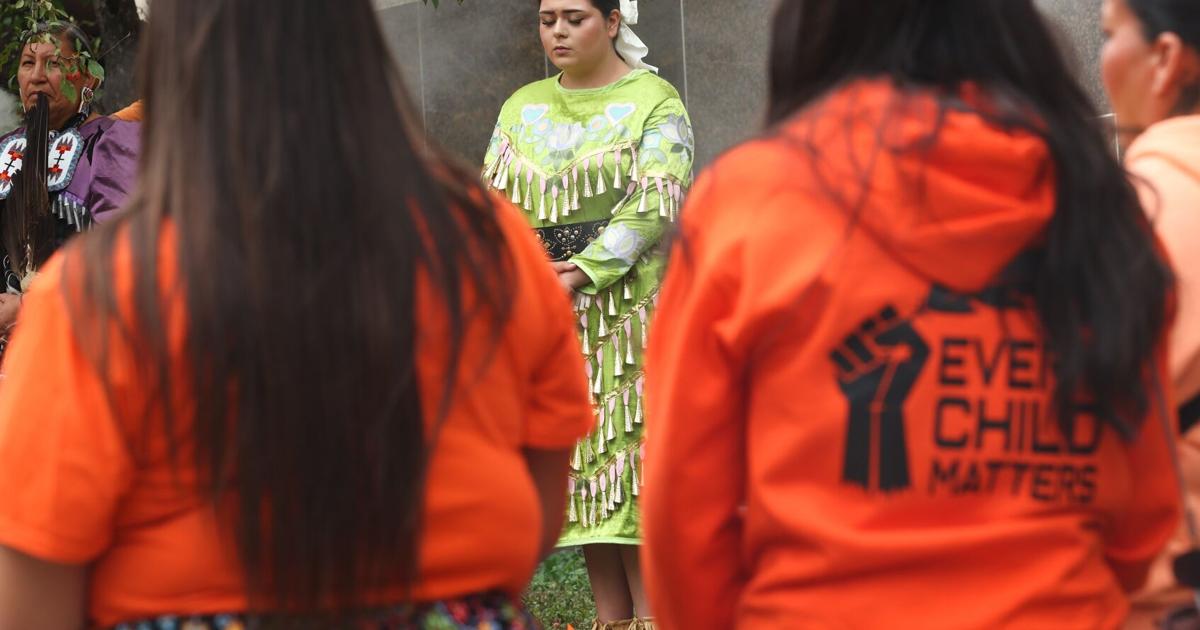
Stephen Kakfwi, a Dene leader and former premier of the Northwest Territories, shared some of his residential school experiences with the packed audience wearing orange shirts at Wednesday’s event. asserted
Kakfwi → share → event
He told of being abused at nine years old. asserted
He → tell → ?
“It took years before I spoke of it,” Kakfwi said. asserted
Kakfwi → take → it
“I spoke to the Commission when it was in Yellowknife, and to the adjudicator in a more graphic, ugly way of what it was like.” asserted
it → speak → what
For Kakfwi, it’s important to preserve the history for his children and future generations. asserted
it → ’ → children
“To protect and keep secure the records of what happened to us, no matter how graphic or ugly it is … it’s important so that it’s not denied or belittled,” Kakfwi said. asserted
Kakfwi → protect → us

💬Give feedback
🕘History 🎫Support