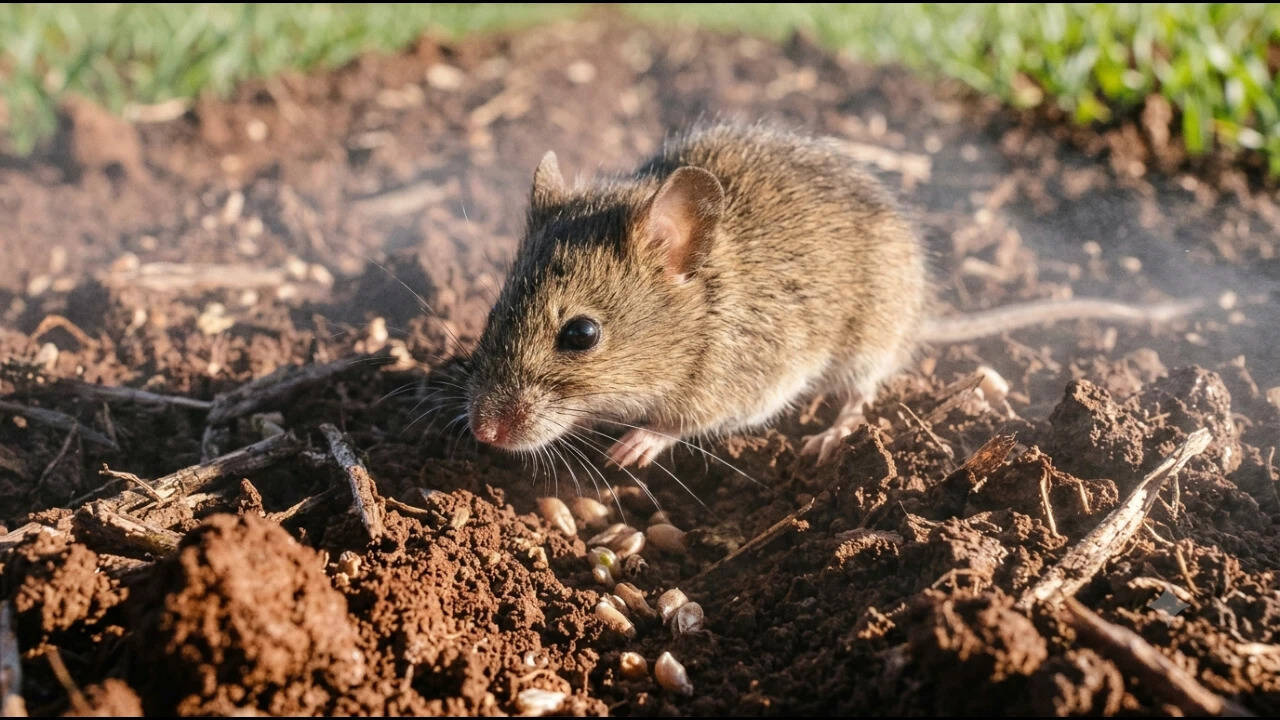
Photo via Times of India

Scientists in Australia reduce wheat seed loss to mice by 63% using diluted wheat germ oil spray

Read the original at Times of India ↗
Cite

TOI Science Desk. (2026, October 1). Scientists in Australia reduce wheat seed loss to mice by 63% using diluted wheat germ oil spray. Times of India. https://timesofindia.indiatimes.com/science/discovery/in-2021-australian-scientists-sprayed-wheat-scent-across-farm-plots-to-confuse-hungry-mice-the-treatment-reduced-seed-loss-by-up-to-74-in-a-field-experiment-without-poisoning-the-rodents/articleshow/134609633.cms

Dated when The Aporia collected the article, usually within hours of publication. Check the original for its exact date and byline.

Times of India · collected 2026-10-01 · by TOI Science Desk

Quick Summary

Australian scientists have developed a non-toxic method to protect wheat seeds from mice using diluted wheat germ oil sprays. Conducted in New South Wales in 2021, the experiment showed a 63% reduction in seed loss compared to untreated plots when applied during and after planting; this increased to 74% when sprayed before planting. The technique works by spreading the smell of wheat seeds across the area, making it difficult for mice to locate individual seeds based on scent alone. The research was led by PhD student Finn Parker and published in Nature Sustainability.
Written by AI on 2026-10-01, from this article's own text only (the story summary below draws on all the coverage).

AI analysis

Story summary

In 2021, scientists at The University of Sydney conducted an experiment in New South Wales, near Pleasant Hills, to reduce wheat seed loss due to mice without using toxic methods. The study involved spraying diluted wheat germ oil on farm plots to mask the smell of the seeds, making it harder for mice to locate them. Across 60 test plots, five different treatments were applied, and results showed that when wheat was sprayed with diluted oil both during and after planting, seed loss decreased by 63% compared to untreated areas. When spraying occurred before planting, the reduction in seed loss was even greater at 74%. This method offers a non-toxic alternative to traditional pest control techniques like poisoning or baiting.

Written for “Wheat Seed Protection Advances” on 2026-11-02, grounded in this article and the 0 other(s) covering the same event.

Story

📰 Wheat Seed Protection Advances
Science · 1 article(s) covering the same event.

Compared with similar articles

Nothing to compare against. No article is close enough to this one for the pipeline to have linked or judged the pair.
How this article was measured signals, leaning charts, publisher record, byline, topics and claims

Signals How these are calculated →

Claims extracted
31
sentences that state something as happening or true
Uncertain
26%
8 of 31 hedged ("reportedly", "may", "according to")
Leaning
not political
takes no side on a contested political question
Publisher signals
59/100
Times of India's corrections and hedging, across everything collected from it. Not a measure of accuracy.
Outlets on this story
1
Science
Same framing elsewhere
1
articles that frame the event the way this one does
Analyzed 2026-10-01 · how these are computed

How this is being covered How these are calculated →

Article leaning vs. publisher reliability
Source leaning vs. consistency

Publisher

Times of India · 3966 article(s) · 3 correction(s) detected
Running correction rate · 3 correction(s)

Who wrote this

TOI Science Desk
306 article(s) here · 1 carrying a prediction
🔮 “Normally, my job is quite monotonous, so I wanted to create something that would entertain people, turning my ‘serious’ job into something fun,” he said in a Guinness World Records news release.
🔮 The subsequent collision between the two galaxy clusters may then have compressed the cloud or re-energised its particles, causing it to shine more brightly in radio wavelengths once again.
🔮 The mathematicians at the University of California, Davis, argue that the answer may already lie within Einstein’s own equations and that an invisible form of energy may not be needed at all.
🔮 The work will be carried out by the West Tennessee River Basin Authority, which is preparing a plan to restore the river and the land around it.
🔮 Cornell University scientists have developed genetically engineered tomato plants that turn red-purple when nitrogen becomes scarce, giving farmers a visible warning that crops may need fertiliser.
🔮 By studying these crystals and other mineral grains, scientists could establish the meteorite's age and identify later changes caused by water.
🔮 Centuries later, bronze objects found in Scandinavia would preserve chemical signatures consistent with the metals produced at this Spanish site, offering evidence of connections that may have crossed much of Europe.
🔮 Deposited impurities and staining may also have contributed, while low temperatures and humidity could cause the fabric to crack.
🔮 Two male king cobras meeting during the breeding season may engage in a prolonged contest, using their bodies to wrestle for control rather than relying on the venomous strikes associated with these snakes.
🔮 The project could offer a new way to build more affordable and sustainable homes across Canada.
Wire or desk byline, not an individual reporter.
Also by TOI Science Desk
Nothing else under this byline is closely related to this article, so these are simply their most recent.
All 306 articles by TOI Science Desk →

Topics

Australian New South Wales Pleasant Hills The University of Sydney the University of Sydney's

Subjects

Banks PERSON · 3× The University of Sydney ORG · 2× Australian NORP · 1× Catherine Price PERSON · 1× Finn Parker PERSON · 1× Jenna Bytheway PERSON · 1× New South Wales GPE · 1× Peter Banks PERSON · 1× Pleasant Hills GPE · 1× the University of Sydney's ORG · 1×

Narrative

Instead of allowing the mice to pick out individual seeds by their smell, the treatment made the wheat odour present across the area. Professor Banks explains that the approach worked by making it difficult for mice to find the food they were looking for.
framing: mixed · carried by 1 article(s) · first seen 2026-10-01
🔮 During the experiment, researchers tested five different treatments across 60 plots to see whether changing the smell around newly sown wheat could reduce the damage caused by mice.

Claims (31 extracted, 8 hedged)

Australian scientists have tested a non-toxic way to protect wheat seeds from hungry mice by making it harder for the rodents to locate them. asserted
rodents → test → them
In an experiment carried out in 2021, instead of poisoning the mice or using bait, the researchers sprayed diluted wheat germ oil across farm plots to camouflage the smell of wheat seeds. asserted
researchers → carry → seeds
According to a report by The University of Sydney, the field experiment was carried out on a farm about 10 kilometres north-west of Pleasant Hills in New South Wales. uncertain
experiment → accord → Wales
During the experiment, researchers tested five different treatments across 60 plots to see whether changing the smell around newly sown wheat could reduce the damage caused by mice. uncertain
changing → test → mice
Mice rely heavily on smell to find seeds underground. asserted
Mice → rely → seeds
As the smell of wheat was spread across the surrounding area, the rodents could no longer easily work out where an individual seed was buried. uncertain
seed → spread → area
Researchers also found that wheat seed loss was 63 per cent lower than in untreated plots when the wheat crop was sprayed with diluted wheat germ oil during and after sowing. asserted
crop → find → sowing
The reduction was even greater when the plots were sprayed before planting. asserted
plots → spray → planting
In this case, seed loss fell by 74 per cent compared with untreated plots. asserted
loss → fall → plots
According to the scientists, this could happen because mice had already learned to ignore the widespread wheat odour by the time the seeds were planted. uncertain
seeds → accord → time
The research was led by PhD student Finn Parker, with Professor Peter Banks, Dr Catherine Price and Jenna Bytheway from the University of Sydney's Sydney Institute of Agriculture and School of Life and Environmental Sciences. asserted
research → lead → Life
Their findings were published in Nature Sustainability. asserted
findings → publish → Sustainability
They can smell wheat seeds in the ground and then dig in the exact place where they detect the smell. asserted
they → smell → smell
The wheat germ oil treatment changed that signal. asserted
treatment → change → signal
Instead of allowing the mice to pick out individual seeds by their smell, the treatment made the wheat odour present across the area. Professor Banks explains that the approach worked by making it difficult for mice to find the food they were looking for. asserted
they → allow → food
“We found we could reduce mice damage even during plague conditions simply by making it hard for mice to find their food, by camouflaging the seed odour. uncertain
mice → find → odour
Because they are hungry, they can’t spend all their time searching for food that’s hard to find,” he said. asserted
he → spend → food
The widespread smell gave the mice less reason to keep digging for individual seeds. asserted
smell → give → seeds
“When the smell of the seed is everywhere, they will just go and look for something else instead of being encouraged to dig,” he added. asserted
he → go → something
“That’s because mice are precise foragers that can smell seeds in the ground and dig exactly where a seed is, but they can’t do that in this situation because everything smells like the seeds,” Banks said. asserted
Banks → ’ → seeds
The same principle could potentially be used in other situations where animals depend on smell to locate food. uncertain
animals → use → food
“This misinformation tactic could work well in other crop systems, indeed any animal that finds food by smell is potentially vulnerable to us manipulating that smell and undermining their ability to search,” Banks said. uncertain
Banks → work → ability
Parker said the camouflage appeared to remain effective until after the seeds had germinated. asserted
seeds → say → ?
“The camouflage appeared to last until after the seeds germinated, which is the period of vulnerability when wheat needs to be protected. asserted
wheat → appear → vulnerability
Most mouse damage occurs from when seeds are sown up to germination, just under two weeks later,” he said. asserted
he → occur → germination
Researchers also said the method does not give mice an obvious way to develop resistance to it because the treatment uses the same odour that the animals normally depend on to find wheat seeds. asserted
animals → say → seeds
The 2021 experiment was conducted during a period of severe mouse problems in Australia. asserted
experiment → conduct → Australia
The University of Sydney said NSW Farmers estimated at the time that the mouse plague could cause $1 billion in damage to Australian crops. uncertain
plague → say → crops
The field trial included two treatments using the wheat germ oil solution. asserted
trial → include → solution
The other three were control treatments in which plots were covered with canola oil, trampled or left untreated. asserted
plots → cover → oil
All three control treatments performed similarly and suffered significantly more damage than the plots treated with wheat germ oil. asserted
treatments → perform → oil

💬Give feedback
🕘History 🎫Support