Photo via The Independent

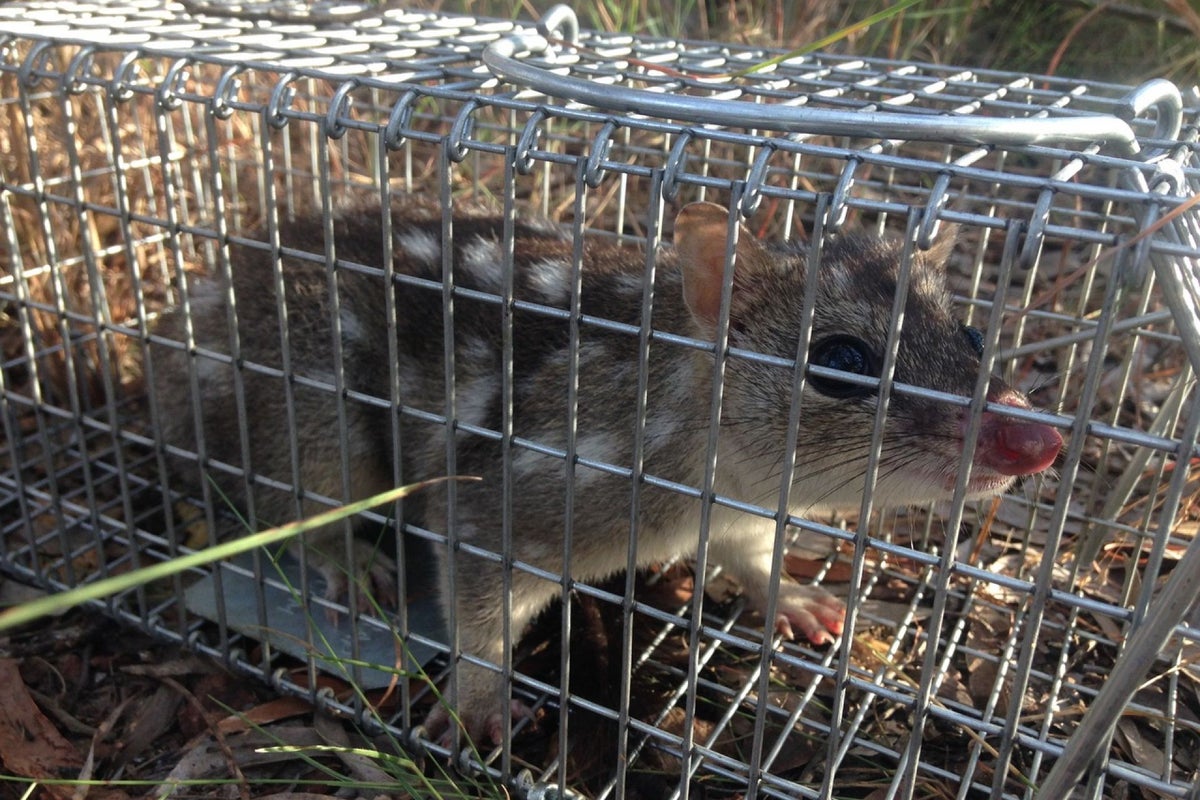
Once-common marsupial inching close to extinction across Australia, scientists warn

Read the original at The Independent ↗
Cite

Sankaran, V. (2026, October 1). Once-common marsupial inching close to extinction across Australia, scientists warn. The Independent. https://www.independent.co.uk/news/science/endangered-marsupial-extinction-northern-quoll-b3059605.html

Dated when The Aporia collected the article, usually within hours of publication. Check the original for its exact date and byline.

The Independent · collected 2026-10-01 · by Vishwam Sankaran

Quick Summary

Scientists warn that the Northern quoll, once abundant across Australia, is now close to extinction after failing to detect even one in 12 months of camera-trap surveys at Litchfield National Park. PhD candidate Ryan Sauermann from the University of Melbourne led a study using 30 automated camera traps which captured images of various animals but no quolls. The decline is attributed to factors like rat and mouse baits, invasive cane toads (with populations over 1.5 billion), feral predators, agricultural expansion, and altered fire regimes, causing a near 95% drop in quoll numbers following cane toad invasions in some areas.
Written by AI on 2026-10-01, from this article's own text only (the story summary below draws on all the coverage).

AI analysis

Story summary

The Northern quoll, a small nocturnal marsupial once abundant across Australia, is now on the brink of extinction. Researchers from the University of Melbourne conducted a 12-month camera-trap survey at the Litchfield National Park but failed to spot even one Northern quoll. PhD candidate Ryan Sauermann warns that the species could be locally extinct in this area. The quoll, which is agile and an important predator in local ecosystems by consuming insects and small animals like lizards, frogs, and rodents, faces threats from feral cats and cane toads. Scientists are developing methods to train quolls to avoid cane toads, a major cause of their decline, alongside advocating for better fire management and control of invasive species to help restore the quoll population.

Written for “Marsupial Extinction Risk” on 2026-11-01, grounded in this article and the 0 other(s) covering the same event.

Story

📰 Marsupial Extinction Risk
Environment · 1 article(s) covering the same event.

Compared with similar articles

Nothing to compare against. No article is close enough to this one for the pipeline to have linked or judged the pair.
How this article was measured signals, leaning charts, publisher record, byline, topics and claims

Signals How these are calculated →

Claims extracted
20
sentences that state something as happening or true
Uncertain
20%
4 of 20 hedged ("reportedly", "may", "according to")
Leaning
not political
takes no side on a contested political question
Publisher signals
59/100
The Independent's corrections and hedging, across everything collected from it. Not a measure of accuracy.
Outlets on this story
1
Environment
Same framing elsewhere
1
articles that frame the event the way this one does
Analyzed 2026-10-01 · how these are computed

How this is being covered How these are calculated →

Article leaning vs. publisher reliability
Source leaning vs. consistency

Publisher

The Independent · 3480 article(s) · 8 correction(s) detected
Running correction rate · 8 correction(s)

Who wrote this

Vishwam Sankaran
11 article(s) here · 1 carrying a prediction
🔮 Saturday’s suspected murder-robbery could complicate the Japanese prime minister’s efforts to move some US marines from the busy Futenma air base in Okinawa to a more remote facility at Henoko.
🔮 The Indian pilot said the cockpit could be opened only using a code from the outside, but could be more easily opened from the inside.
🔮 Ukraine will double down on attacking Russian oil refineries in response to a new policy of airstrikes by Moscow designed to force people to abandon Kyiv and other cities, but will not target civilians, he said.
🔮 In pictures: US carrier George HW Bush visits Thailand after six-month Middle East deployment Iran says Strait of Hormuz will not reopen until conditions are met, Nournews reports The Strait of Hormuz will not reopen until conditions set out in a June interim agreement with the US are met, Nournews reported Iran's parliament speaker Mohammad Bager Ghalibaf as saying on Sunday, a few days after Tehran received Washington's reply to its diplomatic proposal.
🔮 The project will see URIF develop a "joint investment platform" with the BGV Group, founded by Ukrainian billionaire Hennadii Butkevych.
🔮 President Trump warned the US would retaliate if the link is established to Iran, telling reporters: “Oh, they’ll be hit, very hard, don’t worry.”
🔮 Researchers could not catch even a single glimpse of the nationally endangered quoll in 12 months of camera-trap surveys at the Litchfield National Park.
🔮 The US embassy in Canberra has raised “serious concerns” over Australia’s proposed laws that would give its social media users the choice to opt out of Big Tech algorithms, calling it “censorship of protected speech”.
🔮 They caught fewer ticks during midday in the UK in May, associated with higher temperatures. “The results of the present study suggest that during warm weather there is greater risk of tick exposure at night and around dawn,” the researchers concluded.
Also by Vishwam Sankaran
Nothing else under this byline is closely related to this article, so these are simply their most recent.
All 11 articles by Vishwam Sankaran →

Topics

Australia Australian Independent Queensland the University of Melbourne

Subjects

Australia GPE · 5× Queensland GPE · 2× Sauermann PERSON · 2× ABC News ORG · 1× Australian NORP · 1× Hawaii GPE · 1× Independent NORP · 1× Indigenous NORP · 1× Ryan Sauermann PERSON · 1× the University of Melbourne ORG · 1×

Narrative

They call for focused fire and feral animal management in quoll areas to provide the best opportunity to maintain and restore their populations. Scientists also developed a method to train quolls to become averse to cane toads.
framing: assertive · carried by 1 article(s) · first seen 2026-10-01
🔮 Researchers could not catch even a single glimpse of the nationally endangered quoll in 12 months of camera-trap surveys at the Litchfield National Park.

Claims (20 extracted, 4 hedged)

The small, nocturnal Northern quoll, which was abundant across Australia just decades ago, is now close to extinction across the continent, scientists warn following a local survey. asserted
scientists → warn → survey
Researchers could not catch even a single glimpse of the nationally endangered quoll in 12 months of camera-trap surveys at the Litchfield National Park. uncertain
Researchers → catch → Park
The cat-sized marsupial could be locally extinct, according to PhD candidate Ryan Sauermann from the University of Melbourne. uncertain
marsupial → accord → Melbourne
It plays a key role in balancing local ecosystems as an agile predator that consumes large quantities of insects and small animals like lizards, frogs, and rodents. asserted
that → play → lizards
Mr Sauermann conducted a study to estimate quoll numbers in the northern Australian region by analysing data from 30 automated camera traps. asserted
Sauermann → conduct → traps
While the camera traps captured footage of feral cats, cane toads, wild pigs, buffaloes, rodents, birds, and even an echidna, not even one northern quoll could be spotted. uncertain
quoll → capture → cats
"Just because we're not finding anything right now doesn't mean that they're not here, doesn't mean we should stop looking," the PhD candidate told ABC News. asserted
candidate → find → News
Previous studies have warned that quolls across Australia are threatened by rat and mouse baits commonly used around homes and workplaces, as well as feral predators and the expansion of agricultural areas. asserted
quolls → warn → areas
Invasive cane toads and altered forest fire regimes are also suspected to be playing a role in the disappearance of Australia’s quolls. asserted
toads → alter → quolls
The toxic toads were introduced first in Queensland from Hawaii in 1935 to control the native sugarcane beetle, but over the years, they have multiplied into a population of over 1.5 billion. asserted
they → introduce → billion
When quolls eat the cane toads, they ingest lethal neurotoxins that kill them. asserted
that → eat → them
Quoll numbers in many areas have been observed to decline by nearly 95 per cent immediately after a cane toad invasion. asserted
numbers → observe → invasion
But even when marsupial declines were reported in other parts of Australia, the North’s uncleared savannas were once considered a haven for many species. asserted
savannas → report → species
Earlier this year, scientists working with Indigenous leaders estimated that the drastic decline of the once-abundant quolls in northern Australia occurred within just two to three generations. asserted
decline → work → generations
It now occupies only about half of its historical range, broken up into smaller, isolated clusters in Western Australia, the Northern Territory, and Queensland. asserted
It → occupy → Australia
Researchers warn that the quolls could vanish completely within decades if current trends continue. uncertain
trends → warn → decades
They call for focused fire and feral animal management in quoll areas to provide the best opportunity to maintain and restore their populations. Scientists also developed a method to train quolls to become averse to cane toads. asserted
quolls → call → toads
In this technique, conservationists make what’s called a “toad sausage” by mincing up the back legs of the toads that have low toxin levels, and mixing it with a non-lethal, nausea-inducing chemical called thiabendazole. asserted
that → make → chemical
Quolls that eat the sausage fall sick, and once they recover, show an aversion to the toads. asserted
they → eat → toads
"They're the ones managing, not just insect populations, but also other rodent populations," Mr Sauermann said. asserted
Sauermann → manage → populations

💬Give feedback
🕘History 🎫Support