I’ll cover this again under “Silver Bulletin news and notes.”
asserted
I → cover → news
But I wanted to alert subscribers that we published a Model Talk on Tuesday night that evidently landed in a lot of people’s spam folders (including mine).
asserted
that → want → mine
We think it’s an important story, providing historical context on midterm elections that helps to explain FLIPR’s increasingly optimistic forecast for Democrats.
asserted
that → think → Democrats
So I’m going to play one of my “in case you missed it” cards and recommend you check it out.
asserted
you → go → it
We don’t want Still Counting to be solely about the polls and the horse race.
asserted
Counting → want → polls
And we’ll hopefully have a chance to exhibit the show’s breadth … after the midterms.
asserted
we → have → midterms
But for now, we’re in crunch time, with the election less than five weeks away.
asserted
we → ’re → time
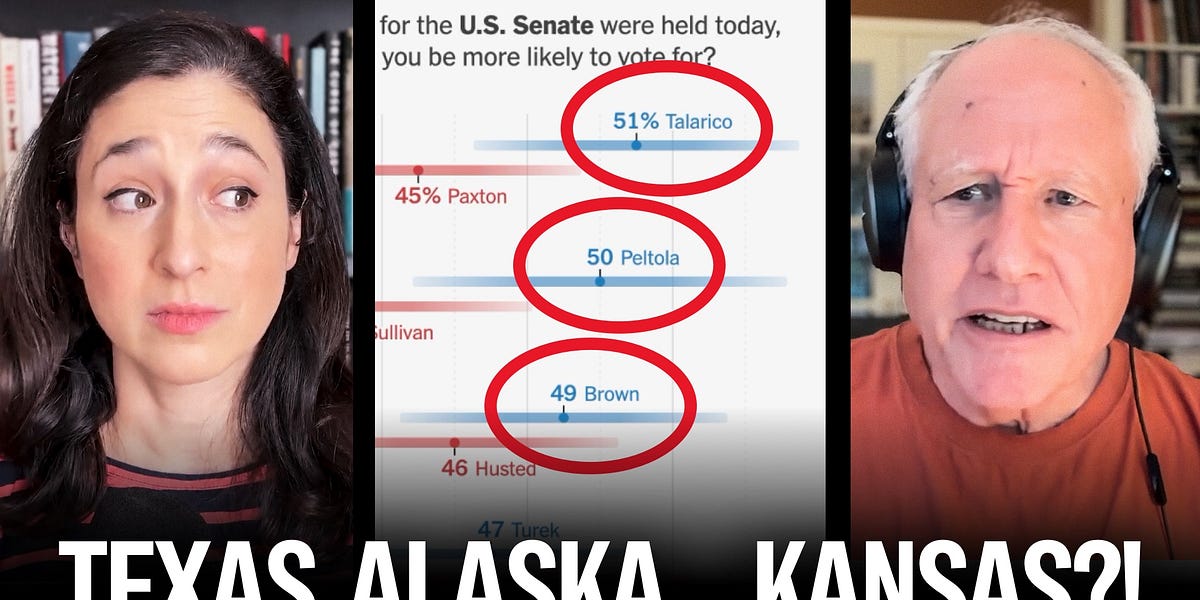
This week, Clare, Galen and I focused on two key Senate races: Maine and Ohio.
asserted
Clare → focus → races
We also talked about the minor scandal1 surrounding Mary Peltola’s treatment of her staffers in Alaska.
asserted
We → talk → Alaska
I don’t think any of us expect this to be a major electoral problem for Peltola, but we differed on how newsworthy the story is.
asserted
story → think → Peltola
The context: A blue wave might revive Ohio’s status as a competitive state
Pop quiz.
uncertain
wave → revive → state
Which Senate seat are Democrats more likely to flip: Ohio or Maine?
asserted
Democrats → flip → ?
This might seem like an easy question.
uncertain
This → seem → question
In 2024, Kamala Harris won the Pine Tree State by 7 points, but lost the Buckeye State by 11.
asserted
Harris → win → 11
If you buy FLIPR’s forecast, though, Ohio is actually the slightly easier pickup for Democrats.
asserted
Ohio → buy → Democrats
It’s a close call, so don’t necessarily expect this to hold through Election Day.
asserted
this → ’ → Day
FLIPR’s interpretation of the “fundamentals” (especially the presidential voting data I described above) tightens the difference in the advanced versions of our forecast, but not enough to close the gap entirely.
asserted
I → describe → gap
In 2018, the previous Trump midterm, Brown won reelection by a healthy 6.8-point margin in a political environment we expect to be similar to what the parties will face this November.
asserted
parties → win → what
Brown lost by 3.6 points in 2024, a considerably worse year for Democrats, but he greatly outperformed Harris, who lost by 11.2.
asserted
who → lose → 11.2
The math here seems fairly simple: the projected swing toward Democrats is considerably greater than Brown’s margin of defeat in 2024.
asserted
swing → seem → 2024
Indeed, a fair percentage of Ohio voters evidently still think that Brown is an incumbent senator.
asserted
Brown → think → voters
It’s obviously not a sure thing, but this is not one of those forecasts that gives me the keeps-me-up-at-night, existential dread that I might have, say, in Texas.
uncertain
I → ’ → Texas
In Maine, we’re navigating with much less of a reliable roadmap.
asserted
we → navigate → roadmap
Not only has Susan Collins massively outperformed the state’s partisan lean in presidential races — Maine hasn’t voted Republican for president since 1988 — she’s also massively outperformed polling averages, particularly in 2020.
asserted
she → outperform → 2020
And Jackson's late replacement of Graham Platner was unusual, though almost certainly an improvement for Democrats given the magnitude of the accusations against Platner.
asserted
replacement → give → Platner
I owe you a Model Talk on what happens if Democrats lose one of the Senate races in a blue state — either Maine, where they’re on offense, or Michigan (or less likely, Minnesota or New Hampshire2) where they’re defending currently D-held seats.
asserted
they → owe → seats
Would this imply that Republicans are almost certain to hold the Senate, or would Democrats still have some backdoor paths?
asserted
Democrats → imply → paths
We’ll save that for another time, because today I want to focus on Ohio.
asserted
I → save → Ohio
In 2004, an election with interesting parallels to 2024, Ohio was the tipping-point state.
asserted
Ohio → tip → 2024
John Kerry lost it by 2.1 points, actually slightly narrower than his 2.5-point margin of defeat to George W. Bush nationally.
asserted
Kerry → lose → Bush
Had Kerry prevailed in Ohio, he would have won the Electoral College.
asserted
he → prevail → College
But Ohio is nowhere near the tipping point now.
asserted
Ohio → tip → point
Barack Obama won it in 2008 and 2012, albeit by slightly less than his national margins of victory.
asserted
Obama → win → victory
Here’s that data, with a comparison between Ohio and its Big Ten neighbors, Pennsylvania and Michigan.
asserted
data → ’ → Ohio
It’s slightly interesting that Ohio, Michigan and Pennsylvania all moved closer to the national margin in 2024.
asserted
Ohio → ’ → 2024
Nov. 5, 2024 was obviously not a great night for Harris, but one silver lining for Democrats is that the Electoral College vs. popular vote gap declined as compared to 2016 and 2020.
asserted
gap → decline → 2016
Still, all three Big Ten states have become much redder in the Trump Era — but Ohio more so than the others.
asserted
Ohio → become → others
After 2016, there was a much-derided journalistic cliché about reporters visiting Trump voters in Youngstown, Ohio diners.
asserted
reporters → be → diners
But the thing was … that was actually kind of a data-driven project.
asserted
that → drive → ?
Youngstown’s Mahoning County voted for Obama by 28 points in 2012.
asserted
County → vote → 2012
…and 36 more, not listed.
 The Aporia