In the grand quest to understand why the universe is expanding faster and faster, most scientists point to an invisible force called dark energy.
asserted
scientists → understand → force
A 14-year-old student from Kingston, Ontario, has taken a different path.
asserted
student → take → path
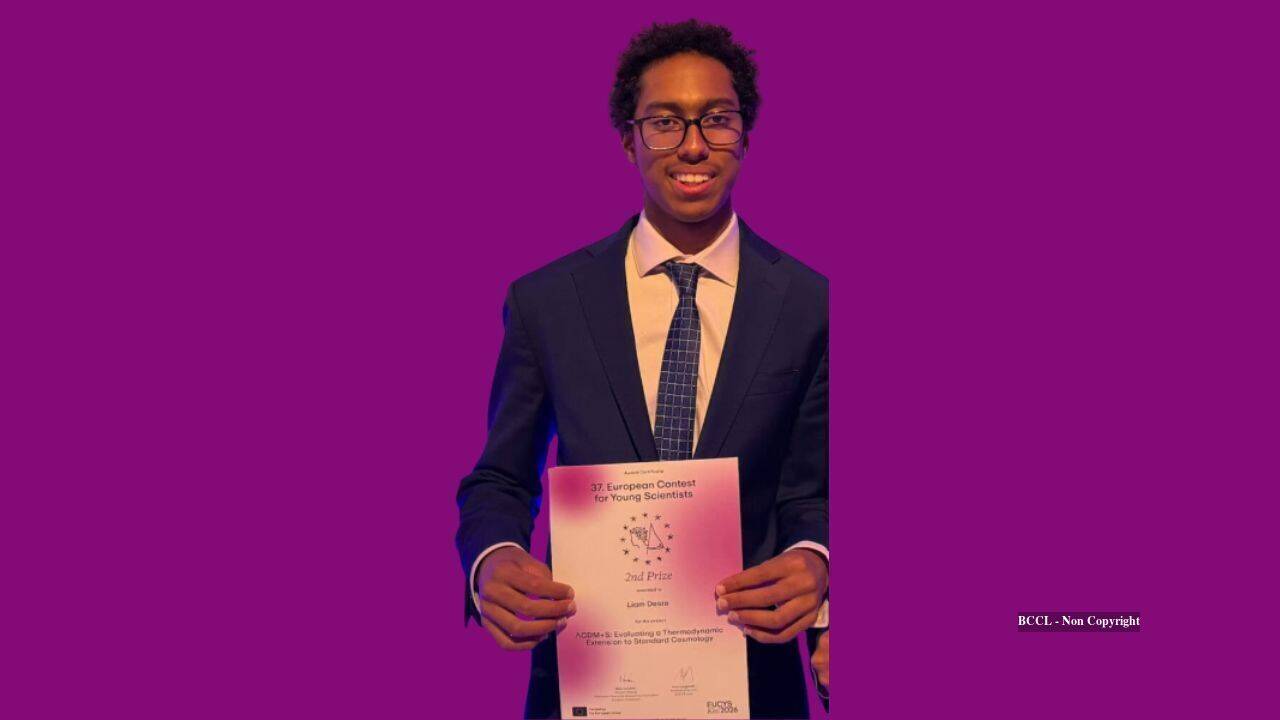
Liam Desre, a Grade 10 teenager, proposed a thermodynamic extension to the standard model of cosmology that could explain cosmic acceleration without invoking dark energy.
uncertain
that → propose → energy
His project, ΛCDM+S: Evaluating a Thermodynamic Extension to Standard Cosmology, won a second prize of €5,000 at the European Union Contest for Young Scientists (EUCYS) 2026 in Kiel, Germany, where 144 young scientists from 37 countries presented their work, according to Youth Science Canada News.
uncertain
scientists → evaluate → News
While his classmates are busy with tests and extracurriculars, he’s been diving deep into one of the biggest puzzles in modern physics.
asserted
he → dive → physics
His project challenges the prevailing ΛCDM model that relies on dark energy to explain the accelerating expansion of the universe.
asserted
that → challenge → universe
Instead, Liam explored whether entropy-related thermodynamic effects could produce the same observational signatures.
uncertain
effects → explore → signatures
The standard cosmological model treats dark energy as a mysterious component making up about 68 percent of the universe’s energy budget.
asserted
model → treat → budget
Yet despite decades of study, its physical nature remains unknown.
asserted
nature → remain → study
Liam’s work asked a simple but profound question: could the acceleration we observe be a consequence of how energy and entropy behave on cosmic scales, rather than evidence of a new, invisible substance?
uncertain
energy → ask → substance
How the thermodynamic extension works
Liam’s approach builds on the ΛCDM framework but adds a thermodynamic layer he labels “S” for entropy.
asserted
he → work → entropy
In his model, he used simulations to test whether entropy-driven effects could mimic the expansion history attributed to dark energy.
uncertain
effects → use → energy
The results suggested that such a thermodynamic extension can reproduce key features of cosmic acceleration without requiring dark energy as a separate entity.
uncertain
extension → suggest → entity
This does not mean dark energy is disproven.
asserted
energy → mean → ?
Liam’s project is a way to test things out that others can interrogate, refine, or contest.
asserted
others → test → that
His thermodynamic approach to cosmic acceleration opens a new avenue of research to complement or contradict existing hypotheses.
asserted
approach → open → hypotheses
His work demonstrates how fresh perspectives, even from young scientists, can contribute to high-level debates in cosmology.
asserted
perspectives → demonstrate → cosmology
From Canada-Wide Science Fair to the European stage
Liam’s journey to Kiel began at the 2026 Canada-Wide Science Fair in Edmonton, where he received the Best Project – Discovery award.
asserted
he → begin → award
That achievement secured his place on Team Canada, alongside Gurnoor Kaur of Waterloo, Ontario, whose project on reducing bias in pulse oximetry won a first prize at EUCYS.
asserted
project → secure → EUCYS
Together, they continued Canada’s remarkable streak of winning two core prizes at the contest for five consecutive years, as per the report.
asserted
they → continue → report
Participants must first win top honours at national science fairs to qualify.
asserted
Participants → win → fairs
In Kiel, they presented their self-developed research to an expert jury, defended their methods in interviews, and engaged with peers from around the world.
asserted
they → present → world
Liam’s second prize placed him among an elite group of young researchers recognised for originality, rigour, and scientific promise.
asserted
prize → place → originality
Why this matters for science and society
Liam’s achievement is more than a personal triumph.
asserted
achievement → matter → triumph
It suggests the importance of encouraging young people to grapple with complex, open-ended questions.
uncertain
It → suggest → questions
Cosmology is usually thought of as the territory of grizzled physicists with supercomputers and telescopes at their disposal.
asserted
Cosmology → think → disposal
But Liam’s project demonstrates that teenagers can have meaningful ideas to add to conversations on the world stage if they’re curious and have access to scientific tools and mentorship.
asserted
they → demonstrate → tools
His work also demonstrates the importance of alternative hypotheses in science.
asserted
work → demonstrate → science
His thermodynamic model may not ultimately replace dark energy, but it does offer a model that can be tested against observations.
uncertain
that → replace → observations
This kind of work refines theories, reveals implicit assumptions and can sometimes even produce surprising breakthroughs.
asserted
kind → refine → breakthroughs
Liam’s story is a reminder to students and teachers that age is no barrier to entering the frontiers of knowledge.
asserted
age → enter → knowledge
A Canadian tradition of excellence in youth science
Canada’s consistent success at EUCYS reflects a strong national ecosystem for youth STEM.
asserted
success → reflect → STEM
Regional science fairs feed into the Canada-Wide Science Fair, which selects Team Canada for international competitions.
asserted
which → feed → competitions
Teachers, volunteers, and organisations like Youth Science Canada support students through every stage, from idea development to presentation skills.
asserted
Teachers → support → skills
This network has helped Canadian students win core prizes in fields as diverse as cancer research, robotics, medical sensing, and now cosmology.
asserted
students → help → research
Liam Desre’s thermodynamic alternative to dark energy adds a striking chapter to this legacy.
asserted
alternative → add → legacy
At 14, he has shown that bold questions and careful modelling can earn global recognition.
asserted
questions → show → recognition
As his work goes on, it could inspire other young scientists to look beyond the old explanations and go into new paths in understanding our universe.
uncertain
it → go → universe
 The Aporia