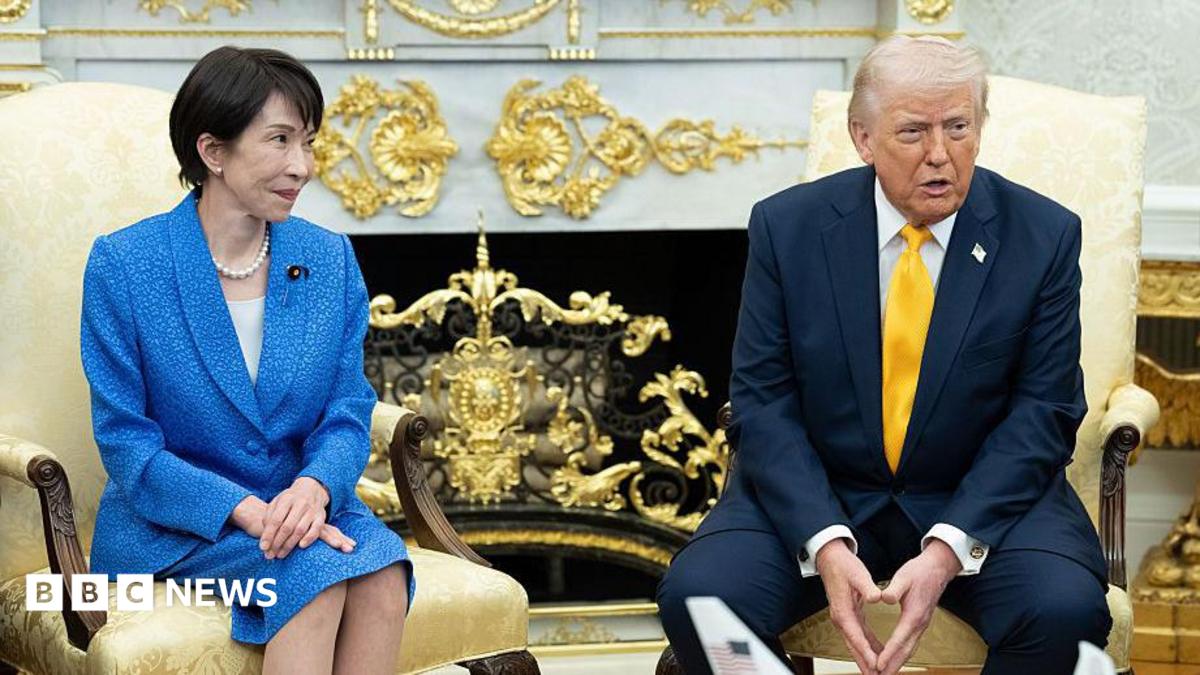
Photo via Al Jazeera

Why the Trump administration is helping support Japan’s weakening yen

Read the original at Al Jazeera ↗
Cite

Power, J., & Hale, E. (2026, August 5). Why the Trump administration is helping support Japan’s weakening yen. Al Jazeera. https://www.aljazeera.com/economy/2026/8/5/why-the-trump-administration-is-helping-support-japans-weakening-yen?traffic_source=rss

Dated when The Aporia collected the article, usually within hours of publication. Check the original for its exact date and byline.

Al Jazeera · collected 2026-08-05 · by John Power, Erin Hale

Quick Summary

The Trump administration has coordinated with Japan to intervene in the currency market and prop up the yen, which has fallen to a 40-year low against the US dollar. The intervention began on July 31, when the US Treasury sold euros for yen, while Japanese authorities bought yen, resulting in the yen rising from 163 to 157 against the dollar. Japan's economic stagnation since the early 1990s and negative interest rates have contributed to the yen's weakness, with Tokyo spending tens of billions of dollars to defend it since 2022. The US's motivation for helping to support the yen is likely driven by its own interests, as a weaker Japanese currency can benefit US exporters.
Written by AI on 2026-08-21, from this article's own text only (the story summary below draws on all the coverage).

AI analysis

Story summary

The US and Japan have jointly intervened in the foreign exchange market for the first time since 2011, taking steps to prop up the yen, which had fallen to a 40-year low. The intervention is unusual, but necessary because the yen's depreciation has global implications, making it the third-most-traded currency worldwide. According to estimates, Japan may have sold almost $59 billion in US dollars to buy yen during its initial intervention, with the US also participating. While the size of the US intervention remains unclear, a note from Treasury Secretary Scott Bessent's cabinet meeting suggests that they may have purchased between $5-10 billion in yen. The coordinated effort aims to prevent a sell-off in Japanese government bonds and to mitigate potential impacts on global borrowing costs.

Written for “US Japan Currency Support” on 2026-10-30, grounded in this article and the 1 other(s) covering the same event.

Story

📰 US Japan Currency Support
Economy/Business · 2 article(s) covering the same event. See how they differ ↓

Compared with similar articles

This article reads leans right and hedges 9% of its claims. Each row says how that neighbour differs.
BBC News
⚖️ Leans right Hedges 2 of 34 claims Outlet record 69/100
How this article was measured signals, leaning charts, publisher record, byline, topics and claims

Signals How these are calculated →

Claims extracted
33
sentences that state something as happening or true
Uncertain
9%
3 of 33 hedged ("reportedly", "may", "according to")
Leaning
Leans right
of the writing, not the subject · beta estimate
Publisher signals
60/100
Al Jazeera's corrections and hedging, across everything collected from it. Not a measure of accuracy.
Outlets on this story
2
Economy/Business
Same framing elsewhere
1
articles that frame the event the way this one does
Analyzed 2026-08-05 · how these are computed

How this is being covered How these are calculated →

Article leaning vs. publisher reliability
Source leaning vs. consistency

Publisher

Al Jazeera · 4452 article(s) · 2 correction(s) detected
Running correction rate · 2 correction(s)

Who wrote this

John Power
37 article(s) here · 1 carrying a prediction
🔮 Brent futures for delivery in October 2027 stood at more than $90 a barrel on Friday, in a sign that markets see normality as a long way off, still. “When could prices return to $70?
🔮 “Our security teams are reviewing all relevant information with urgency, and we will provide updates through official Binance channels as soon as we have verified information,” Binance said in a statement to Al Jazeera.
🔮 Recommended Stories list of 4 items- list 1 of 4Israelis rally for Jewish-Arab government after election gains - list 2 of 4Riot police deployed in Madrid as protests erupt over deadly train crash - list 3 of 4Bolsonaro in Miami: I am the ‘true president-elect’ - list 4 of 4Serbians storm TV studio as pro-Vucic media faces reckoning The charges come after a federal judge in August ruled that Utah could enforce its stringent anti-gambling laws against prediction markets such as Kalshi and Polymarket.
🔮 The Bank of Israel last week raised its GDP growth forecast for all of 2026 to 5.6 percent, up from 4 percent, citing ramped-up production by Israeli firms overseas.
🔮 They typically fall when investors are worried that the AI story might be running out of steam, and they rise when animal spirits are running high around the technological revolution,” Coatsworth said.
🔮 Gross domestic product (GDP) expanded 1 percent on a quarterly basis, or 3.4 percent year-on-year, advance estimates released by the Bank of Korea showed on Tuesday. Recommended Stories list of 4 items- list 1 of 4Bolsonaro’s party accepts Brazil election after Trump calls vote ‘rigged’ - list 2 of 4Trump suggests renaming the Atlantic Ocean the ‘American Ocean’ - list 3 of 4Russia halts strikes on Ukraine’s Kherson as Oleshky ceasefire takes effect - list 4 of 4Moroccan police intercept migrant swimming back towards Ceuta The Bank of Korea forecast in August that GDP would grow 0.3 percent in the third quarter.
🔮 Meta dropped nearly 7 percent after it raised its projected capital spending for this year to $135bn to $145bn in its latest earnings report, even as the Facebook parent company’s net profit fell short of expectations.
🔮 “It is possible that this behavior is simply an example of ‘benign’ overpersistence, with models not understanding why monitoring is important or insisting that instructions be executed beyond what a reasonable person might expect,” the San Francisco-based firm said.
2026-10-21 · assertive framing · OpenAI says its agents turned off own safeguards
🔮 Elon Musk has revealed that SpaceX and Tesla are exploring a possible merger, a tie-up that would create a corporate colossus worth more than $3 trillion.
🔮 France’s borrowing costs now stand at their highest levels since 2002, swallowing up a growing share of tax revenues that could otherwise be directed towards essential services such as education and healthcare.
Also by John Power
Nothing else under this byline is closely related to this article, so these are simply their most recent.
All 37 articles by John Power →
Erin Hale
1 article(s) here · 1 carrying a prediction
🔮 It’s trying to prevent a disorderly decline that could spill over into Treasury markets, global funding conditions, and broader financial stability,” Loo told Al Jazeera.
The only article under this byline in the corpus.

Topics

Israel Japan Japanese Tokyo Washington

Subjects

Japan GPE · 11× Washington GPE · 5× Japanese NORP · 4× Tokyo GPE · 4× Al Jazeera ORG · 2× Israel GPE · 2× 4Colombia GPE · 1× Petro ORG · 1× Spokane GPE · 1× The United States GPE · 1×

Narrative

That would put upward pressure on interest rates in the US, raising the cost of servicing the country’s rapidly growing national debt, which already exceeds $39 trillion. “The financial cost of intervention for the US is low and, given that President Donald Trump favours a weaker US dollar, the domestic political cost is minimal,” Shigeto Nagai, head of Japan economics at Oxford Economics, wrote in a research briefing on Monday. “Coordinated intervention is a cost-effective method as it allows the US to do a significant favour for Japan, a precious loyal ally in Asia, and take some pressure off US interest rates.
framing: assertive · carried by 1 article(s) · first seen 2026-08-05
🔮 It’s trying to prevent a disorderly decline that could spill over into Treasury markets, global funding conditions, and broader financial stability,” Loo told Al Jazeera.
2026-08-05 · Al Jazeera
Why the Trump administration is helping support Japan’s weakening yen · assertive framing

Claims (33 extracted, 3 hedged)

The United States and Japan last week staged a coordinated intervention to halt the slide of the yen after the Japanese currency fell to a 40-year low against the US dollar. asserted
currency → stag → dollar
While it is unusual for authorities to intervene to help prop up another country’s currency, the yen has an important role in international finance as the world’s third-most-traded currency, meaning its depreciation has repercussions far beyond Japan. asserted
depreciation → intervene → Japan
Recommended Stories list of 4 items- list 1 of 4Colombia’s Petro repeats asserted
Petro → repeat → items-
- list 2 of 4Bodycam video shows firefighters battling blaze in Spokane, US - list 3 of 4Why are the Washington wildfires so severe? - list 4 of 4Palestine weekly: Israel kills dozens in Gaza after Hamas disarmament deal Here is everything you need to know about the currency intervention: What is a currency intervention and how did the US and Japan coordinate? A currency intervention occurs when a government or central bank buys or sells large quantities of foreign currency to help stabilise the value of its own currency. asserted
government → show → currency
In this case, the US and Japan coordinated an intervention to lift the value of the yen after it slid to 163 against the dollar for the first time since 1986. asserted
it → coordinate → 1986
The intervention began on July 31 when the US Treasury began selling euros for yen, while Japanese authorities also bought yen. asserted
authorities → begin → yen
In the days after the intervention, the yen began to rise and reached 157 to the dollar on Wednesday. asserted
yen → begin → Wednesday
The US last staged a currency intervention with Japan in 2011 when the yen began appreciating rapidly following the Tohoku earthquake and tsunami. asserted
yen → stag → earthquake
It also stepped in to support the Japanese currency during the Asian Financial Crisis in 1998. asserted
It → step → 1998
How did the yen get so weak? asserted
yen → get → ?
The yen’s collapse is the result of longstanding economic challenges combined with new pressures from the US-Israel war on Iran. asserted
collapse → combine → Iran
Japan has struggled with economic stagnation since the early 1990s. asserted
Japan → struggle → 1990s
The Bank of Japan has for decades attempted to stimulate growth with ultra-low and even negative interest rates, a policy that has exerted downward pressure on the yen. asserted
that → attempt → yen
While Japan’s weak currency has helped draw record numbers of tourists and kept exports cheap, it has also placed a strain on households by raising the cost of imported goods. asserted
it → help → goods
Tokyo has spent tens of billions of dollars since 2022 trying to defend the yen, but the economic policies of successive Japanese leaders, including current Prime Minister Sanae Takaichi, have partly offset these efforts. asserted
policies → spend → efforts
“Takaichi wants it all: Growth, loose fiscal policy, loose monetary policy and a stable yen – but their policy mix is leading to a weak yen, which is causing an inflation problem,” Chris Turner, global head of markets at ING, told Al Jazeera. asserted
Turner → want → Jazeera
Why does the US want a stronger yen? asserted
US → want → yen
While Japan is a close US ally, Washington stepped in for its own benefit as much as Tokyo’s, said Masahiko Loo, a senior fixed income strategist at State Street Investment Management in Tokyo. asserted
Loo → step → Tokyo
“Washington isn’t trying to strengthen the yen for Japan’s sake. asserted
Washington → try → sake
It’s trying to prevent a disorderly decline that could spill over into Treasury markets, global funding conditions, and broader financial stability,” Loo told Al Jazeera. uncertain
Loo → try → Jazeera
“A free-falling yen isn’t just Japan’s problem. asserted
yen → fall → ?
At some point it becomes a global liquidity and financial stability issue, which is why Washington stepped in.” asserted
Washington → become → point
The yen is the most traded currency after the US dollar and the euro, which means dramatic changes in its value can have ripple effects across the global financial system. asserted
changes → trade → system
One of Washington’s biggest concerns is the prospect of Japan selling off its holdings of US Treasury securities, which were valued at $1.114 trillion in May. uncertain
which → sell → May
If the yen continued to fall, Tokyo would be encouraged to sell large quantities of US Treasuries to raise cash it can use to defend the currency. asserted
it → continue → currency
That would put upward pressure on interest rates in the US, raising the cost of servicing the country’s rapidly growing national debt, which already exceeds $39 trillion. “The financial cost of intervention for the US is low and, given that President Donald Trump favours a weaker US dollar, the domestic political cost is minimal,” Shigeto Nagai, head of Japan economics at Oxford Economics, wrote in a research briefing on Monday. “Coordinated intervention is a cost-effective method as it allows the US to do a significant favour for Japan, a precious loyal ally in Asia, and take some pressure off US interest rates. asserted
US → put → rates
Will the intervention work? asserted
intervention → work → ?
While the joint intervention has provided short-term support for the yen, Japan will need to take more fundamental measures, such as raising interest rates, to raise the value of the currency in the long term, according to experts. uncertain
Japan → provide → experts
Japan’s benchmark interest rate currently stands at 1.0 percent, its highest since 1995 but far lower than other advanced economies, including the US. asserted
rate → stand → US
Without a change in Japan’s low-interest-rate environment, the latest currency intervention is just “throwing good money after bad,” said Derek Tang, an economist and CEO of Monetary Policy Analytics, a US research advisory firm. asserted
Tang → throw → Analytics
“Ultimately… the gravitational force of economic fundamentals will overwhelm intervention efforts,” Tang told Al Jazeera. asserted
Tang → overwhelm → Jazeera
“Nevertheless, Japan seems very reluctant to tighten monetary policy to raise its own interest rates and allow the currency to appreciate in that manner,” Tang said. asserted
Tang → seem → manner
“So this situation will persist for the time being.” asserted
situation → persist → time

💬Give feedback
🕘History 🎫Support