Each year on October 1, as the final notes of China’s national anthem ring out over Tiananmen Square, thousands of pigeons are set free into the dawn sky.
asserted
thousands → set → sky
In a flurry of beating wings, they sweep past the giant portrait of Chairman Mao presiding over the square before disappearing over Beijing’s rooftops, as applause erupts from the crowds lining the streets to celebrate China’s National Day.
asserted
applause → beat → Day
About 10,000 pigeons took flight at this year’s ceremony on Thursday.
asserted
pigeons → take → Thursday
Many would have arrived back on their owners’ doorsteps within minutes, well before the spectators began slowly dispersing from the square.
asserted
spectators → arrive → square
“By the time you hear on the broadcast that the pigeons have been released, yours have basically already come home,” says Li Zhaoli, 79, a retired boilermaker and veteran pigeon keeper in Beijing’s Xicheng district, not far from the square.
asserted
Zhaoli → hear → square
“They land directly on top of the loft.
asserted
They → land → loft
Once you open the door, you don’t have to do anything – they just go inside by themselves.”
asserted
they → open → themselves
That the humble homing pigeon is a highlight of China’s major ceremonial days is due, in large part, to old Beijingers such as Li.
asserted
is → home → Li
His birds didn’t take part in the National Day release this year, but he has contributed dozens over the past 40 years.
asserted
he → take → years
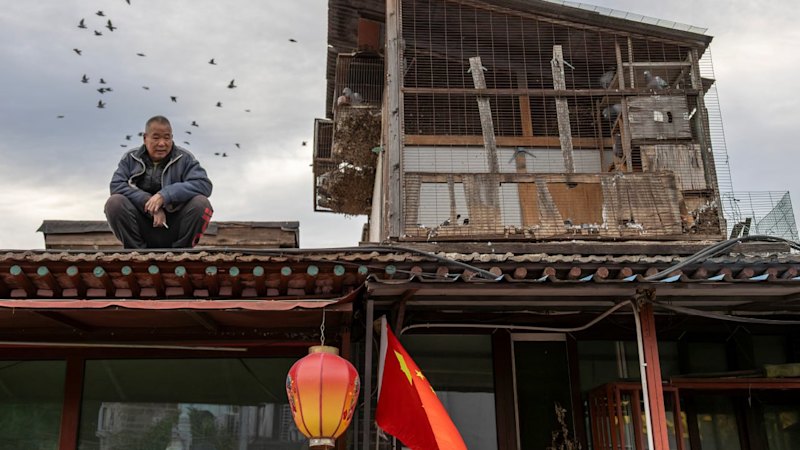
Li is among an ageing cohort of tradition-keepers who raise pigeons on the courtyard rooftops of the city’s hutongs – the ancient alleyways that wind through Beijing’s imperial heart – even as their neighbourhoods have gentrified around them.
asserted
neighbourhoods → age → them
Li keeps his brood in a loft-style cage above his compact 22-square-metre flat, where he’s lived for decades on a street that now hosts boutique coffee shops, a wine bar, a steak restaurant and a premium flower shop.
asserted
that → keep → shops
“I started keeping pigeons when I was eight or nine years old,” he says.
asserted
he → start → pigeons
I’ve loved pigeons my whole life.
asserted
I → love → pigeons
I’m not really interested in selling them.
asserted
I → ’m → them
Back then, food was scarce and people rarely kept more than 10 pigeons at a time.
asserted
people → keep → time
“My family was struggling.
asserted
family → struggle → ?
We ate cornmeal buns.
asserted
We → eat → buns
Sometimes I couldn’t even bring myself to finish mine – I’d hide half of it, and after everyone had finished eating, I’d cut it into little pieces and feed it to the pigeons,” he says.
asserted
he → bring → pigeons
The hobby has noble origins in the Qing dynasty (1644 to 1912), when pigeon-keeping was an aristocratic pastime, before it spread among the working-class living in the hutongs.
asserted
it → have → hutongs
Some old hands such as Li still handcraft pigeon whistles from gourd and bamboo, which are attached to the bird’s tail feathers, creating a distinctive hum that echoes across the skies when they take flight.
asserted
they → handcraft → flight
It helps ward off prey, while owners can identify their flocks by the sound.
asserted
owners → help → sound
In days gone by, the sound was a morning clarion call over the hutongs, raising locals from their slumber.
asserted
sound → go → slumber
These days, the pigeon-keeping scene is regulated by racing associations.
asserted
scene → keep → associations
Ahead of every National Day and other occasional significant events, local authorities will tap the associations in each Beijing district to put the call out among their members to volunteer birds.
asserted
authorities → tap → birds
The animals are vetted before they are approved to fly.
asserted
they → vet → ?
In past years, this has sparked amusing international headlines about thousands of pigeons undergoing anal cavity searches for suspicious objects.
asserted
this → spark → objects
Sometimes owners are given a small stipend for each bird, but the main drawcard is honour and prestige.
asserted
drawcard → give → bird
Participants are rewarded with government-issued commemorative certificates and leg bands for each bird.
asserted
Participants → reward → bird
Li volunteered 20 birds for China’s military parade in September last year, where President Xi Jinping hosted Russia’s Vladimir Putin and North Korea’s Kim Jong-un as guests of honour.
asserted
Jinping → volunteer → honour
“All of them made it home,” Li says.
asserted
All → make → it
“Because this was a political assignment, you had to feel a certain sense of pride about it.”
asserted
you → have → it
The parade was watched across the world, as the latest Chinese weapons systems and nuclear-capable arsenal rolled down Chang’an Avenue and past Tiananmen Square, before 80,000 pigeons were released into the sky.
asserted
pigeons → watch → sky
Zhang Jianquan, a keeper who lives just two kilometres south of Tiananmen, was not so fortunate.
asserted
who → live → Tiananmen
He and his brother dispatched 70 of their best pigeons for the parade.
asserted
He → dispatch → parade
“More than a dozen didn’t come back, although one returned two months later,” he says, adding he has no regrets.
“It brings honour to yourself and to the local community.
asserted
It → come → community
There are quite a few pigeon keepers around here, but not everyone gets the chance to take part in major events like this.
asserted
everyone → be → this
There’s politics involved too, he says.
asserted
he → ’ → ?
If you don’t have the right connections in the pigeon association, chances are you don’t get the opportunity to contribute.
asserted
you → have → opportunity
Almost 60 years old, Zhang is considered a relatively youthful hobbyist among the old-timers.
asserted
Zhang → consider → timers
“The tradition is already close to disappearing,” he says, speaking from the roof of his home as he watches his flock circle the city’s evening skies.
asserted
flock → disappear → skies
…and 16 more, not listed.
 The Aporia