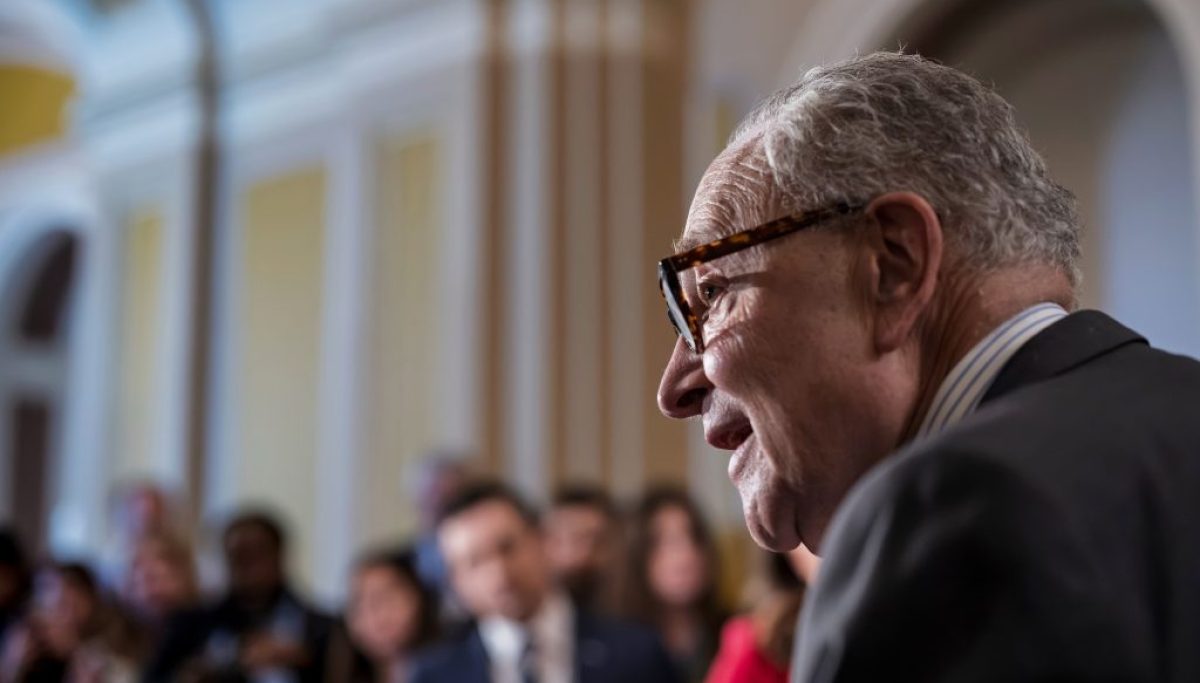
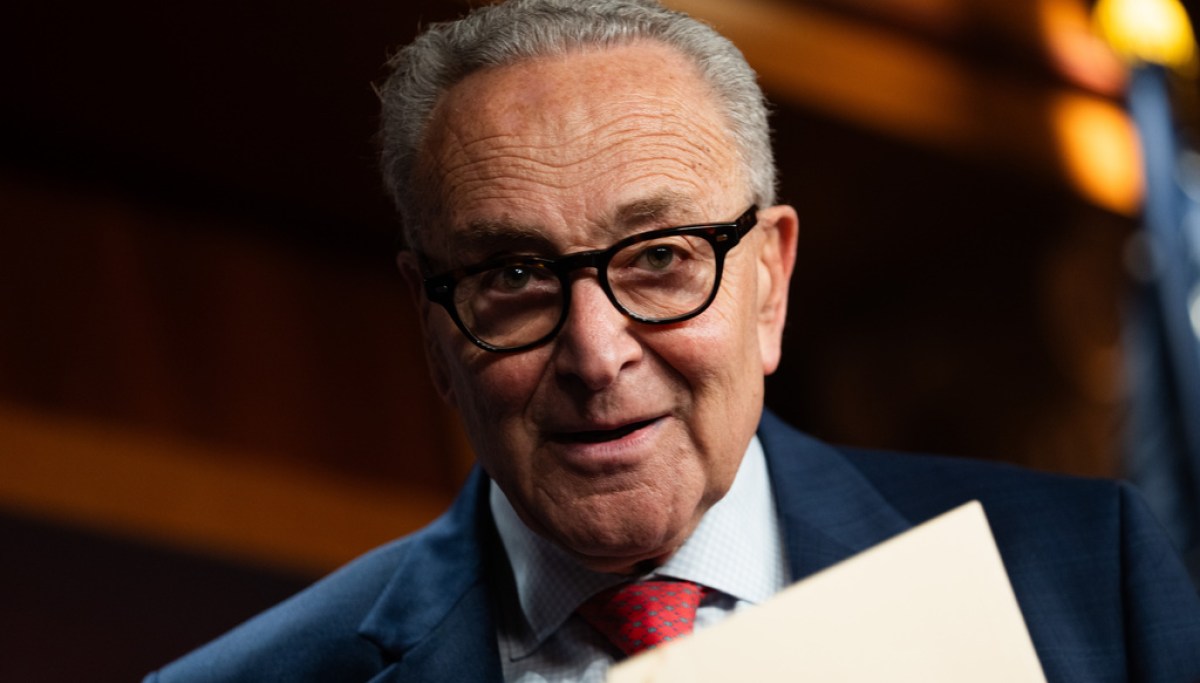
Only one thing could put a damper on a good election night for Sen. Chuck Schumer (D-NY): the arrival of Senate nominees who, if successful in November, have vowed to oppose him as Democratic leader.
uncertain
who → put → leader
Schumer told reporters this week that he will run for another term as the top Senate Democrat, and that he plans on doing so regardless of whether his party recaptures the majority.
asserted
party → tell → majority
No matter what, Schumer, 75, is expected to welcome new faces who believe it’s time for him to step aside and make room for the next generation of leadership.
asserted
him → expect → leadership
That includes Julianna Stratton, the lieutenant governor of Illinois, who is slated to replace retiring Sen. Dick Durbin (D-IL) in a decidedly blue state.
asserted
who → include → state
The open question is how many Schumer-skeptical Democrats join her as freshmen from battleground states and whether that opposition is enough to give rise to a meaningful challenge to his leadership.
asserted
opposition → join → leadership
So far, there is no challenge to speak of, but nominees such as Abdul el Sayed in Michigan want to see a progressive Democrat take Schumer’s place — and he’s named Sen. Chris Van Hollen (D-MD) as his preferred replacement.
asserted
he → be → replacement
On Tuesday, Van Hollen sidestepped whether he was willing to run.
asserted
he → sidestep → Tuesday
“Look, I am 100% focused on winning the midterms,” he said.
asserted
he → look → midterms
That’s all I’m focused on.”
asserted
I → ’ → ?
Other swing state Democrats who want to see Schumer go include Troy Jackson in Maine and Peggy Flanagan in Minnesota.
asserted
Schumer → want → Minnesota
Even more are unwilling to say how they’d vote in internal leadership elections that are typically held in early December.
asserted
that → say → December
The opposition is based, in part, on the perception that Schumer, who has led Senate Democrats since 2017, has failed to adequately confront the Trump administration and that his vote to help Republicans keep the government open last year was evidence of that failure.
asserted
Republicans → base → failure
The uproar over that vote was so intense, in fact, that it revived talk of a competitive primary in 2028, when Schumer is up for reelection in New York, and whether Rep. Alexandria Ocasio-Cortez (D-NY) might challenge him.
uncertain
Cortez → revive → him
She most recently raised eyebrows with a swing through upstate New York, although she also has her eye on the White House.
asserted
she → raise → House
Since last year, Schumer has fashioned himself as a resistance figure, telling reporters on Wednesday that “we have fought Trump with every tool available to the minority.”
asserted
we → fashion → minority
That obstruction includes two subsequent shutdowns he forced over healthcare and then immigration enforcement.
asserted
he → include → healthcare
Still, Schumer is as vulnerable as he’s ever been to a leadership challenge and is running at a time of antiestablishment fervor outside of Washington.
Noncommittal candidates may not want to say if they’d support Schumer out of fear of associating themselves with an unpopular party figure, but other Democrats genuinely see him as too compromising.
uncertain
Democrats → run → him
Schumer entered the Senate a quarter century ago as a centrist and has since evolved to keep up with the changing political environment.
asserted
Schumer → enter → environment
At his core, he is a pragmatist, however, and has made recruitment decisions this cycle that infuriated the Left, including his initial opposition to el Sayed.
asserted
that → make → Sayed
All may be forgiven if Democrats retake the Senate in November.
uncertain
Democrats → forgive → November
They need to pick up at least four seats, an outcome that would shore up Schumer’s standing and allow him to make the case that Democrats should not let leadership divisions sully their midterm success.
asserted
divisions → need → success
“Look, I have focused totally, like the North Star, on taking back the Senate, and I think people recognize that we have had a lot of success, and we’re getting very close,” Schumer said on Wednesday.
He is sure to emphasize the tens of millions he funneled into competitive races through leadership-aligned groups and take credit for recruitment decisions that are more likely than ever to pan out, including former Gov. Roy Cooper’s decision to run for Senate in North Carolina.
asserted
that → look → Carolina
“It’s a positive thing to win an election, and he’s done an awful lot to help us,” Durbin, the No. 2 Democrat in the Senate, said of Schumer.
asserted
Durbin → ’ → Schumer
If Democrats stay in the minority, Schumer may face internal griping regardless of the progressive critics he helps elect, and the conversation will shift to how Democrats squandered a political climate that had decidedly swung in their favor due to the war in Iran and Trump’s low approval ratings.
uncertain
that → stay → Iran
As many as a dozen states are in play, and senior Republicans readily acknowledge that deep red territory has suddenly become competitive.
asserted
territory → acknowledge → play
The uncertainty has effectively frozen any talk of the leadership elections, and Democrats were wary of litigating Schumer’s strength as leader.
asserted
Democrats → freeze → leader
“I don’t want to speculate,” said Sen. Bernie Sanders (I-VT), an independent socialist who caucuses with the Democrats.
asserted
who → want → Democrats
“Let’s worry about what happens in November.”
asserted
what → let → November
Regardless, there will be at least some reshuffling in the leadership ranks with Durbin retiring.
asserted
Durbin → retire → ranks
Sen. Brian Schatz (D-HI) is expected to take his place as Democratic whip.
asserted
Schatz → expect → whip
Sen. Cory Booker (D-NJ) may also ascend to the No. 3 leadership spot currently held by Sen. Amy Klobuchar (D-MN), who is expected to become the next governor of Minnesota.
uncertain
who → ascend → Minnesota
The last example of genuine Democratic infighting came in 2014, when Senate Democrats were wiped out of power and blame fell to Schumer’s predecessor, the late Sen. Harry Reid.
asserted
blame → come → predecessor
Reid faced token opposition from at least half a dozen Democrats in his caucus and then retired from both leadership and the Senate two years later.
asserted
Reid → face → leadership
On the Republican side of the aisle, Senate Majority Leader John Thune (R-SD) has faced muted complaints about his cautious leadership style and persistent needling from Trump, although he’s so far staved off talk of a challenge.
asserted
he → face → challenge
Sen. Rick Scott (R-FL), who ran against Thune and Sen. Mitch McConnell (R-KY) in the last two Congresses, has ruled out a bid for leader.
asserted
who → run → leader
Sen. John Kennedy (R-LA), an open critic of Thune who has hit the road to fundraise for Republicans, also ruled out a run in a brief interview with the Washington Examiner.
asserted
who → hit → Examiner
“I don’t aspire to anything like that,” he said, chalking up his criticism to the fact that he doesn’t “completely fit in” with Senate Republicans.
asserted
he → aspire → Republicans
“It’s one of my best qualities,” Kennedy said.
asserted
Kennedy → ’ → qualities
“I go my own way, and my colleagues know that.
asserted
colleagues → go → that
But I’m not going to bulls***.
asserted
I → go → *
…and 1 more, not listed.
 The Aporia