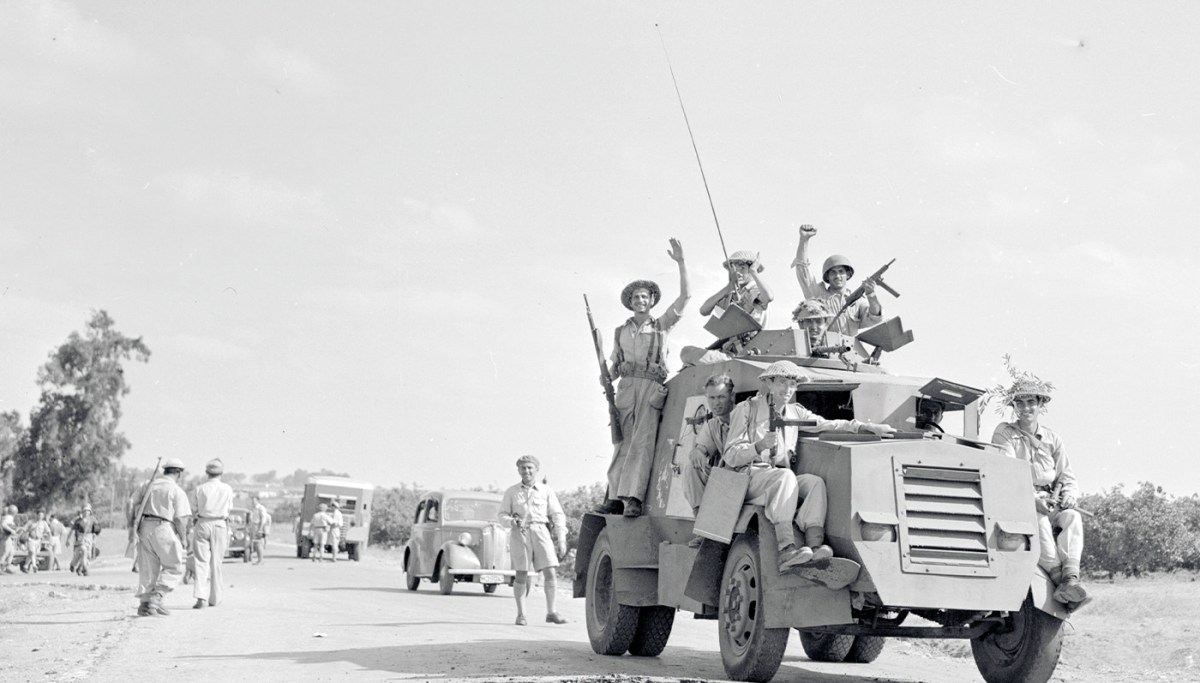
Oct. 7, 2023, forever changed Israel.
asserted
Oct. → change → Israel
The Jewish state is more somber, more defiant, and more determined to persevere in its decadeslong fight to secure its existence.
asserted
state → persevere → existence
But as Israel looks ahead, it confronts a question that has plagued the tiny country since its rebirth nearly eight decades ago.
asserted
that → look → rebirth
It is a country of contradictions, where thousands of tech startups solving the problems of tomorrow exist mere miles from holy sites that inspired visionaries and prophets millennia ago.
asserted
that → solve → visionaries
Israel is unique in another respect: The Jewish state has existed in a state of permanent siege even before it was recreated in 1948.
asserted
it → exist → 1948
From the beginning, Israel’s borders were disputed and perennially redrawn by war.
asserted
borders → dispute → war
In part, this stems from the unusual circumstances of its birth.
asserted
this → stem → birth
World War I shattered empires throughout the world, including the Ottoman Empire, which had ruled, if haphazardly, over much of the Middle East for centuries.
asserted
which → shatter → centuries
In the last year of the war, the British issued the Balfour Declaration, which called for a “national home for the Jewish people” in the Ottoman region often referred to as “Palestine” or “Southern Syria.”
asserted
which → issue → Palestine
The 1920 San Remo Agreement and the 1924 Anglo-American Convention also enshrined Jewish claims into territorial law.
uncertain
Agreement → enshrine → law
“Nothing shall be done,” Foreign Secretary Arthur Balfour pledged, “which may prejudice the civil and religious rights of existing non-Jewish communities in Palestine.”
uncertain
which → do → Palestine
This may have sounded good in theory, but it proved to be impossible in practice.
uncertain
it → sound → practice
But one thing was soon clear: Many Arab leaders living in the British-ruled Mandate Palestine were unwilling to accept Jewish political and social equality in any form.
asserted
leaders → live → form
Jews had a continuous presence in the land, which predated the Arab and Islamic conquests of the seventh and eighth centuries.
asserted
which → have → centuries
But in recent centuries, they had been treated as second-class citizens and subjected to the whims of the Muslim majority.
asserted
they → treat → majority
Their sudden change in political fortunes and power was bound to stir outrage from the majority, and it did.
asserted
it → bind → majority
On April 4, 1920, a violent riot erupted during the Nebi Musa festival in Jerusalem.
asserted
riot → erupt → Jerusalem
Five Jews were murdered, and hundreds more were injured by Arab demonstrators who shouted, “The Jews are our dogs.”
asserted
Jews → murder → demonstrators
Before the riot, anonymous Arabic-language flyers were circulated promising “the government is with us, kill the Jews; there is no punishment for killing Jews.”
asserted
government → circulate → Jews
Some British military officials, opposed to a Jewish national home, encouraged the violence, hoping to demonstrate to politicians in London the unworkability of the Zionist project.
asserted
officials → oppose → project
Two months after Nebi Musa, a revolt unfolded in British-ruled Iraq.
asserted
revolt → unfold → Iraq
France, which administered the mandates for the newly created entities of Lebanon and Syria, also faced upheaval.
asserted
which → administer → upheaval
In 1921, the British, their coffers depleted by World War I, came up with what they were sure was a solution.
asserted
they → deplete → I
They removed 77% of the original territory of the Mandate for Palestine and created a new country called Transjordan, and placed Abdullah bin Hussein on its throne.
asserted
They → remove → throne
This, it was thought, would appease the Arabs of Mandate Palestine and give a crown to Abdullah, who was threatening to invade French-controlled Syria.
asserted
who → think → Syria
Britain’s colonial secretary, a young Winston Churchill, never lacking in ego or wit, remarked: “The Emir Abdullah is in Transjordan where I put him on Sunday afternoon at Jerusalem.”
asserted
I → lack → Jerusalem
Yet again, the Brits had wholesale created a polity in the Middle East and installed its rulers.
asserted
Brits → create → rulers
To this day, legend has it that the 90-mile zig-zag border between Transjordan and Saudi Arabia, nicknamed “Winston’s hiccup,” was the byproduct of a “particularly liquid lunch” on Churchill’s part.
asserted
border → have → part
In fact, it was to give Britain an uninterrupted air corridor between the Mediterranean and Iraq, air power being a feature that the British had learned to value during the previous year’s revolt.
asserted
British → give → revolt
The British hoped that creating another Arab state out of the ashes of the Ottoman Empire would placate Arab anti-Zionism.
asserted
creating → hop → Zionism
But they were soon disappointed.
asserted
they → disappoint → ?
On a 1921 train journey from Egypt to Gaza, Arab crowds gathered and held a reception for Churchill.
asserted
crowds → gather → Churchill
The future prime minister didn’t speak Arabic and mistook their chants as gratitude, only to be told by his adviser, the legendary T.E. Lawrence, or “Lawrence of Arabia,” that they were yelling, “Down with the Jews” and “Cut their throats.”
asserted
they → speak → throats
This was not the last time that Western rulers in the Middle East failed to appreciate the full extent of Arab antisemitism, nor was it the last time that they tried to appease it.
asserted
they → fail → it
Meanwhile, the borders of the “Jewish national home” continued to shrink.
asserted
borders → continue → home
By the end of the 1930s, they had almost disappeared.
asserted
they → disappear → 1930s
Violent antisemitic attacks erupted again in 1929, with no fewer than 133 Jews murdered and hundreds more wounded.
asserted
hundreds → erupt → 1929
The ancient Jewish community of Hebron was forced to leave, and bit by bit, the British distanced themselves from their pledge of 1917.
asserted
British → force → 1917
The 1937 Peel Commission recommended that the mandate be divided once more and another Arab polity be carved from its remnants.
asserted
polity → recommend → remnants
However, Arab leaders under Amin al Husseini, the grand mufti of Jerusalem, refused to make any compromises and recognize any Jewish state, irrespective of its borders.
asserted
leaders → refuse → borders
…and 128 more, not listed.
 The Aporia