Alienation of Affections as Complicity

Read the original at Reason ↗
Cite

Volokh, E. (2026, September 6). Alienation of Affections as Complicity. Reason. https://reason.com/volokh/2026/09/06/alienation-of-affections-as-complicity/

Dated when The Aporia collected the article, usually within hours of publication. Check the original for its exact date and byline.

Reason · collected 2026-09-06 · by Eugene Volokh

Quick Summary

The Volokh Conspiracy discusses the concept of alienation of affections and its relation to complicity liability. The author argues that a spouse's lover can be held liable in cases where they knowingly encourage or assist their partner in breaching a contract or fiduciary duty owed to the other spouse, citing examples such as intentional interference with contract. This view is based on the dominant legal system's treatment of analogous scenarios, including solicitation and aiding and abetting. The author notes that 45 states have abolished the alienation of affections tort.
Written by AI on 2026-09-06, from this article's own text only (the story summary below draws on all the coverage).

AI analysis

Story summary

In a discussion about the alienation of affections tort, Kyrsten Sinema, a politician, was mentioned as an example. This tort holds someone liable for causing a breakup or divorce by encouraging their romantic partner to leave their spouse. Some commenters argued that only spouses can be at fault in a breakup, while lovers cannot, because they didn't make promises to the other spouse. However, Eugene Volokh, a law professor, disagrees, pointing out that this view doesn't align with how similar cases are typically handled in court. He argues that the tort is analogous to complicity liability, where someone who encourages or helps another person commit a wrong can be held liable themselves. This is seen as a form of "solicitation" or "aiding and abetting." 45 states have abolished this tort, but Volokh believes it's still useful in certain situations.

Written for “Alleged Sex Abuse Coverup” on 2026-11-02, grounded in this article and the 0 other(s) covering the same event.

Story

📰 Alleged Sex Abuse Coverup
Crime & Law · 1 article(s) covering the same event.

Compared with similar articles

Nothing to compare against. No article is close enough to this one for the pipeline to have linked or judged the pair.
How this article was measured signals, leaning charts, publisher record, byline, topics and claims

Signals How these are calculated →

Claims extracted
25
sentences that state something as happening or true
Uncertain
4%
1 of 25 hedged ("reportedly", "may", "according to")
Leaning
Leans strongly right
of the writing, not the subject · beta estimate
Publisher signals
67/100
Reason's corrections and hedging, across everything collected from it. Not a measure of accuracy.
Outlets on this story
1
Crime & Law
Same framing elsewhere
1
articles that frame the event the way this one does
Analyzed 2026-09-06 · how these are computed

How this is being covered How these are calculated →

Article leaning vs. publisher reliability
Source leaning vs. consistency

Publisher

Reason · 1070 article(s) · 4 correction(s) detected
Running correction rate · 4 correction(s)

Who wrote this

Eugene Volokh
186 article(s) here · 1 carrying a prediction
🔮 From Sanchez v. Almond, decided Wednesday by Judge John McConnell (D.R.I.): Mr. Sanchez began working at the office of Rhode Island Governor Daniel J. McKee in May 2021 as a "constituent services" staffer.
🔮 Beauchamp believed that the post appeared to condone murder based on the victim's political viewpoints and statements and became concerned that this post and perception would reflect on GCAO in the public's eyes and thereby undermine the public's trust in GCAO's official duty to prosecute homicides without bias and without regard to a victim's views, statements, or affiliations.
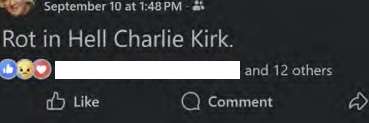
2026-11-02 · assertive framing · Firing for "Rot in Hell Charlie Kirk" Post Upheld
🔮 Some excerpts from the long First Superseding Indictment in U.S. v. Hakim (E.D. Mich.), filed Oct. 21, alleging conspiracy to transmit threats in interstate commerce as well as, for two defendants, witness intimidation and destruction of property to prevent seizure (8 of the 12 defendants had originally been indicted in May); the targets included UM officials and businesses connected with them, as well as the Jewish Federation of Metropolitan Detroit:
🔮 Because "[t]he costs and efforts required to defend a lawsuit through [discovery] could chill free speech nearly as effectively as the absence of the actual malice standard altogether[,]" a public figure plaintiff must plausibly allege actual malice at the outset of the litigation.
🔮 The First Amendment forbids a State from using its investigative power that way, and I will not allow it while this case is pending.
🔮 The same logic could apply to nuns who had felt religious pressure to do the educational or nursing work that their order was known for, or to monks who had felt religious pressure to do agricultural work that supports the monastery.
2026-10-30 · assertive framing · Amicus Brief in OneTaste Criminal Prosecution
🔮 Before doing so, "he entered the coffee shop to purchase a cookie, which he hoped would be seen as a sign of goodwill."
🔮 While individuals who are the subjects of unwanted speech may be able to limit some speech directed to them, they cannot limit offensive speech about them directed to others.
🔮 Because "the conduct regulated depend[ed] on—and [could not] be separated from—the ideas communicated," Florida's law was "functionally a regulation of speech" implicating the First Amendment.
🔮 You might assume that some judge is "woke" or "Trumpy" or what have you, but there's a pretty good chance that the judge's legal analysis is still correct.
Also by Eugene Volokh
Open Thread
2026-11-02 · Reason
Nothing else under this byline is closely related to this article, so these are simply their most recent.
All 186 articles by Eugene Volokh →

Topics

No topics tagged.

Subjects

Alan PERSON · 12× Cathy PERSON · 8× Betty PERSON · 6× Kyrsten Sinema PERSON · 1× Volokh PERSON · 1×

Narrative

But if Cathy lures Alan away to instead sing in her opera house, especially knowing of Alan's binding contract with Betty, then she is liable—not for stealing Alan as if he were property, but for inducing his breach of the contract that he voluntarily entered into.
framing: assertive · carried by 1 article(s) · first seen 2026-09-06
🔮 Perhaps most analogously to alienation of affections, if Alan breaches his contract with Betty, and Cathy encouraged him to breach it, she will in many situations be liable for intentional interference with contract.
2026-09-06 · Reason
Alienation of Affections as Complicity · assertive framing

Claims (25 extracted, 1 hedged)

In the discussion of the Kyrsten Sinema alienation of affections case, several commenters took roughly the following view: Spouses have promised fidelity to each other, and if they break those promises, they are at fault towards the other spouse. asserted
they → take → spouse
But one spouse's lover hasn't made any promises to the other spouse. asserted
lover → make → spouse
The lover therefore can't be said to be at fault. asserted
lover → say → fault
I don't think that view is right, and I don't think it fits the norm for how our legal system treats analogous scenarios. asserted
system → think → scenarios
I think that on balance the abolition of the alienation of affections tort (which has happened in 45 states) is a good idea. asserted
which → think → states
If Alan commits an intentional wrong against Betty, either a crime or a tort, and Cathy encourages Alan to do that, Cathy is generally liable. asserted
Cathy → commit → that
The term sometimes used for this is "solicitation," though sometimes it's seen as a form of aiding and abetting. asserted
it → use → aiding
If Cathy helps Alan in committing the wrong, or participates in committing it, Cathy is likewise liable for aiding and abetting or conspiracy. asserted
Cathy → help → aiding
(Both those concepts apply to civil liability as well as criminal liability.) asserted
concepts → apply → liability
Perhaps most analogously to alienation of affections, if Alan breaches his contract with Betty, and Cathy encouraged him to breach it, she will in many situations be liable for intentional interference with contract. asserted
she → breach → contract
Likewise if Alan breached a fiduciary duty to Betty, and Cathy encouraged that breach. asserted
Cathy → breach → breach
Among other things, complicity liability will often apply only if Cathy has the purpose of bringing about Alan's misbehavior, or at least knows that Alan is misbehaving. asserted
Alan → apply → misbehavior
Negligently providing assistance is enough in some cases (see, e.g., negligent entrustment of cars or weapons), but usually not enough. asserted
providing → provide → cars
But in many alienation of affections cases, the defendant knew that the defendant's lover was married. asserted
lover → know → cases
And I think that on balance this sort of complicity liability makes sense in most situations. asserted
sort → think → situations
Knowingly helping someone else commit a wrong against a third party, and especially urging that person to commit the wrong, is itself a wrong against the third party. asserted
someone → help → party
But whether or not you agree with that, that's the dominant view in our legal system. asserted
that → agree → system
The intentional interference with contract example also responds to the argument that "spouses don't own each other, so a third party can't 'steal' a spouse from the other spouse." asserted
party → respond → spouse
Contracting parties also don't own each other: If Alan promises to sing in Betty's opera house for a year, that doesn't mean that Alan is Betty's property. asserted
Alan → contract → year
But if Cathy lures Alan away to instead sing in her opera house, especially knowing of Alan's binding contract with Betty, then she is liable—not for stealing Alan as if he were property, but for inducing his breach of the contract that he voluntarily entered into. asserted
he → lure → that
Likewise, an alienation of affections claim doesn't rely on claims of ownership any more than does the intentional interference claim. uncertain
claim → rely → ownership
As I said, I think there are good reasons why the alienation of affections tort has been abolished in the great majority of states. asserted
tort → say → states
I'll likely write a bit more about those reasons in a later post. asserted
I → write → post
But I think the reasons are largely functional and pragmatic, rather than conceptual. asserted
reasons → think → ?
The inability to sue those who aid in the wrong of adultery is actually something of a departure from the conceptual framework of civil and criminal liability. asserted
who → sue → liability

💬Give feedback
🕘History 🎫Support