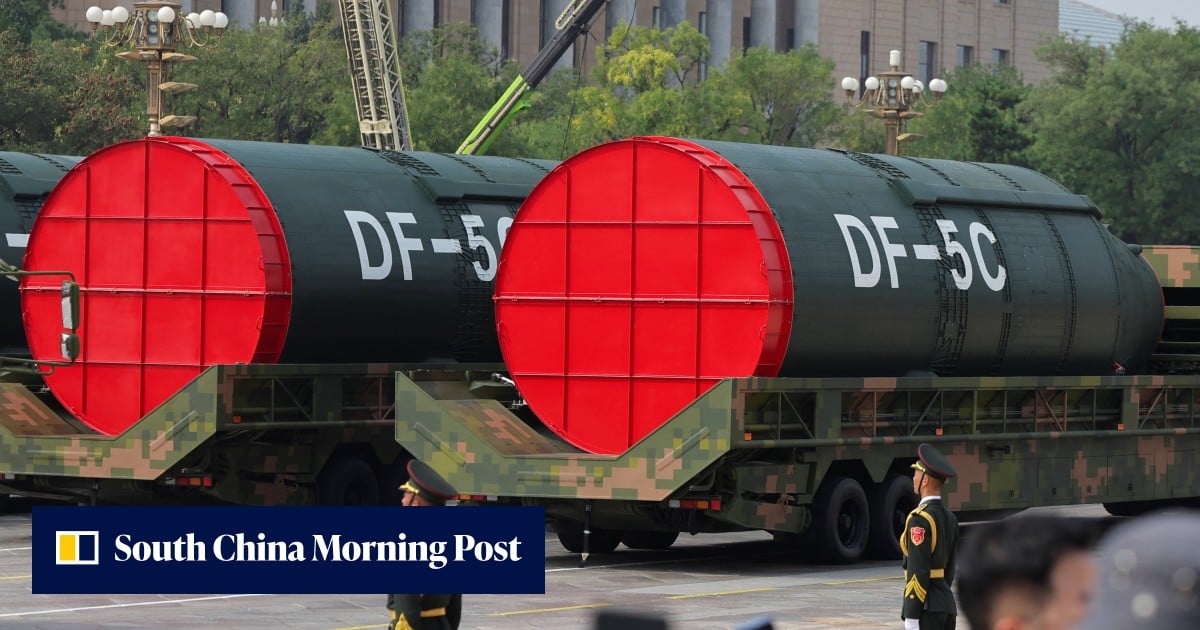
Photo via South China Morning Post

US blast simulation targets China’s alleged secret nuclear testing

Read the original at South China Morning Post ↗
Cite

Choi, S. H. (2026, October 2). US blast simulation targets China’s alleged secret nuclear testing. South China Morning Post. https://www.scmp.com/news/china/diplomacy/article/3369638/us-blast-simulation-targets-chinas-alleged-secret-nuclear-testing?utm_source=rss_feed

Dated when The Aporia collected the article, usually within hours of publication. Check the original for its exact date and byline.

South China Morning Post · collected 2026-10-02 · by Seong Hyeon Choi

Quick Summary

The US Department of Energy's National Nuclear Security Administration conducted an underground non-nuclear experiment at the Nevada National Security Site to improve detection capabilities for low-yield nuclear explosions. This test is directly related to a suspected 2020 Chinese nuclear explosion, which China denies. The international nuclear-test monitoring body acknowledges that available seismic data are inconclusive regarding the nature of the event in question.
Written by AI on 2026-10-02, from this article's own text only (the story summary below draws on all the coverage).

AI analysis

Story summary

On September 30, The US National Nuclear Security Administration conducted a "subsurface, non-nuclear chemical high-explosive experiment" at the Nevada National Security Site in the P Tunnel in Area 12. The experiment used chemical high-explosives and radiotracers to simulate conditions that could mimic a decoupled nuclear explosion, which is designed to reduce seismic detection. This comes after Washington accused Beijing of conducting a secret low-yield nuclear test in June 2020, an allegation China denied, stating it was "entirely unfounded" and an attempt by the US to justify resuming its own nuclear testing. The data collected from this experiment will be used to improve detection capabilities for future potential nuclear blasts, enhancing scientific models and refining algorithms crucial for monitoring such events globally.

Written for “US Nuclear Blast Experiment” on 2026-11-04, grounded in this article and the 1 other(s) covering the same event.

Story

📰 US Nuclear Blast Experiment
Science · 2 article(s) covering the same event. See how they differ ↓

Compared with similar articles

This article reads leans right and hedges 0% of its claims. Each row says how that neighbour differs.
The Straits Times
Hedges 0 of 7 claims Outlet record 66/100
How this article was measured signals, leaning charts, publisher record, byline, topics and claims

Signals How these are calculated →

Claims extracted
5
sentences that state something as happening or true
Uncertain
0%
0 of 5 hedged ("reportedly", "may", "according to")
Leaning
Leans right
of the writing, not the subject · beta estimate
Publisher signals
62/100
South China Morning Post's corrections and hedging, across everything collected from it. Not a measure of accuracy.
Outlets on this story
2
Science
Same framing elsewhere
1
articles that frame the event the way this one does
Analyzed 2026-10-02 · how these are computed

How this is being covered How these are calculated →

Article leaning vs. publisher reliability
Source leaning vs. consistency

Publisher

South China Morning Post · 3707 article(s) · 8 correction(s) detected
Running correction rate · 8 correction(s)

Who wrote this

Seong Hyeon Choi
10 article(s) here · 0 carrying a prediction
🔮 Hegseth pledges stronger military framework with Philippines, but lacks details Defence secretary reaffirms US support without specifying how much more funding is involved and what procedures or timeline it will pay for 3-MIN READ3-MIN Listen US Defence Secretary Pete Hegseth announced additional military cooperation funding for the Philippines and agreed with Manila on efforts for enhanced interoperability between their forces on Wednesday, as Washington sought to strengthen its defence posture along the first island chain.
🔮 US troops in South Korea must be ready for missions beyond peninsula, commander says Eighth Army chief stresses regional readiness as Washington pushes Seoul to take greater responsibility for its own defence The commander of the US Eighth Army in South Korea said his troops must be ready for deployment outside the Korean peninsula if ordered, arguing that it would be “irresponsible” to focus “myopically” on threats there.
🔮 How land power could help US forces counter China in the Indo-Pacific US commanders say the army’s long-range missiles, air defences and ground operations are vital to deterring China and protecting its forces
🔮 Hegseth calls US$1.5 trillion defence budget ‘critical’ to counter China Pentagon chief warns US risks falling behind China in drones, robotics and AI without major investment in military capabilities US Defence Secretary Pete Hegseth has called a nearly US$1.5 trillion defence budget request “absolutely critical”, warning that whoever falls behind in autonomy, robotics and AI will fall “even further behind” as Washington eyes China’s rapid military modernisation.
🔮 The deal – which updates and amends a 1951 defence agreement between Denmark and the US – allows expansion and modernisation of the Pituffik US Space Force Base in northwestern Greenland and for additional military bases to be established in Narsarsuaq and Mestersvig, though they will still require approval from Greenland and Denmark. Narsarsuaq is a settlement located in southern Greenland with a former civilian airport and US airbase that was closed in 1958.
🔮 There are no previous confirmed reports of its export to Middle Eastern entities, suggesting the Chinese-made missile may have been delivered covertly to the region.
Also by Seong Hyeon Choi
Nothing else under this byline is closely related to this article, so these are simply their most recent.
All 10 articles by Seong Hyeon Choi →

Topics

Beijing China The US Department of Energy Washington the National Nuclear Security Administration

Subjects

Beijing GPE · 3× Washington GPE · 2× China GPE · 1× NNSA ORG · 1× Nevada GPE · 1× The US Department of Energy ORG · 1× the United States’ GPE · 1× the National Nuclear Security Administration ORG · 1×

Narrative

The US Department of Energy announced on Wednesday that the National Nuclear Security Administration (NNSA) conducted a “subsurface, non-nuclear chemical high-explosive” experiment at the Nevada National Security Site, which it said aimed to “increase the United States’ ability to detect low-yield nuclear explosions”.
framing: assertive · carried by 1 article(s) · first seen 2026-10-02
2026-10-02 · South China Morning Post
US blast simulation targets China’s alleged secret nuclear testing · assertive framing

Claims (5 extracted, 0 hedged)

The US has conducted a non-nuclear underground experiment to enhance its ability to detect low-yield nuclear explosions that it explicitly linked with a test that Washington suspects China carried out in 2020 – an accusation Beijing denies. asserted
Beijing → conduct → 2020
The US Department of Energy announced on Wednesday that the National Nuclear Security Administration (NNSA) conducted a “subsurface, non-nuclear chemical high-explosive” experiment at the Nevada National Security Site, which it said aimed to “increase the United States’ ability to detect low-yield nuclear explosions”. asserted
it → announce → explosions
The experiment, which did not involve any nuclear explosions, collected data to validate scientific models and refine algorithms critical to US nuclear explosion detection capabilities. asserted
which → involve → capabilities
The Nevada test highlights the constraints of verifying suspected low-yield nuclear tests. asserted
test → highlight → tests
Despite Washington’s allegation that Beijing has covertly conducted a nuclear test at the Lop Nur testing site in June 2020, Beijing denied the accusation, and the international nuclear-test monitoring body has said the available seismic data cannot establish the cause of the events with confidence. asserted
data → conduct → confidence
💬Give feedback
🕘History 🎫Support