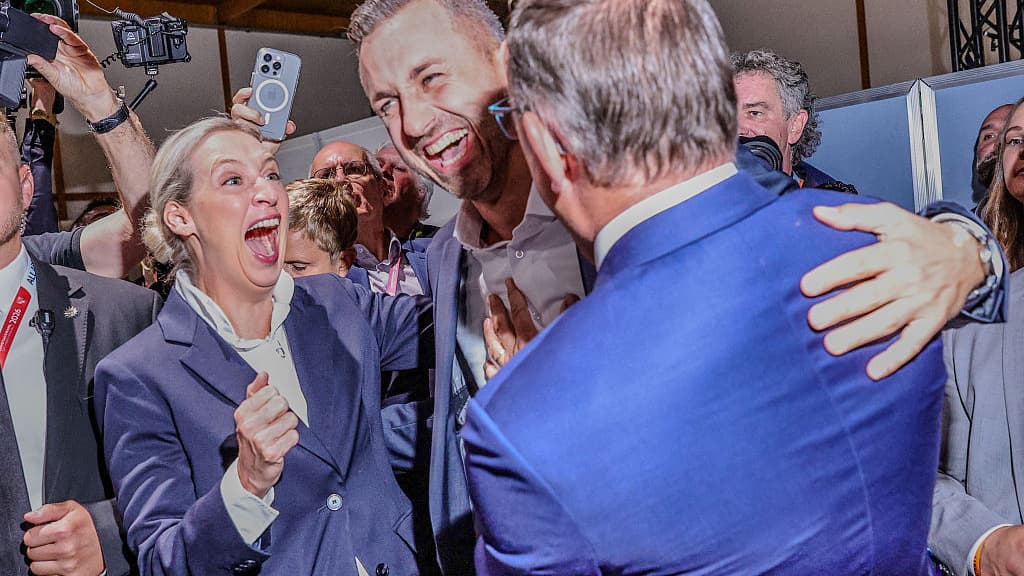
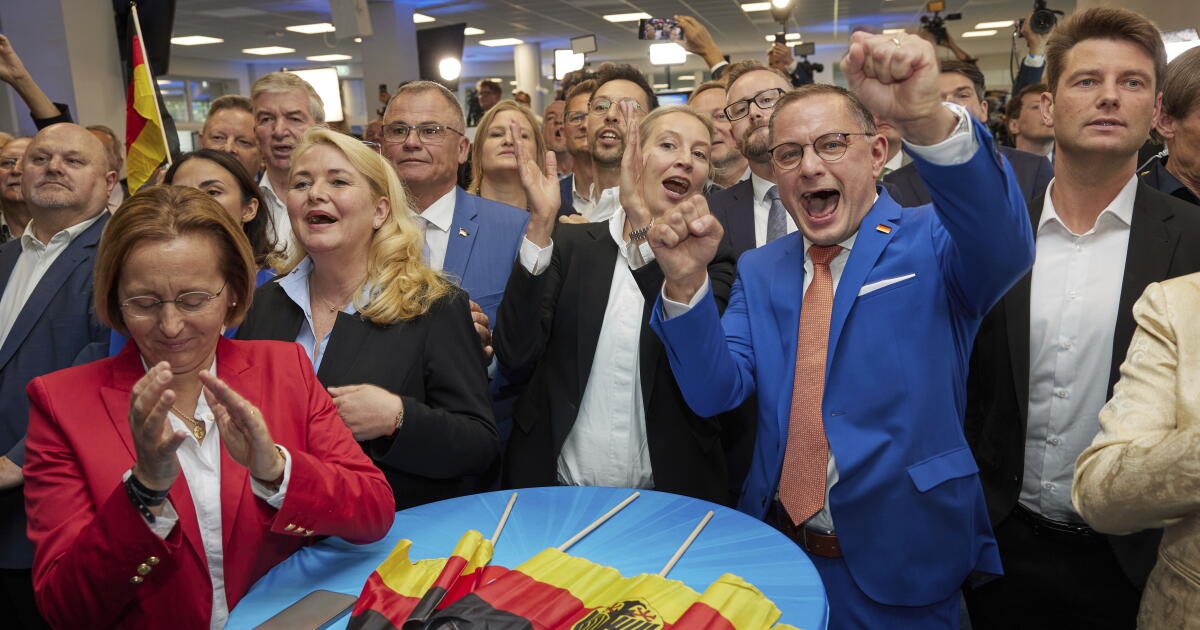
Photo via The Independent

Germany braced for political earthquake as far-right AfD eyes first taste of power

Read the original at The Independent ↗
Cite

Reynolds, J. C. (2026, September 6). Germany braced for political earthquake as far-right AfD eyes first taste of power. The Independent. https://www.independent.co.uk/news/world/europe/germany-afd-election-saxony-parliament-b3044830.html

Dated when The Aporia collected the article, usually within hours of publication. Check the original for its exact date and byline.

The Independent · collected 2026-09-06 · by James C. Reynolds

Quick Summary

Germany is bracing itself for what could be its first taste of far-right power since World War II, as voters head to the polls in Saxony-Anhalt on Sunday. The Alternative for Germany (AfD) party, polling at 40 per cent, is expected to decisively win the election, potentially marking a historic shift in German politics. A victory would mean that Chancellor Friedrich Merz and the mainstream parties have failed to keep the AfD out of power, with polls suggesting Merz has become the most unpopular chancellor since the founding of the Federal Republic, with 85 per cent of voters dissatisfied. The AfD's potential win could also pave the way for a hardline path ahead for Germany, marked by policies such as immigration restrictions and an overhaul of the education system.
Written by AI on 2026-09-06, from this article's own text only (the story summary below draws on all the coverage).

AI analysis

Story summary

In an upcoming Sunday election, Germany's far-right party, Alternative for Germany (AFD), is poised to win control of the eastern state of Saxony-Anhalt, a position it hasn't held since World War II. AFD’s lead candidate, Ulrich Siegmund, has gained significant traction by addressing concerns like immigration and Russia normalization through social media platforms such as TikTok. Polls suggest AFD could secure around 44% of the vote, more than double its previous performance in 2016. Should AFD achieve an outright victory, it would control state resources, aiming to implement policies including separate classrooms for refugees and a reduced focus on Germany's Nazi past. This historic shift raises concerns about emboldening far-right influence across Germany, with implications for national politics beyond the regional level.

Written for “German Far Right Election Gains” on 2026-11-02, grounded in this article and the 63 other(s) covering the same event.

Story

📰 German Far Right Election Gains
Politics · 64 article(s) covering the same event. Compare every outlet's account →

Compared with similar articles

This article reads leans left and hedges 23% of its claims. Each row says how that neighbour differs.
BBC News
⚖️ Leans left Hedges 7 of 44 claims Outlet record 68/100
TIME
⚖️ Leans strongly left further left than this Hedges 6 of 45 claims Outlet record 59/100
Semafor
⚖️ Leans right further right than this Hedges 1 of 4 claims Outlet record 59/100
Semafor
⚖️ Leans right further right than this Hedges 1 of 5 claims Outlet record 59/100
The Independent
⚖️ Leans strongly right further right than this Hedges 6 of 37 claims Outlet record 59/100
The Independent
⚖️ Leans right further right than this Hedges 1 of 37 claims Outlet record 59/100
CBC News
⚖️ Leans left Hedges 15 of 58 claims Outlet record 60/100
NPR
Hedges 3 of 37 claims Outlet record 60/100
Los Angeles Times
⚖️ Leans strongly right further right than this Hedges 6 of 46 claims Outlet record 95/100
Al Jazeera
⚖️ Centre further right than this Hedges 0 of 2 claims Outlet record 60/100
How this article was measured signals, leaning charts, publisher record, byline, topics and claims

Signals How these are calculated →

Claims extracted
31
sentences that state something as happening or true
Uncertain
23%
7 of 31 hedged ("reportedly", "may", "according to")
Leaning
Leans left
of the writing, not the subject · beta estimate
Publisher signals
59/100
The Independent's corrections and hedging, across everything collected from it. Not a measure of accuracy.
Outlets on this story
64
Politics
Same framing elsewhere
1
articles that frame the event the way this one does
Analyzed 2026-09-06 · how these are computed

How this is being covered How these are calculated →

Article leaning vs. publisher reliability
Source leaning vs. consistency

Publisher

The Independent · 3531 article(s) · 8 correction(s) detected
Running correction rate · 8 correction(s)

Who wrote this

James C. Reynolds
62 article(s) here · 1 carrying a prediction
🔮 Some 20,000 protesters were expected to march in the Italian capital on Friday morning, as part of wider demonstrations scheduled in more than 50 cities over war and the rising cost of living.
🔮 The eldest son of former far-right president Jair Bolsonaro had been expected to win the election but ended up losing in a shock result to leftist incumbent Luiz Inacio Lula da Silva.
🔮 His Russian counterpart, Yana Lantratova, added that space would also be provided for their pets.
🔮 Flydubai Flight 1073 from Dubai to Tel Aviv plunged 16,000ft in 30 seconds before the attacker was overwhelmed and two other pilots who were on board were able to safely land in Saudi Arabia. Capt Machchhar, still wearing a sling and with stitches in the back of his head, told UAE president Sheikh Mohammed during yesterday’s ceremony that it would still be another two months before he heals fully.
🔮 I love, I loved, and I will always love being your mum.”
🔮 Eisenkot’s bloc was projected to win 48 seats in the election with almost all votes counted, while Netanyahu is on course for 53.
🔮 “It will not be enough to extinguish the anger.”
🔮 US president Donald Trump has said he will “take a look” at helping Benjamin Netanyahu after the prime minister claimed the Israel election was “stolen”.
🔮 Benjamin Netanyahu and his allies are on track to win the most seats in Israel’s parliament, despite weeks of polling predicting he would not survive Tuesday’s election.
Also by James C. Reynolds
Nothing else under this byline is closely related to this article, so these are simply their most recent.
All 62 articles by James C. Reynolds →

Topics

AfD CDU Germany SPD Saxony-Anhalt

Subjects

AfD ORG · 13× CDU ORG · 7× Saxony-Anhalt GPE · 7× SPD ORG · 3× Germany GPE · 2× Greens ORG · 2× Left NORP · 2× Merz PERSON · 2× Alternative for Germany ORG · 1× German NORP · 1×

Narrative

The AfD seeks to restrict immigration, quit the Euro and restore ties with Russia as most of Europe rallies around Ukraine. But the party has gone from strength to strength in recent years, buoyed by popular disillusion with successive governments in Berlin and drawing support from formerly communist states in the east.
framing: mixed · carried by 1 article(s) · first seen 2026-09-06
🔮 The far-right will be vying to seize its first taste of power in Germany since the Second World war on Sunday as voters head to the polls in the eastern state of Saxony-Anhalt.

Claims (31 extracted, 7 hedged)

The far-right will be vying to seize its first taste of power in Germany since the Second World war on Sunday as voters head to the polls in the eastern state of Saxony-Anhalt. asserted
voters → vie → Anhalt
A win for the Alternative for Germany (AfD) party - which was polling at 40 per cent in the build up to Sunday’s vote – could spell an historic shift in German politics after years of cooperation between the other parties to keep the hard right out of power. uncertain
which → poll → power
The AfD seeks to restrict immigration, quit the Euro and restore ties with Russia as most of Europe rallies around Ukraine. But the party has gone from strength to strength in recent years, buoyed by popular disillusion with successive governments in Berlin and drawing support from formerly communist states in the east. asserted
party → seek → east
Ahead of the 2029 national elections, a victory in Saxony-Anhalt could offer a glimpse of a hardline path ahead for the EU’s biggest economy, marked by a deportation offensive, an overhaul of the education system, and the promotion of “traditional” relationships. uncertain
victory → offer → relationships
The Independent looks at what a win for the AfD could mean for the state and the future of Germany. uncertain
win → look → Germany
Can the AfD win the election in Saxony-Anhalt? asserted
AfD → win → Anhalt
The AfD is expected to decisively win Sunday’s election with 40 per cent of the vote, twice the support it saw there just five years ago. asserted
it → expect → vote
Polls have routinely put the AfD 10 to 15 points ahead of the centre-right Christian Democrats (CDU), which currently leads a coalition with the centre-left Social Democrats (SPD) and the free-market Free Democrats (FDP). asserted
which → put → Democrats
Winning enough votes to secure an outright majority and govern the state alone would be especially humiliating for Chancellor Friedrich Merz, upsetting decades of alignment across the mainstream parties to keep the hard right out of power. asserted
Winning → win → power
Nationwide, the AfD has swollen to become the most popular party, polling at 29 per cent, while Merz has become the most unpopular chancellor since the founding of the Federal Republic, with 85 per cent of voters dissatisfied. asserted
cent → swell → voters
In Saxony-Anhalt, all the parties except the small far-left BSW party have ruled out joining a coalition with the AfD, which has also said it aims to govern alone. asserted
it → rule → AfD
But there is no guarantee that the other parties will be able to form a viable coalition. asserted
parties → be → coalition
If both the SPD (polling at 8.5 per cent) and the Greens (6 per cent) reach the minimum 5 per cent threshold, their votes – together with the CDU (23 per cent) and the far-left Left party (11.5 per cent) – could be enough to stop the AfD from forming a government in the state. uncertain
votes → poll → state
But the CDU has ruled out a coalition with the Left Party and combining with the SPD and Greens may not be enough for a majority. uncertain
combining → rule → majority
The Brookings Institution, an American think-tank that describes itself as nonpartisan, concluded that an absolute majority for AfD candidate Ulrich Siegmund “is within reach”. asserted
majority → describe → reach
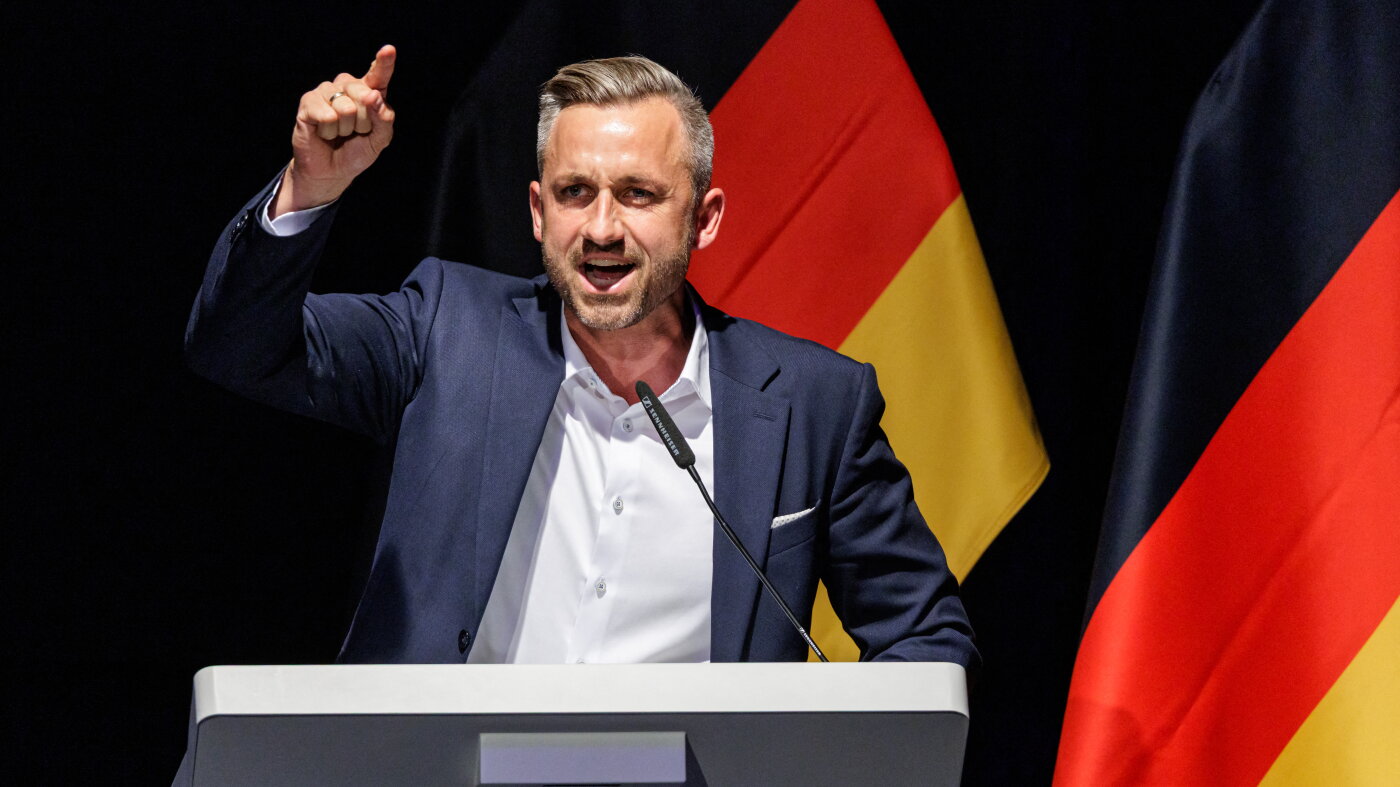
They acknowledged that Siegmund - described as “a glib salesman with a degree in business psychology who once cofounded a company for room fragrances” - had organised a “remarkably successful campaign”, despite failing to disavow the AfD’s links to extremist movements, and despite the clumsy shortcomings of his deputy. asserted
who → acknowledge → deputy
And even if the AfD does fail to achieve an outright majority, they said, “the task of organizing a CDU-led governing majority faces almost insurmountable difficulties”, exacerbated by the CDU’s ruling out of any coalition with the Left party. asserted
task → fail → party
The Left party has indicated it would be open to an arrangement formalising support for a CDU-led government over the AfD. asserted
it → indicate → AfD.
But the CDU faces internal divisions over a possible alliance with the ideologically remote far-left. asserted
CDU → face → left
Merz said ahead of the election last Sunday that they would “assess the situation in light of the election results” and “do everything we can to prevent Saxony-Anhalt from falling into the hands of the radicals”. asserted
we → say → radicals
What would an AfD win mean for Saxony-Anhalt? asserted
win → mean → Anhalt
Based on the party’s “Vision 2026” election manifesto, victory in Saxony-Anhalt could invite sweeping reforms around state policy on migration, education, culture and the family. uncertain
victory → base → migration
Under Germany's federal system, state governments sit in the upper house of parliament, the Bundesrat, and also have wide powers in education, domestic security and culture. asserted
governments → sit → education
An AfD-led state would launch a crackdown on migration with a task force set up to coordinate quicker deportations. asserted
state → lead → deportations
The children of refugees would be placed in separate classes at school to prevent what the party claims are “stresses” on the other children from being around different cultures. uncertain
party → place → cultures
Meanwhile children with disabilities would no longer be taught in the same classroom as those without, instead being sent to special schools. asserted
children → teach → schools
Schools would also be banned from flying rainbow flags, and the government would exhaust “all legal avenues” to limit Islamic expression. asserted
government → ban → expression
The party has claimed greater acceptance of what it offensively labels as"sexual deviations and non-reproductive lifestyles" has contributed to sinking birth rates and promises to aggressively promote "traditional" family structures consisting of a mother, father and children. asserted
it → claim → mother
An AfD government would see major changes to the school curriculum around a “patriotic cultural policy”, extended to raising the German national flag daily and singing the national anthem at school celebrations. asserted
government → see → celebrations
It would also advocate for removing war refugee status for Ukrainians in Germany as long as the conflict remains concentrated in eastern Ukraine, arguing they should seek refuge in western Ukraine. asserted
they → advocate → Ukraine
The current structure of the public broadcasting system would be dismantled and funding withdrawn for some cultural institutions. asserted
funding → dismantle → institutions

💬Give feedback
🕘History 🎫Support