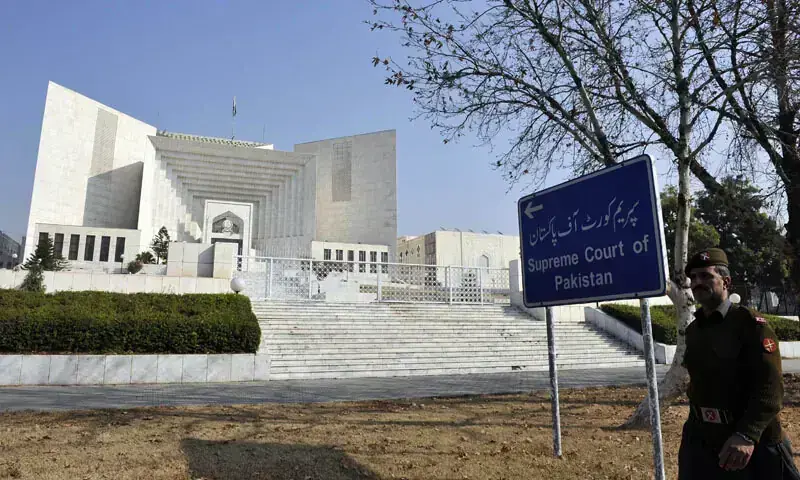
• Observes Pharmacy Act and Drugs Act perform different legal functions
• Sets aside 2023 PHC order restraining regulatory action
ISLAMABAD:
asserted
Act → observe → action
The Federal Constitutional Court (FCC) on Friday ruled that a registered medical practitioner (doctor) may prescribe and dispense medicine to his own patient within the scope of Section 31(4)(a) of the Pharmacy Act 1967, but cannot maintain a medical store or retail drug outlet without a licence under the Drugs Act 1976.
uncertain
practitioner → rule → Act
The FCC issued the ruling while setting aside a June 5, 2023 order of the Peshawar High Court’s D.I. Khan bench, which had restrained regulatory action against registered medical practitioners allegedly running medical stores and dispensaries.
uncertain
which → issue → stores
The FCC ruled that registration as a doctor does not exempt them from the licensing requirements of the Drugs Act.
asserted
registration → rule → Act
A two-judge FCC bench, headed by FCC Chief Justice Aminuddin Khan and comprising Justice Ali Baqar Najafi, issued the verdict while taking up an appeal moved by the secretary of the Khyber Pakhtunkhwa health department.
asserted
bench → head → department
The controversy arose when respondents, including Dr Muhammad Rizwan Rajpoot, who were registered medical practitioners, were found maintaining dispensaries/medical stores within their respective clinical establishments and allegedly stocking and vending pharmaceutical drugs without possessing the requisite drug sale licences.
uncertain
who → arise → licences
This culminated in an inspection conducted on Jan 21, 2020, during which the drugs were taken into custody through Form-6 and consequential show-cause notices were issued.
asserted
notices → culminate → Form-6
The respondents invoked the constitutional jurisdiction of the PHC, challenging the legality of the regulatory action.
asserted
respondents → invoke → action
Their writ petition was allowed by the high court through its impugned judgement of June 5, 2023.
asserted
petition → allow → June
While setting aside the PHC order, Chief Justice Aminuddin observed that registration with the medical regulatory body and registration under the Pharmacy Act perform different juridical functions.
asserted
registration → set → functions
Holding them otherwise would amount to judicially engrafting upon the licensing regime, an exemption which the rule-making authority itself had not enacted, said the nine-page judgement authored by the FCC chief justice.
asserted
judgement → hold → justice
During the hearing, the FCC framed three core questions: whether the drug inspector had lawful authority to inspect and take action under the Drugs Act; whether registration as medical practitioners, coupled with Section 31(4)(a) of the Pharmacy Act 1967, gave them an unfettered right to stock and sell drugs without a licence; and whether the high court was justified in intervening at the show-cause stage.
asserted
court → frame → stage
On the first question, the court held that Sections 17 and 18 of the Drugs Act empower inspectors to inspect premises, take samples, and search and seize drugs.
asserted
Sections → hold → drugs
Section 19 prescribes the procedure, including issuance of a receipt in Form-6.
asserted
Section → prescribe → Form-6
The FCC noted that no case had been established that the inspector concerned lacked appointment, territorial competence or authorisation.
asserted
inspector → note → appointment
Drawing a distinction between the Pharmacy Act and the Drugs Act, the judgement observed that Section 31(4)(a) of the Pharmacy Act merely creates an exception allowing a registered medical practitioner to dispense medicine to his own patients or serve his own prescriptions.
asserted
practitioner → draw → prescriptions
It does not authorise him to establish or maintain a medical store or retail drug outlet without a licence under the Drugs Act.
asserted
It → authorise → Act
“The legal effect of an exception cannot be enlarged beyond the prohibition from which it operates,” the judgement explained, adding that Section 23(1)(c) of the Drugs Act clearly provides that no person shall sell any drug except under a licence, and the expression “no person” admits of no occupational exception for registered doctors.
asserted
expression → enlarge → doctors
The FCC emphasised that the Pharmacy Act was primarily concerned with regulation of the profession and practice of pharmacy, constitution of pharmacy councils and registration of pharmacists.
asserted
Act → emphasise → pharmacists
Section 31(1) prohibits practice as a pharmacist by an unregistered person.
asserted
Section → prohibit → person
Subsection (4)(a), upon which the respondents rested their entire claim, merely carves out an exception from that prohibition in favour of a registered medical practitioner who dispenses medicine to his own patients or serves his own prescriptions.
uncertain
who → rest → prescriptions
Whereas the objective of the Drugs Act was to regulate the import, export, manufacture, storage, distribution and sale of drugs, Section 23(1)(c) employs language of unmistakable amplitude by providing that no person shall sell any drug except under, and in accordance with, the conditions of a licence issued under the Act.
asserted
person → regulate → Act
The expression “no person” admits of no occupational exception merely on account of the seller being a registered medical practitioner.
asserted
seller → admit → account
The judgement pointed to the specialised mechanism under the Drugs Act, including the Provincial Quality Control Board and the Drug Court, which should examine technical and factual questions before judicial review.
asserted
which → point → review
It clarified that Section 11 of the Drugs Act is not a conventional appellate remedy but part of the statutory machinery.
asserted
Section → clarify → machinery
The FCC also disapproved the argument that Article 18 of the Constitution protects the respondents from licensing requirements, stating that the right to enter a profession or trade was expressly subject to qualifications prescribed by law, and regulation through a licensing system was constitutionally permissible, especially for pharmaceuticals linked to public health.
asserted
regulation → disapprove → health
“Constitutional jurisdiction is essentially corrective and supervisory; it is not ordinarily a substitute for a fact-finding forum specially constituted under statute,” it observed.
asserted
it → find → statute
The FCC regretted that constitutional jurisdiction in the present case was exercised prematurely and upon an erroneous construction of the governing enactments.
asserted
jurisdiction → regret → enactments
“The petition, therefore, merits conversion into an appeal and acceptance, with the result that the impugned judgement is liable to be set aside and the parties relegated to the statutory process for determination of the show-cause proceedings in accordance with law,” the court ruled.
asserted
court → merit → law
 The Aporia