Photo via Times of India

Doudna team finds ancient CRISPR ancestor with unusual gapped DNA code

Read the original at Times of India ↗
Cite

TOI Science Desk. (2026, October 3). Doudna team finds ancient CRISPR ancestor with unusual gapped DNA code. Times of India. https://timesofindia.indiatimes.com/science/discovery/jennifer-doudnas-team-found-an-ancient-crispr-ancestor-in-viruses-using-a-never-before-seen-gapped-dna-code-the-smaller-vipr-system-can-target-broadly-and-may-become-a-new-gene-editing-tool/articleshow/134626567.cms

Dated when The Aporia collected the article, usually within hours of publication. Check the original for its exact date and byline.

Times of India · collected 2026-10-03 · by TOI Science Desk

Quick Summary

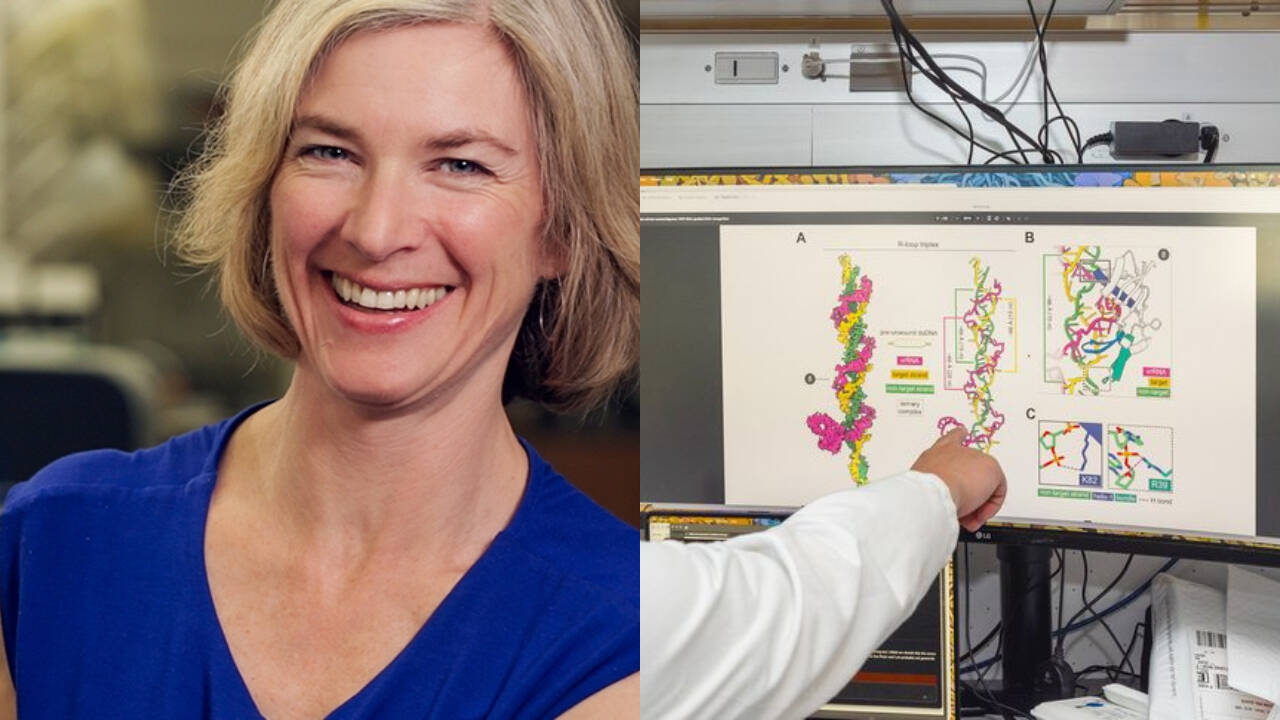
Researchers at Jennifer Doudna’s Innovative Genomics Institute discovered an ancient viral system called VIPR that uses a unique “gapped” DNA code, distinct from conventional genetic sequencing methods. Published in Science in September 2026, the study reveals how VIPR skips certain bases to create hidden codes and can bind to DNA without cutting it, potentially offering new approaches for genome editing. This finding sheds light on the origins of CRISPR systems and could overcome challenges associated with delivering larger gene-editing machinery into cells.
Written by AI on 2026-10-03, from this article's own text only (the story summary below draws on all the coverage).

AI analysis

Story summary

Researchers at the Innovative Genomics Institute (IGI), founded by Jennifer Doudna, discovered a viral system called VIPR that uses an unconventional "gapped" DNA coding strategy. This finding, reported in two papers published in Science in September 2026, sheds light on the ancient origins of CRISPR technology and could potentially advance genome engineering techniques. The IGI team, led by Peter Yoon and Kenneth Loi, utilized AI-assisted analysis to screen around 2.3 million protein structures, identifying VIPR among hundreds of candidates due to its resemblance to proteins linked with ancient CRISPR systems. This discovery is significant because it offers insights into the evolution of genetic editing tools and suggests potential new avenues for genome manipulation.

Written for “Crispr Ancient Ancestor Discovered” on 2026-11-05, grounded in this article and the 0 other(s) covering the same event.

Story

📰 Crispr Ancient Ancestor Discovered
Science · 1 article(s) covering the same event.

Compared with similar articles

Nothing to compare against. No article is close enough to this one for the pipeline to have linked or judged the pair.
How this article was measured signals, leaning charts, publisher record, byline, topics and claims

Signals How these are calculated →

Claims extracted
30
sentences that state something as happening or true
Uncertain
13%
4 of 30 hedged ("reportedly", "may", "according to")
Leaning
not political
takes no side on a contested political question
Publisher signals
59/100
Times of India's corrections and hedging, across everything collected from it. Not a measure of accuracy.
Outlets on this story
1
Science
Same framing elsewhere
1
articles that frame the event the way this one does
Analyzed 2026-10-03 · how these are computed

How this is being covered How these are calculated →

Article leaning vs. publisher reliability
Source leaning vs. consistency

Publisher

Times of India · 4148 article(s) · 4 correction(s) detected
Running correction rate · 4 correction(s)

Who wrote this

TOI Science Desk
308 article(s) here · 1 carrying a prediction
🔮 Researchers are continuing to examine daily measurements to determine whether temperatures will climb further.
🔮 According to Reuters reporting by Will Dunham, a new study published in the journal Spixiana documents more than 90 Bangka slow lorises identified between 2015 and 2025.
🔮 “Normally, my job is quite monotonous, so I wanted to create something that would entertain people, turning my ‘serious’ job into something fun,” he said in a Guinness World Records news release.
🔮 The subsequent collision between the two galaxy clusters may then have compressed the cloud or re-energised its particles, causing it to shine more brightly in radio wavelengths once again.
🔮 The mathematicians at the University of California, Davis, argue that the answer may already lie within Einstein’s own equations and that an invisible form of energy may not be needed at all.
🔮 The work will be carried out by the West Tennessee River Basin Authority, which is preparing a plan to restore the river and the land around it.
🔮 Cornell University scientists have developed genetically engineered tomato plants that turn red-purple when nitrogen becomes scarce, giving farmers a visible warning that crops may need fertiliser.
🔮 By studying these crystals and other mineral grains, scientists could establish the meteorite's age and identify later changes caused by water.
🔮 Centuries later, bronze objects found in Scandinavia would preserve chemical signatures consistent with the metals produced at this Spanish site, offering evidence of connections that may have crossed much of Europe.
🔮 Deposited impurities and staining may also have contributed, while low temperatures and humidity could cause the fabric to crack.
Wire or desk byline, not an individual reporter.
Also by TOI Science Desk
Nothing else under this byline is closely related to this article, so these are simply their most recent.
All 308 articles by TOI Science Desk →

Topics

IGI Science VIPR the Innovative Genomics Institute

Subjects

IGI ORG · 1× Jennifer Doudna PERSON · 1× Kenneth Loi PERSON · 1× Peter Yoon PERSON · 1× Science ORG · 1× UC Berkeley Research ORG · 1× the Innovative Genomics Institute ORG · 1×

Narrative

But its unusual structure, tiny size and broad targeting potential give scientists another piece of the evolutionary puzzle, and another molecular system to explore as the genome-editing toolbox continues to expand.
framing: assertive · carried by 1 article(s) · first seen 2026-10-03
🔮 This could give the system an advantage when targeting rapidly changing viral genomes.
2026-10-03 · Times of India
Doudna team finds ancient CRISPR ancestor with unusual gapped DNA code · assertive framing

Claims (30 extracted, 4 hedged)

The genetic code is usually described as an orderly language, read one letter after another in precise three-letter units. asserted
code → describe → units
But nature has never been particularly interested in following the rules humans use to describe it. asserted
humans → follow → it
Researchers at the Innovative Genomics Institute (IGI), founded by Jennifer Doudna, have now uncovered a viral system that appears to rewrite some of those assumptions. asserted
that → found → assumptions
Called VIPR, the system uses a previously unknown “gapped” coding strategy to recognise DNA, offering clues about the ancient origins of CRISPR and potentially opening another route to genome engineering. asserted
system → call → engineering
The findings were reported in two connected papers in Science in September 2026. asserted
findings → report → September
A mystery hidden in viral RNA The discovery began with a search for ancient relatives of Class 1 CRISPR systems, the older and more widespread branch of CRISPR biology. asserted
discovery → hide → biology
Unlike the better-known Cas9 system, Class 1 systems rely on several proteins working together. asserted
systems → know → proteins
Researchers Peter Yoon and Kenneth Loi used AI-assisted structural analysis to screen roughly 2.3 million protein structures. asserted
Yoon → use → structures
Among hundreds of candidates, one stood out because its shape resembled proteins associated with ancient CRISPR systems, even though it was paired with an unfamiliar RNA rather than a recognisable CRISPR guide. asserted
it → stand → RNA
The RNA initially appeared almost impossible to interpret. asserted
RNA → appear → ?
Its sequence contained repeating patterns that conventional genetic analysis did not explain. asserted
analysis → contain → that
The code between the gaps A second AI approach helped reveal the pattern. asserted
approach → help → pattern
The researchers found that groups of three bases repeatedly contained a predictable pair followed by a highly variable third position. asserted
groups → find → position
, the system appeared to skip across it, effectively creating a hidden code. asserted
system → appear → code
That pattern ultimately allowed the researchers to identify matching sequences in viral DNA. asserted
researchers → allow → DNA
The finding is unusual because genetic information is generally interpreted as a continuous sequence. asserted
information → interpret → sequence
VIPR instead appears to ignore positions that are more prone to mutation while concentrating on more stable parts of the genetic code. asserted
that → appear → code
This could give the system an advantage when targeting rapidly changing viral genomes. uncertain
This → give → genomes
A different way to engage DNA VIPR also behaves differently from familiar CRISPR systems. asserted
way → engage → systems
Rather than using a protein to cut DNA, researchers found that its RNA can wrap around the DNA double helix, forming a three-stranded structure known as a triplex. asserted
RNA → use → triplex
That interaction can interfere with gene activity rather than cutting the DNA itself. asserted
interaction → interfere → DNA
In laboratory experiments, the researchers were able to reprogram VIPR to bind near a gene's promoter and silence the gene. asserted
researchers → reprogram → gene
Its compact size could be useful because delivering large genome-editing machinery into cells remains a major challenge in developing practical gene-editing technologies. uncertain
delivering → deliver → technologies
The IGI itself identifies delivery as one of the biggest barriers to broader use of CRISPR-based therapies. asserted
IGI → identify → therapies
A viral origin story for CRISPR The discovery may also reshape ideas about where CRISPR came from. uncertain
CRISPR → reshape → where
The researchers found VIPR systems in viruses that appear to use them against competing viruses, suggesting that viral competition helped shape this unusual molecular weapon. asserted
competition → find → weapon
Even more intriguingly, some functional VIPR systems appear to have moved into bacteria. asserted
systems → appear → bacteria
The researchers propose that bacteria may have acquired such viral machinery and repurposed it against viruses, potentially contributing to the evolutionary pathway that eventually produced ancient Class 1 CRISPR systems. uncertain
that → propose → systems
For now, VIPR remains a research tool rather than an established medical technology. asserted
VIPR → remain → ?
But its unusual structure, tiny size and broad targeting potential give scientists another piece of the evolutionary puzzle, and another molecular system to explore as the genome-editing toolbox continues to expand. asserted
toolbox → give → puzzle

💬Give feedback · no sign-in needed

No sign-in needed for now. Your note is sent without a name, so it cannot be answered.

🕘History 🎫Support