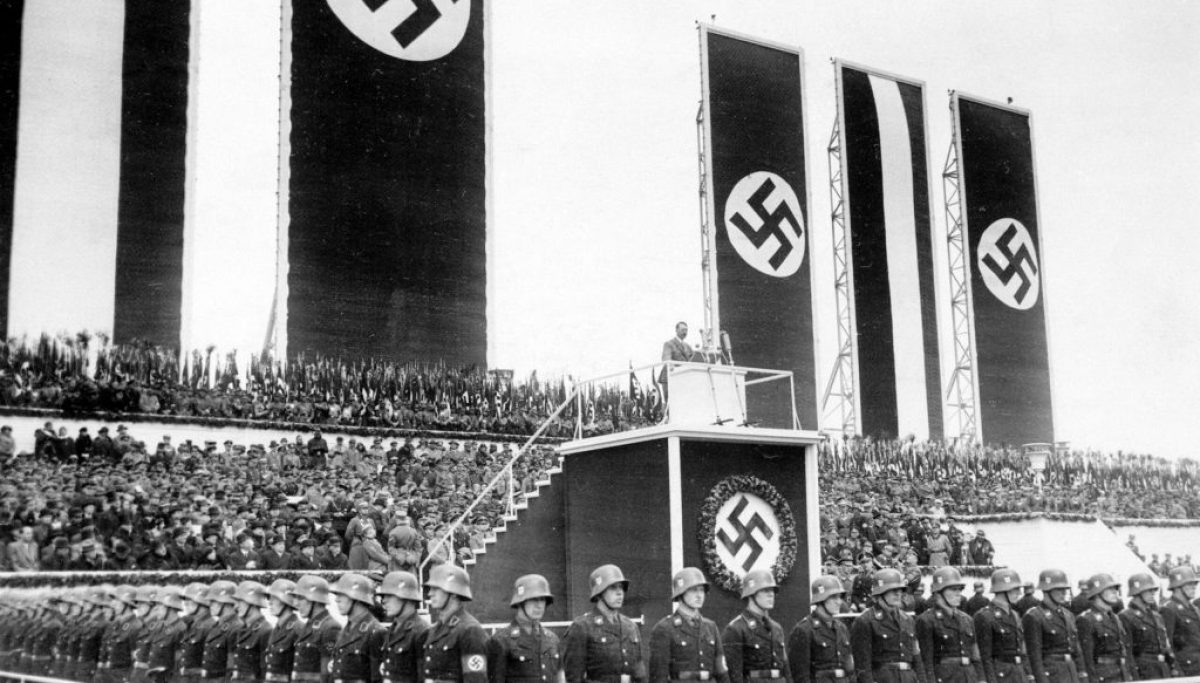
Photo via Washington Examiner

Read Hitler’s 1920 platform and tell me he was a conservative

Read the original at Washington Examiner ↗
Cite

Wiley, D. (2026, October 3). Read Hitler’s 1920 platform and tell me he was a conservative. Washington Examiner. https://www.washingtonexaminer.com/op-eds/4748577/was-hitler-conservative-political-spectrum/

Dated when The Aporia collected the article, usually within hours of publication. Check the original for its exact date and byline.

Washington Examiner · collected 2026-10-03 · by Dory Wiley

Quick Summary

The article discusses the misconception that Adolf Hitler was a conservative or right-wing figure by examining his political platform and actions during his rule in Germany. It highlights that Hitler's National Socialist Party advocated for policies such as nationalization of industries, abolition of unearned income, and strict control over corporate practices, which are more aligned with left-wing economic principles. The author argues against the common mislabeling of Hitler as a conservative by contrasting Nazi ideology with American conservatism, emphasizing values like limited government, free markets, and individual freedoms that oppose the totalitarian state control under Hitler's regime.
Written by AI on 2026-10-03, from this article's own text only (the story summary below draws on all the coverage).

AI analysis

Story summary

In an article published by the Washington Examiner, Dory Wiley challenges the common narrative that Adolf Hitler was aligned with modern American conservatism. Wiley points out that Hitler never referred to himself as a fascist but rather called himself a National Socialist, leading the National Socialist German Workers' Party. The party’s 1920 platform included demands for nationalization of trusts, profit-sharing in large industries, abolition of unearned income, confiscation of war profits, land reform, and expansion of old-age pensions—policies that do not align with contemporary conservative ideals. Wiley argues that when the party's original platform is examined without knowing its author, it becomes clear that these policies are more characteristic of left-wing or socialist ideologies rather than right-wing conservatism. This perspective challenges the frequent association made between Hitler and American conservatives in political discourse.

Written for “Nazi History Debated” on 2026-11-01, grounded in this article and the 0 other(s) covering the same event.

Story

📰 Nazi History Debated
Politics · 1 article(s) covering the same event.

Compared with similar articles

Nothing to compare against. No article is close enough to this one for the pipeline to have linked or judged the pair.
How this article was measured signals, leaning charts, publisher record, byline, topics and claims

Signals How these are calculated →

Claims extracted
55
sentences that state something as happening or true
Uncertain
7%
4 of 55 hedged ("reportedly", "may", "according to")
Leaning
Leans strongly left
of the writing, not the subject · beta estimate
Publisher signals
70/100
Washington Examiner's corrections and hedging, across everything collected from it. Not a measure of accuracy.
Outlets on this story
1
Politics
Same framing elsewhere
1
articles that frame the event the way this one does
Analyzed 2026-10-03 · how these are computed

How this is being covered How these are calculated →

Article leaning vs. publisher reliability
Source leaning vs. consistency

Publisher

Washington Examiner · 3888 article(s) · 7 correction(s) detected
Running correction rate · 7 correction(s)

Who wrote this

Dory Wiley
1 article(s) here · 1 carrying a prediction
🔮 When they fell out, they fought over who would own the collective, not over whether the collective should own the man.
The only article under this byline in the corpus.

Topics

American Republican a National Socialist the Four-Year Plan the National Socialist German Workers’ Party

Subjects

Hitler PERSON · 8× American NORP · 4× Stalin PERSON · 3× Abraham Lincoln PERSON · 1× Adolf Hitler PERSON · 1× Hugo Junkers PERSON · 1× John Adams PERSON · 1× Republican NORP · 1× a National Socialist NORP · 1× the National Socialist German Workers’ Party ORG · 1×

Narrative

The party’s 25-point program of 1920 demanded the nationalization of trusts, profit-sharing in large industries, the abolition of unearned income, the confiscation of war profits, land reform, and a large expansion of old-age pensions.
framing: assertive · carried by 1 article(s) · first seen 2026-10-03
🔮 When they fell out, they fought over who would own the collective, not over whether the collective should own the man.
2026-10-03 · Washington Examiner
Read Hitler’s 1920 platform and tell me he was a conservative · assertive framing

Claims (55 extracted, 4 hedged)

Abraham Lincoln once observed that we all declare for liberty, but in using the same word, we do not all mean the same thing. asserted
we → observe → thing
The shepherd drives the wolf from the sheep’s throat, he said, and the sheep thanks him as a liberator while the wolf denounces him as a destroyer of liberty. asserted
wolf → drive → liberty
Words matter. asserted
Words → matter → ?
When words are bent, voters are misled. asserted
voters → bend → ?
We have been told for years, in leading newspapers and in classrooms, that Adolf Hitler was a man of the “Right,” and therefore a distant cousin of the American conservative. asserted
Hitler → tell → conservative
The label is then hung, election after election, on whichever Republican is handy. asserted
Republican → hang → election
Facts are stubborn things, as John Adams said. asserted
Adams → say → ?
Hitler never called himself a fascist. asserted
Hitler → call → himself
He called himself a National Socialist, and he led the National Socialist German Workers’ Party. asserted
he → call → Party
Names can lie, so look at the platform. asserted
Names → lie → platform
The party’s 25-point program of 1920 demanded the nationalization of trusts, profit-sharing in large industries, the abolition of unearned income, the confiscation of war profits, land reform, and a large expansion of old-age pensions. asserted
program → demand → pensions
Read that list without naming its author, and ask which side of the aisle wrote it. asserted
side → read → it
Then look at what the regime did. asserted
regime → look → what
It abolished independent unions and herded workers into a single state labor front. asserted
It → abolish → front
It capped corporate dividends. asserted
It → cap → dividends
Under the Four-Year Plan of 1936, the state set prices and wages, rationed raw materials, and told industry what to build. asserted
state → set → what
Owners kept the deeds to their factories, but only so long as they obeyed. asserted
they → keep → factories
Hugo Junkers lost his own aircraft company in 1933, and Fritz Thyssen, who had bankrolled Hitler, saw his property seized in 1939 after he broke with him. asserted
he → lose → him
Hitler hated the communists, and they hated him, but rivals are not opposites. asserted
rivals → hat → him
In August 1939, Hitler and Josef Stalin signed a pact and carved up Poland between them. asserted
Hitler → sign → them
When they fell out, they fought over who would own the collective, not over whether the collective should own the man. asserted
collective → fall → man
One organized it by class, the other by race. asserted
One → organize → race
Both agreed that the individual belongs to the state. asserted
individual → agree → state
Two wolves may fight over the same sheep. uncertain
wolves → fight → sheep
But he was a nationalist, comes the reply, and nationalism belongs to the Right. asserted
nationalism → come → Right
Hitler’s nation was not a people joined by language, law, or creed. asserted
nation → join → language
It was a people joined by blood, and no one could enter it who was not born to it. uncertain
who → join → it
Lincoln said immigrants with no ancestors at the founding could still claim the Declaration of Independence “as though they were blood of the blood, and flesh of the flesh” of the men who wrote it. uncertain
who → say → it
A nation you may join by believing in it is the opposite of a nation you must be bred into. uncertain
you → join → nation
Its creed is limited government, a written constitution, separation of powers, free markets, private property, free speech, freedom of worship, and an armed citizenry. asserted
creed → write → worship
Hitler tore down every such fence he found. asserted
he → tear → fence
Measure politics the sensible way, with total state power at one end and individual liberty at the other, and Hitler, Stalin, and Mao Zedong stand together at one end. asserted
Hitler → measure → end
The American founding stands at the other. asserted
founding → stand → other
The cost is written in graves. asserted
cost → write → graves
The Holocaust murdered 6 million Jews and millions of others. asserted
Holocaust → murder → others
Stalin’s famine starved millions of Ukrainians. asserted
famine → starve → Ukrainians
Mao’s Great Leap Forward killed at least 30 million Chinese. asserted
Forward → kill → Chinese
The Khmer Rouge killed as much as a quarter of Cambodia in four years. asserted
Rouge → kill → years
The flags differed. asserted
flags → differ → ?
The method did not — all of them wolves. asserted
all → do → them
…and 15 more, not listed.

💬Give feedback
🕘History 🎫Support