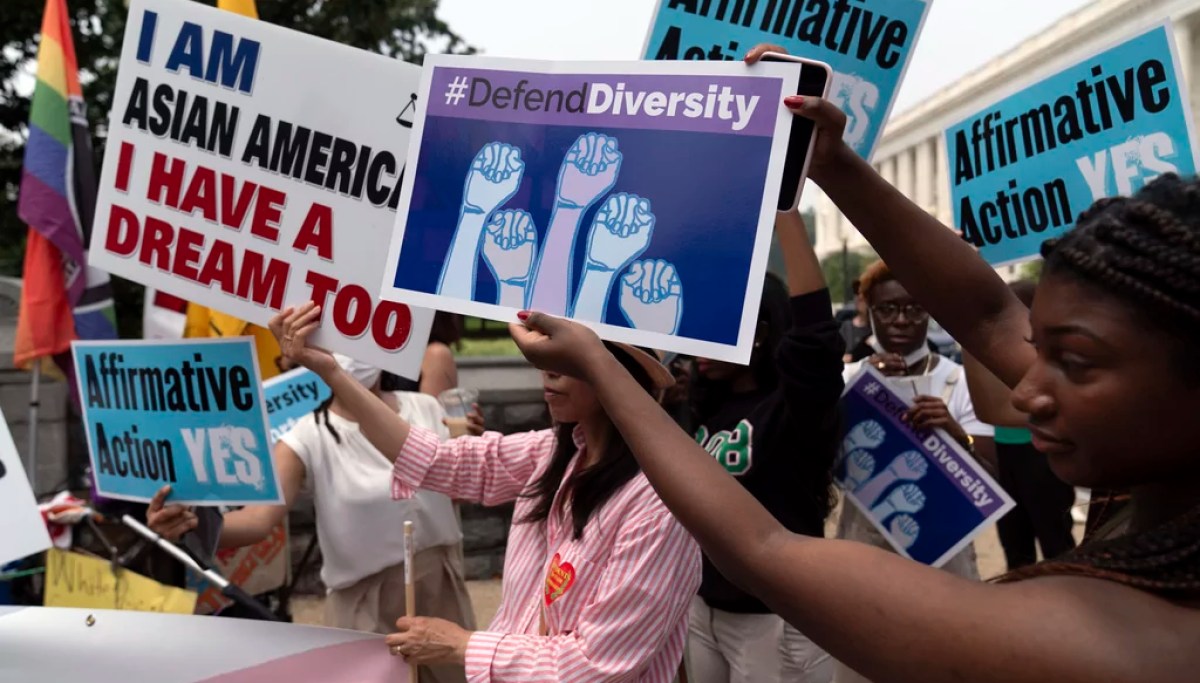
Growing up in Guntur, India, structural inequality was not an abstraction — it was the street I grew up on.
asserted
I → grow → Guntur
For centuries, the caste system fixed entire communities into place at birth, and the doors that mattered — schools, government jobs, land — opened or closed accordingly.
asserted
that → fix → birth
India’s fix was Reservations, an affirmative action system so large it now sets aside as much as half of university seats and civil service jobs for historically disadvantaged groups.
asserted
it → set → groups
The goal in 1950 was reasonable: repair a specific, documented harm.
asserted
goal → repair → harm
But policy has a way of outliving its purpose once politicians discover what it can do for them.
asserted
it → have → them
Over the decades that followed, Reservations shifted from repair to political currency.
asserted
Reservations → follow → currency
Every election brought pressure to add another group to the list or raise the ceiling again.
asserted
election → bring → ceiling
The pendulum, once aimed squarely at fixing a real wrong, swung past the center of the arc and kept going — until communities with no personal connection to the original injustice found themselves locked out by the very system built to correct it.
asserted
themselves → aim → it
I have watched a similar shape take form in the United States, and it deserves a plain, unemotional description rather than a partisan one.
asserted
it → watch → description
America’s civil rights era responded to a real and well-documented history: slavery, Jim Crow, redlining, and decades of legal exclusion that shut black Americans and other minorities out of housing, credit, education, and the vote.
asserted
that → respond → housing
But political incentives, once set in motion, rarely stay in their lane.
asserted
incentives → set → lane
Minority voters became an organized and decisive force in American politics, visible most dramatically when a first-term senator from Illinois overcame his own party’s establishment favorite in 2008 and went on to win the presidency twice.
asserted
senator → become → presidency
Instead of the national conversation narrowing as old barriers came down, much of it kept expanding outward — from dismantling specific, provable barriers to a broader and vaguer suspicion of white people in general, and white men in particular, with young white men absorbing the sharpest edge of it despite holding the least institutional power of any of them.
asserted
much → narrow → them
Some of that pressure has already started to reverse, which is itself evidence the pendulum is real rather than a rhetorical device.
asserted
pendulum → start → device
In 2023, the Supreme Court ended race-conscious college admissions in Students for Fair Admissions v. Harvard.
asserted
Court → end → Harvard
In 2025, the federal government moved to unwind a wide range of diversity, equity, and inclusion programs across agencies and federal contractors.
asserted
government → move → agencies
People will disagree, fairly, about whether those specific moves were right.
asserted
moves → disagree → ?
But the larger point holds regardless of which side one takes: policy in this space has been swinging on a wide arc for 60 years, and it is swinging hard again right now — precisely the pattern India lived through with Reservations, and precisely why it deserves study rather than dismissal.
asserted
it → hold → study
Who are we actually talking about
Public debate treats “white men” as a single, dominant bloc, as though the label alone settles the question of power.
asserted
label → talk → power
The actual arithmetic tells a narrower story.
asserted
arithmetic → tell → story
Non-Hispanic white Americans make up just under 58% of the population, according to the latest Census Bureau estimates — down from roughly 63% as recently as 2010.
uncertain
Americans → make → 2010
Cut that figure roughly in half for gender and white men lay at around 29% of the country.
asserted
men → cut → country
Now subtract the two groups that hold the least day-to-day economic or institutional power: retirees living on Social Security and Medicare at one end, and boys and teenagers still financially dependent on their parents at the other.
asserted
that → subtract → other
What remains — the working-age, college-age cohort actually competing for seats, jobs, and promotions right now — is commonly estimated at somewhere near 1 in 10 of the public.
asserted
remains → remain → public
The precise figure matters less than the direction of the numbers underneath it, and those are unambiguous.
asserted
those → matter → it
Women made up 57.3% of U.S. undergraduates in the fall of 2024, against 42.7% for men — a gap of nearly 15 points that barely existed 50 years ago, according to National Center for Education Statistics data.
uncertain
that → make → data
Among adults 25 to 34, 47% of women now hold a bachelor’s degree compared with 37% of men, a 10-point gap the Pew Research Center has tracked widening every year this decade.
asserted
Center → hold → gap
Detachment from both school and work is rising for young men specifically: Census-based research puts the share of men aged 16 to 24 who are neither enrolled nor employed at roughly 8%, double the 1990 rate.
asserted
who → rise → %
And in the year from July 2024 to July 2025, women accounted for slightly more than half of all net job growth nationally, with the surge concentrated heavily in sectors expected to keep growing fastest.
asserted
surge → account → sectors
None of this makes young men today a historically oppressed class on the order of what black Americans endured under Jim Crow, or what lower castes endured in India for centuries.
asserted
castes → make → centuries
Drawing that equivalence would be dishonest, and I am not drawing it.
asserted
I → draw → it
What the numbers do show is narrower and more useful: the cultural shorthand of “privileged white male” no longer describes the daily reality of a large share of the group it is meant to describe.
asserted
it → show → group
Numerically and practically, they are behaving less like an entrenched majority and more like a shrinking cohort absorbing blame for a structure most of them never built and had no hand in running.
asserted
most → behave → hand
Two wrongs still don’t make a right
asserted
wrongs → make → right
The lesson from India’s decadeslong experience with Reservations, and from the U.S.’s own more recent experience, is not that discrimination was ever acceptable, or that correcting it was a mistake.
asserted
correcting → correct → it
It is that any remedy built to punish a group, rather than to repair a specific and provable harm, eventually becomes its own injustice — just aimed at whoever is standing in the crosshairs next.
asserted
whoever → build → crosshairs
Replacing one system of collective blame with another does not produce fairness.
asserted
Replacing → replace → fairness
It only relocates the target.
asserted
It → relocate → target
And the people caught in the new one rarely had any say in building the old one; most were children, or not yet born, when the harm they are now implicitly asked to answer for actually took place.
asserted
they → catch → place
The way forward is not complicated, even if it is politically inconvenient to say plainly: judge people as individuals, on merit and character, not as stand-ins for whatever group they were born into.
asserted
they → say → born
…and 9 more, not listed.
 The Aporia