Photo via Fox News

Police officers spot strange objects underwater, then make remarkable ancient discovery

Read the original at Fox News ↗
Cite

Margolis, A. (2026, October 3). Police officers spot strange objects underwater, then make remarkable ancient discovery. Fox News. https://www.foxnews.com/travel/police-officers-spot-strange-objects-underwater-remarkable-ancient-discovery

Dated when The Aporia collected the article, usually within hours of publication. Check the original for its exact date and byline.

Fox News · collected 2026-10-03 · by Andrea Margolis

Quick Summary

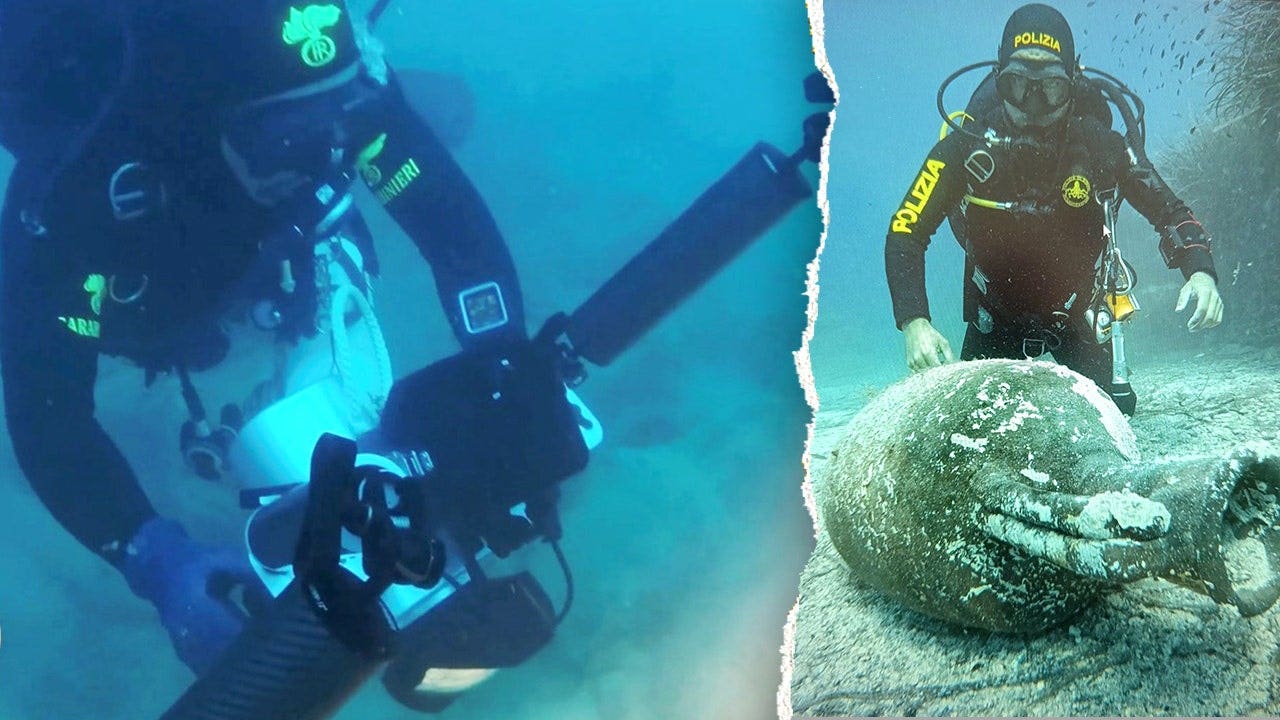
Police officers conducting an underwater safety operation off the coast of Porto Rotondo in Sardinia, Italy, recently discovered ancient Roman artifacts dating back approximately 2,000 years. The divers initially spotted a piece of broken terracotta and returned for another dive to uncover three intact terracotta vessels along with other minor items. Officials estimate that these artifacts date from the late 1st century B.C. to early 1st century A.D., potentially originating from regions like Lazio, Campania, or the Iberian Peninsula.
Written by AI on 2026-10-03, from this article's own text only (the story summary below draws on all the coverage).

AI analysis

Story summary

Police officers on a routine dive near Porto Rotondo in Sardinia, Italy, recently discovered ancient Roman artifacts dating back over 2,000 years. The find was made while conducting an underwater safety operation by police based in Olbia. Initially spotting a piece of broken terracotta prompted the divers to return for further exploration, where they identified and recovered three intact terracotta transport basins along with other minor items. These artifacts are believed to date from the second half of the 1st century B.C. to the 1st century A.D., potentially originating in regions such as Lazio, Campania, or the Iberian Peninsula. The discovery was announced by the Sassari Police Headquarters in late August and has been recorded for the Archaeological Superintendent.

Written for “Ancient Underwater Discovery” on 2026-11-04, grounded in this article and the 0 other(s) covering the same event.

Story

📰 Ancient Underwater Discovery
World · 1 article(s) covering the same event.

Compared with similar articles

Nothing to compare against. No article is close enough to this one for the pipeline to have linked or judged the pair.
How this article was measured signals, leaning charts, publisher record, byline, topics and claims

Signals How these are calculated →

Claims extracted
19
sentences that state something as happening or true
Uncertain
11%
2 of 19 hedged ("reportedly", "may", "according to")
Leaning
not political
takes no side on a contested political question
Publisher signals
68/100
Fox News's corrections and hedging, across everything collected from it. Not a measure of accuracy.
Outlets on this story
1
World
Same framing elsewhere
1
articles that frame the event the way this one does
Analyzed 2026-10-03 · how these are computed

How this is being covered How these are calculated →

Article leaning vs. publisher reliability
Source leaning vs. consistency

Publisher

Fox News · 6507 article(s) · 12 correction(s) detected
Running correction rate · 12 correction(s)

Who wrote this

Andrea Margolis
61 article(s) here · 1 carrying a prediction
🔮 A powerful new telescope has discovered a dwarf planet candidate beyond Pluto — and scientists say it could be among the largest of its kind ever found in the reaches of our solar system.
🔮 "Travelers looking ahead to Thanksgiving and Christmas travel will need to plan ahead for a larger travel budget this year, as the 2026 holiday travel is on track to be the most expensive in a decade," the report said.
🔮 They carefully dug a small silver coin out of the soil — and more finds would follow."
🔮 Villa Vie Residences had offered lifetime access to the ship through its "Endless Horizons" program for a one-time payment of $299,999 for a single-occupancy cabin or $499,999 for double occupancy, Fox Business reported in May 2024.
🔮 The "rusty treasure," as researchers called it in a press release, would have been extremely valuable during the Iron Age, when iron production and trade were expanding across Europe.
🔮 A scholar believes a nearly 2,000-year-old account of Jesus may be more historically reliable than previously thought, challenging longstanding doubts about one of the earliest non-Christian accounts of his life.
🔮 Workers fear the findings could lead to pay cuts of up to 8%, according to local news outlet betevé.
🔮 Fox Business reported in May 2024 that Villa Vie Residences was offering lifetime access to its Odyssey cruise ship through its "Endless Horizons" program for a one-time payment of $299,999 for a single-occupancy cabin or $499,999 for double occupancy.
🔮 They found the remains of two colossal statues believed to depict Ramses II, the pharaoh some scholars believe may have confronted Moses in the biblical Book of Exodus.
🔮 They determined it would need repairs at a shipyard, a TUI Cruises official told Fox News Digital.
Also by Andrea Margolis
Nothing else under this byline is closely related to this article, so these are simply their most recent.
All 61 articles by Andrea Margolis →

Topics

Cover Images Italian Italy Roman Sardinia

Subjects

Cover Images ORG · 3× Sardinia GPE · 3× Italian NORP · 2× Italy GPE · 2× Roman NORP · 2× Lazio ORG · 1× Olbia GPE · 1× Porto Rotondo GPE · 1× the Roman Empire GPE · 1× the Roman Republic ORG · 1×

Narrative

"Careful dredging action allowed the identification and subsequent recovery of three intact terracotta artifacts, specifically a transport basin, along with other minor items," officials said, as Cover Images noted.
framing: assertive · carried by 1 article(s) · first seen 2026-10-03
🔮 "From a preliminary analysis, it is hypothesized that the items may date back to a time frame between the second half of the 1st century B.C. and the 1st century A.D., with a potential origin area that can be linked to Lazio, Campania or the Iberian Peninsula

Claims (19 extracted, 2 hedged)

Police officers on a routine dive in Italy recently made an unusual discovery recently: ancient Roman artifacts resting on the seabed, 2,000 years later. asserted
officers → make → seabed
The artifacts were uncovered off the coast of Porto Rotondo in Sardinia, an Italian island in the Mediterranean Sea, news agency Cover Images reported. asserted
Images → uncover → Sea
The discovery was announced by the Sassari Police Headquarters in late August. asserted
discovery → announce → August
The officers were based in Olbia, Sardinia. asserted
officers → base → Olbia
They spotted the ancient objects while conducting an underwater safety operation. asserted
They → spot → operation
They first noticed a piece of broken terracotta — prompting them to return for a second dive, when they discovered the largely intact vessels. asserted
they → notice → vessels
The find led divers to conduct a more detailed search of the area for other archaeological objects. asserted
find → lead → objects
"Careful dredging action allowed the identification and subsequent recovery of three intact terracotta artifacts, specifically a transport basin, along with other minor items," officials said, as Cover Images noted. asserted
Images → allow → items
"The artifacts were recorded and made available to the competent Archaeological Superintendent." Pictures show police divers examining the seabed and ancient pottery submerged in the waters off Sardinia. asserted
divers → record → Sardinia
One image shows an intact amphora nestled among thick seagrass on the seafloor — while another shows a police diver examining a large, heavily encrusted vessel. asserted
diver → show → vessel
In the ancient world, amphorae were used to transport a variety of materials, including wine, olive oil and grain. asserted
amphorae → use → wine
Police said the artifacts appear to date to the period spanning the fall of the Roman Republic and the beginning of the Roman Empire. asserted
artifacts → say → Empire
"From a preliminary analysis, it is hypothesized that the items may date back to a time frame between the second half of the 1st century B.C. and the 1st century A.D., with a potential origin area that can be linked to Lazio, Campania or the Iberian Peninsula uncertain
that → hypothesize → Lazio
," officials said, according to Cover Images. uncertain
officials → say → Images
Looking ahead, specialists will examine the vessels to glean more information about them, including their precise age and origin. asserted
specialists → look → age
Researchers will also determine whether the vessels came from a larger archaeological site — and if more artifacts await discovery. asserted
artifacts → determine → discovery
Earlier this year, Italian authorities announced the discovery of a Roman merchant shipwreck still carrying its cargo of amphorae in the Ionian Sea. asserted
authorities → announce → Sea
At the time, officials said the shipwreck had been discovered off the coast of Apulia during a routine maritime patrol in June 2025. asserted
shipwreck → say → June
The vessel was dated to the late Imperial era, which spanned roughly 284 A.D. to 641 A.D. asserted
which → date → A.D.

💬Give feedback · no sign-in needed

No sign-in needed for now. Your note is sent without a name, so it cannot be answered.

🕘History 🎫Support