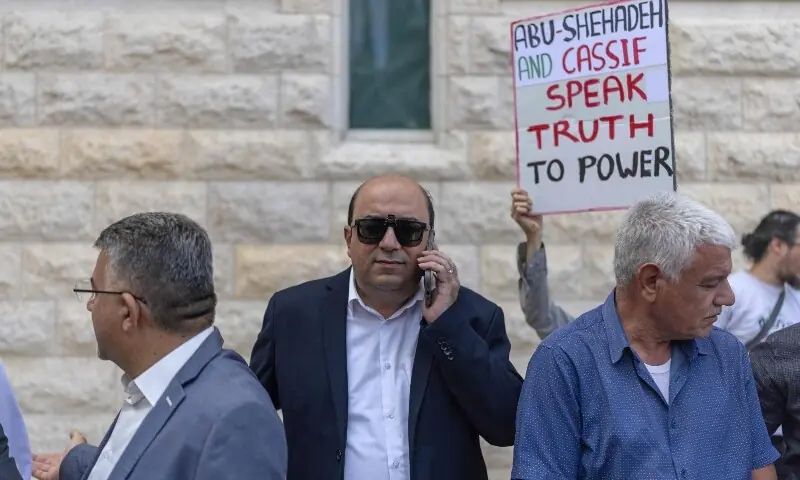
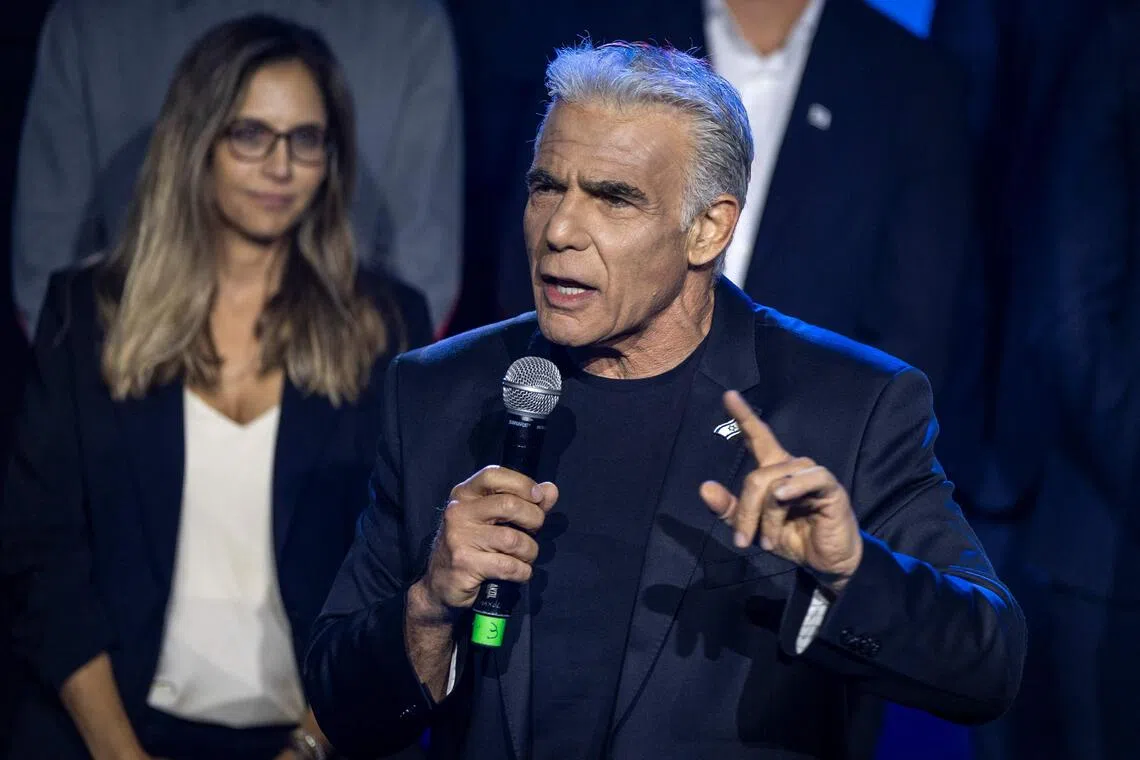
Photo via Al Jazeera

Israel election double standard: Arab leader forced out, far right cleared

Read the original at Al Jazeera ↗
Cite

Siddiqui, U. (2026, October 3). Israel election double standard: Arab leader forced out, far right cleared. Al Jazeera. https://www.aljazeera.com/news/2026/10/3/israel-election-double-standard-arab-leader-forced-out-far-right-cleared?traffic_source=rss

Dated when The Aporia collected the article, usually within hours of publication. Check the original for its exact date and byline.

Al Jazeera · collected 2026-10-03 · by Usaid Siddiqui

Quick Summary

The Israeli Supreme Court advised Palestinian-Israeli party leader Sami Abu Shehadeh to drop his bid for upcoming elections on October 27 due to comments about the Gaza war. In contrast, far-right leaders remain unaffected despite their incendiary rhetoric and calls for violence against Palestinians. Critics argue this demonstrates a double standard in Israel’s electoral process, targeting Arab politicians while allowing Zionist candidates accused of incitement to run freely.
Written by AI on 2026-10-03, from this article's own text only (the story summary below draws on all the coverage).

AI analysis

Story summary

Sami Abu Shehadeh, leader of the Balad party in Israel, withdrew from the October 27 Knesset elections after the country’s Supreme Court indicated it would disqualify him if he did not drop out. The decision came following a September 23 vote by the Central Elections Committee to ban Abu Shehadeh and other Arab parties at the request of far-right politicians, who accused Balad of supporting Hamas's October 7 attack on Israel. Although Abu Shehadeh denies supporting the attack, his withdrawal has raised concerns among Palestinians about their political representation in Israeli elections, as they make up 20% of the population. Political analysts view Arab parties as potential "kingmakers" due to neither Prime Minister Benjamin Netanyahu’s coalition nor the main opposition bloc being on track for an outright majority.

Written for “Israeli Election Party Disqualifications” on 2026-11-05, grounded in this article and the 8 other(s) covering the same event.

Story

📰 Israeli Election Party Disqualifications
Politics · 9 article(s) covering the same event. Compare every outlet's account →

Compared with similar articles

This article reads leans strongly left and hedges 6% of its claims. Each row says how that neighbour differs.
Al Jazeera
Hedges 0 of 19 claims Outlet record 60/100
Dawn
⚖️ Leans left further right than this Hedges 0 of 22 claims Outlet record 72/100
The Guardian
⚖️ Leans strongly left Hedges 1 of 38 claims Outlet record 66/100
“The articles discuss different aspects of the Israeli-Palestinian conflict and its impact on politics, but they do not describe the same specific incident.”
The Hindu
⚖️ Leans left further right than this Hedges 5 of 33 claims Outlet record 60/100
“Article A reports on the specific decision by Israel's Central Elections Committee to ban Arab parties from the upcoming elections, while Article B discusses a broader issue of alleged double standards in political treatment and mentions different individuals being affected.”
The Straits Times
Hedges 1 of 22 claims Outlet record 66/100
“The articles discuss different aspects of Israel's political climate and election process, with Article A focusing on Netanyahu's warnings of pre-election attacks and Article B discussing alleged double standards in the treatment of Palestinian and far-right politicians.”
Al Jazeera
Hedges 4 of 24 claims Outlet record 60/100
“The articles describe different political incidents related to Israel's upcoming elections, with Article A focusing on Lapid accusing Netanyahu of fear-mongering and Article B discussing a double standard in electoral treatment between Palestinian Israeli politicians and far-right leaders.”
Al Jazeera
⚖️ Leans left further right than this Hedges 7 of 34 claims Outlet record 60/100
“The articles discuss different aspects of Israeli politics surrounding the October 7, 2023 attacks and subsequent election issues, but do not describe the same specific incident.”
The Guardian
Hedges 7 of 70 claims Outlet record 66/100
“Article A discusses public sentiment and polls regarding an upcoming Israeli election, while Article B focuses on alleged political double standards in electoral eligibility for Palestinian politicians.”
Al Jazeera
Hedges 1 of 3 claims Outlet record 60/100
Al Jazeera
⚖️ Leans left further right than this Hedges 0 of 2 claims Outlet record 60/100
How this article was measured signals, leaning charts, publisher record, byline, topics and claims

Signals How these are calculated →

Claims extracted
52
sentences that state something as happening or true
Uncertain
6%
3 of 52 hedged ("reportedly", "may", "according to")
Leaning
Leans strongly left
of the writing, not the subject · beta estimate
Publisher signals
60/100
Al Jazeera's corrections and hedging, across everything collected from it. Not a measure of accuracy.
Outlets on this story
9
Politics
Same framing elsewhere
1
articles that frame the event the way this one does
Analyzed 2026-10-03 · how these are computed

How this is being covered How these are calculated →

Article leaning vs. publisher reliability
Source leaning vs. consistency

Publisher

Al Jazeera · 5003 article(s) · 3 correction(s) detected
Running correction rate · 3 correction(s)

Who wrote this

Usaid Siddiqui
11 article(s) here · 1 carrying a prediction
🔮 So a great divide could really mean an opportunity divide, and really could deepen the socioeconomic divide,” he said.
🔮 “Trade will prosper, and long-term investment will create its potential only with a safe and stable environment.”
🔮 Iranian strikes on Qatar’s Ras Laffan industrial complex in March damaged facilities, with repairs expected to take several years. “We were surprised,” Al Thani said when asked about the attack, adding that there had since been “a lot of discussion with Iran”.
🔮 “On the other hand, AI gives individuals access to types and quantities of information they didn’t have previously that may facilitate the commission of mass casualty events, a concern it’s not easy to dismiss.”
🔮 Varga said current flows could be maintained as long as those methods and routes remain secure.
🔮 Gulf countries, she suggested, may be paying Iran to allow their oil through – potentially handing Tehran a significant portion of the value of the cargo.
🔮 Sami Abu Shehadeh, the leader of the Balad party, withdrew his candidacy after the Supreme Court warned he could be disqualified from the race.
🔮 As Iran and the United States work with mediators to end seven months of hostilities, the reality in the Strait of Hormuz is shifting in ways that could prove to be a game-changer in ongoing negotiations.
🔮 The proposal, effectively an “AI hotline”, was discussed on Sunday during talks in New York between US Treasury Secretary Scott Bessent and Chinese Vice Premier He Lifeng, ahead of a summit between US President Donald Trump and Chinese President Xi Jinping in Washington this week. Recommended Stories list of 3 items- list 1 of 3Doomsday AI: panic, regulation and the China fear - list 2 of 3Australia seeks big tech support for internet safety, AI regulation - list 3 of 3Trump says he will create ‘AI Force’ with new ‘AI czar’ The two leaders are expected to consider establishing a broader US-China dialogue on AI, including the proposed notification system, around which details remain limited.
🔮 “Let’s see if a hike could open SOH or produce a single barrel,” he wrote, referring to interest rate hikes and the Strait of Hormuz, a crucial waterway Iran has effectively blocked for global shipping.
Also by Usaid Siddiqui
Nothing else under this byline is closely related to this article, so these are simply their most recent.
All 11 articles by Usaid Siddiqui →

Topics

Balad Israel Israeli Palestinian Palestinians

Subjects

Israeli NORP · 9× Palestinian NORP · 6× Israel GPE · 5× Abu Shehadeh PERSON · 4× Arab NORP · 4× Balad ORG · 4× the Supreme Court ORG · 4× Palestinians NORP · 3× 3Israel GPE · 2× Netanyahu PERSON · 2×

Narrative

Experts and critics, including Palestinian rights groups, have accused electoral system staff of applying a double standard in which Arab candidates have faced attempts to remove them from the ballot, while far-right Israeli politicians accused of repeatedly inciting violence against Palestinians have been allowed to run. “It’s always been the case whether the Israeli political system, the political elite, has always designed the political system in a way to ensure that it’s a Zionist state, not just or even a Jewish state,” Zaidon Alkinani, founding director of the Arab Perspectives Institute, told Al Jazeera.
framing: assertive · carried by 1 article(s) · first seen 2026-10-03
🔮 Sami Abu Shehadeh, the leader of the Balad party, withdrew his candidacy after the Supreme Court warned he could be disqualified from the race.

Claims (52 extracted, 3 hedged)

A prominent Palestinian Israeli politician has been forced to withdraw from the upcoming elections over his remarks about the Gaza war, while Israeli far-right leaders have remained untouched despite their incendiary rhetoric and calls for violence against Palestinians. asserted
leaders → force → Palestinians
The Israeli political institutions, including the electoral body, have been accused of double standards for targeting Palestinian politicians and parties in Israel. asserted
institutions → include → Israel
Recommended Stories list of 3 items- list 1 of 3Israel’s Supreme Court advises Arab party leader to drop election bid - list 2 of asserted
Court → advise → bid
3Israel’s Lapid accuses Netanyahu of ‘fear-mongering’ over attack warning - list 3 of 3The asserted
Lapid → accuse → warning
Sami Abu Shehadeh, the leader of the Balad party, withdrew his candidacy after the Supreme Court warned he could be disqualified from the race. uncertain
he → withdraw → race
He has described the decision to disqualify him from the upcoming elections as “a historical catastrophe for democracy”. asserted
He → describe → democracy
That court advisory came after Israel’s central elections committee barred him from running over comments he made about the war on Gaza. asserted
he → come → Gaza
The election, set for October 27, has renewed scrutiny of the challenges faced by Palestinian citizens of Israel seeking political representation. asserted
election → set → representation
Experts and critics, including Palestinian rights groups, have accused electoral system staff of applying a double standard in which Arab candidates have faced attempts to remove them from the ballot, while far-right Israeli politicians accused of repeatedly inciting violence against Palestinians have been allowed to run. “It’s always been the case whether the Israeli political system, the political elite, has always designed the political system in a way to ensure that it’s a Zionist state, not just or even a Jewish state,” Zaidon Alkinani, founding director of the Arab Perspectives Institute, told Al Jazeera. asserted
Alkinani → include → Jazeera
So, what happened, and what does the controversy say about Palestinian participation in Israeli elections? asserted
controversy → happen → elections
Abu Shehadeh is a historian from Jaffa and the leader of Balad, a Palestinian nationalist party that advocates equal rights for all citizens of Israel. asserted
that → advocate → Israel
He served in the Knesset from 2019 until 2022. asserted
He → serve → 2022
His candidacy was challenged by far-right Israeli National Security Minister Itamar Ben-Gvir over an article published on October 8, 2023, the day after the Hamas-led attacks on Israel, which he described as “an important historical event”. asserted
he → challenge → event
Attorney General Gali Baharav-Miara backed his disqualification, arguing the wording could amount to support for armed struggle. uncertain
wording → back → struggle
Abu Shehadeh, speaking at the Supreme Court on Thursday, said he did not support “armed struggle”, but acknowledged that a paragraph in the article had been incorrectly worded. asserted
paragraph → speak → article
The Balad leader said his intention was to urge moving the conflict towards a political process. asserted
intention → say → process
Last month, the Central Elections Committee voted to bar Abu Shehadeh, Hadash politician Ofer Cassif and the two main Arab-majority electoral lists – the Joint List, which includes Balad, Hadash and Ta’al, and Ra’am, or the United Arab List. asserted
Committee → vote → Balad
The Supreme Court overturned the bans on the two lists and Cassif. asserted
Court → overturn → lists
In the late 1980s, the pro-Palestinian Israeli spent time in jail for refusing to serve as a soldier in the occupied territories. asserted
Israeli → spend → territories
He claimed in 2021 that police beat him while he participated in a protest against an illegal Jewish settlement in occupied East Jerusalem. asserted
he → claim → Jerusalem
Abu Shehadeh accused the Supreme Court of bowing to pressure from Ben-Gvir and questioned how a politician he accused of promoting violence and displacement against Palestinians could seek his exclusion from the election. “Someone [Ben-Gvir] who was calling for starving people to death in Gaza, for preventing medicine, water and food, and supports the occupation and ethnic cleansing in the [occupied] West Bank … was able to disqualify me, a human rights activist for three decades,” Abu Shehadeh told Al Jazeera. uncertain
Shehadeh → accuse → Jazeera
Adalah, the legal rights group representing him, called his withdrawal “a severe blow” to Palestinian citizens’ right to political representation. “This entire process was a deliberate attempt to delegitimise Palestinian citizens and their parliamentary representatives and to turn racism against Palestinians into election propaganda,” it said in a media statement. asserted
it → represent → statement
Have Israeli leaders used incendiary language? asserted
leaders → use → language
Before the Supreme Court hearings, petitions were also submitted seeking to disqualify the parties of Ben-Gvir and that of another far-right cabinet member, Finance Minister Bezalel Smotrich. asserted
petitions → submit → member
The Central Elections Committee rejected those petitions, leaving both parties on the ballot. asserted
Committee → reject → ballot
Section 7A of Israel’s Basic Law on the Knesset provides the legal grounds for barring candidates or electoral lists, including rejecting Israel’s character as a “Jewish and democratic state”, promoting racism, or backing an armed campaign against Israel by a hostile state or a designated “terrorist” group. asserted
Section → provide → state
Attorney General Baharav-Miara found that the attempts to exclude the far-right parties lacked sufficient legal basis. asserted
attempts → find → basis
Ben-Gvir and Smotrich have repeatedly faced international backlash over their incendiary rhetoric towards Palestinians. asserted
Gvir → face → Palestinians
In 2025, the United Kingdom, Canada, Australia, New Zealand and Norway imposed sanctions on both ministers, accusing them of repeatedly inciting violence against Palestinians in the occupied West Bank. asserted
Kingdom → impose → Bank
More recently, Ben-Gvir proposed a seven-year plan for Palestinians to leave Gaza through what he called “voluntary emigration”. asserted
he → propose → what
“Instead of illusions of peace now, we need actions of emigration now,” he said in September. asserted
he → need → September
“Instead of [them] digging tunnels, it’s time to pack suitcases.” asserted
it → dig → suitcases
Smotrich has also advocated the displacement of Palestinians from Gaza and annexation of the occupied West Bank. asserted
Smotrich → advocate → Bank
Both he and Ben-Gvir have called for the permanent takeover of Gaza and re-establishment of Jewish settlements there, proposals Netanyahu has rejected. asserted
Netanyahu → call → proposals
The different treatment of Abu Shehadeh and Israel’s far-right politicians has led Palestinian politicians and experts to accuse the electoral system of applying a double standard. asserted
treatment → lead → standard
Palestinian political analyst and playwright Ahmed Najjar told Al Jazeera that Abu Shehadeh’s case exposed what he described as the “two-tier nature of Israeli democracy”. asserted
he → tell → democracy
“This is not the equal application of the law,” he said. asserted
he → say → law
“It establishes one threshold for Jewish Israeli politicians and another for Palestinian citizens of Israel.” asserted
It → establish → Israel
Najjar pointed to the contrast between the court’s treatment of Abu Shehadeh’s October 2023 article and the continued eligibility of Ben-Gvir and Smotrich, despite inflammatory statements attributed to the two far-right politicians. asserted
Najjar → point → politicians
“Jewish extremism can be accommodated within Israel’s political system,” Najjar argued, “while Palestinian political speech is treated as an existential threat”. asserted
speech → accommodate → threat
…and 12 more, not listed.

💬Give feedback · no sign-in needed

No sign-in needed for now. Your note is sent without a name, so it cannot be answered.

🕘History 🎫Support