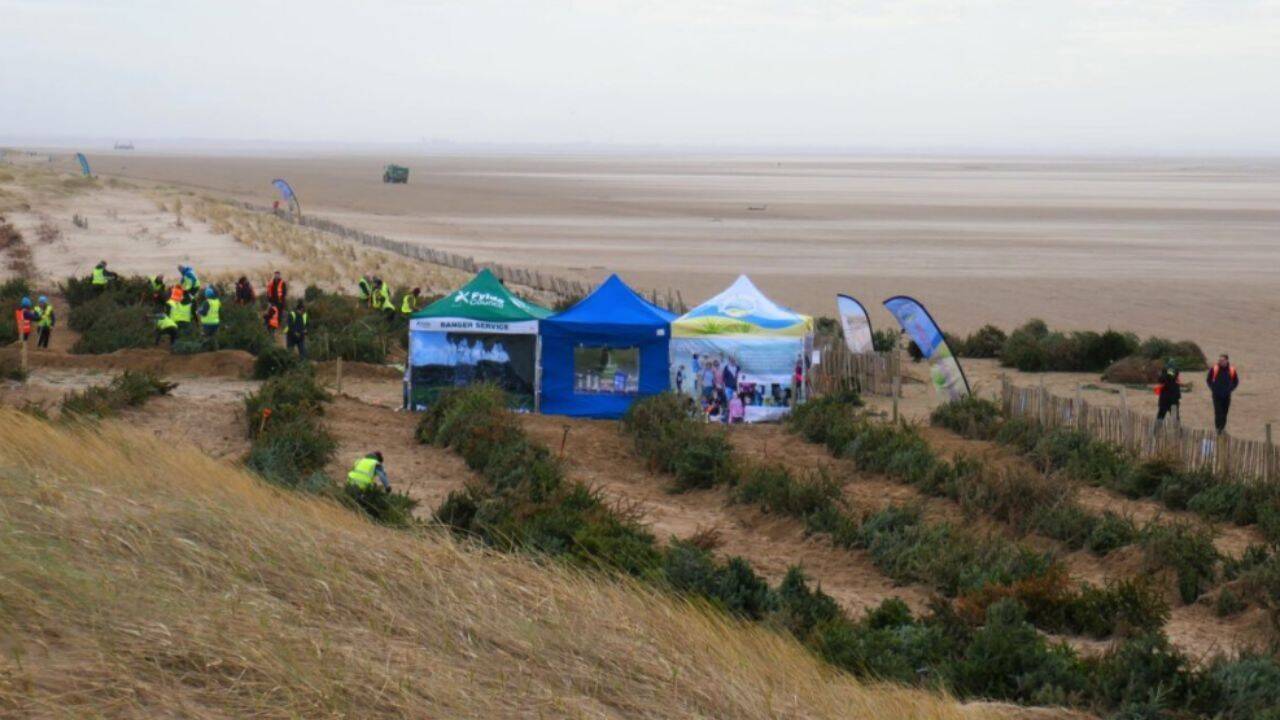
Photo via Times of India

How discarded Christmas trees are being used to build dunes on a UK beach

Read the original at Times of India ↗
Cite

TOI World Desk. (2026, September 6). How discarded Christmas trees are being used to build dunes on a UK beach. Times of India. https://timesofindia.indiatimes.com/world/uk/in-2013-a-uk-beach-began-planting-discarded-christmas-trees-to-trap-blowing-sand-by-2026-the-project-had-created-90-metres-of-new-dunes-that-help-defend-homes-from-flooding/articleshow/133826930.cms

Dated when The Aporia collected the article, usually within hours of publication. Check the original for its exact date and byline.

Times of India · collected 2026-09-06 · by TOI World Desk

Quick Summary

Since 2013, discarded Christmas trees have been used in a project on St Annes beach in Lancashire, UK, where they trap wind-blown sand and help build wider dunes. Over 2,000 trees were collected last year and helped create a 90-metre increase in the width of the Fylde Sand Dune system. The Fylde Sand Dunes Project, which involves Fydle Council, Lancashire Wildlife Trust, and Blackpool Council, aims to restore and conserve the coastal dunes. This is done by placing trees in front of existing dunes, where their branches slow down the wind and trap sand, eventually becoming part of a new dune.
Written by AI on 2026-09-06, from this article's own text only (the story summary below draws on all the coverage).

AI analysis

Story summary

In Lancashire, UK, discarded Christmas trees are being used to help protect homes and businesses along the Fylde Coast by building wider sand dunes. Since 2013, old Christmas trees have been placed on St Annes beach as part of the Fylde Sand Dunes Project, which aims to restore and conserve the coastal dunes. The project, funded by the Environment Agency, involves collaboration between Fydle Council, Lancashire Wildlife Trust, and Blackpool Council. Last year, over 2,000 Christmas trees were collected from residents and used in the planting work, resulting in a 90-metre increase in the width of the Fylde Sand Dune system. The project provides habitat for various plants and animals and acts as a natural defense against sea erosion.

Written for “Beach Dune Restoration Project” on 2026-10-31, grounded in this article and the 0 other(s) covering the same event.

Story

📰 Beach Dune Restoration Project
Environment · 1 article(s) covering the same event.

Compared with similar articles

Nothing to compare against. No article is close enough to this one for the pipeline to have linked or judged the pair.
How this article was measured signals, leaning charts, publisher record, byline, topics and claims

Signals How these are calculated →

Claims extracted
49
sentences that state something as happening or true
Uncertain
10%
5 of 49 hedged ("reportedly", "may", "according to")
Leaning
not political
takes no side on a contested political question
Publisher signals
59/100
Times of India's corrections and hedging, across everything collected from it. Not a measure of accuracy.
Outlets on this story
1
Environment
Same framing elsewhere
1
articles that frame the event the way this one does
Analyzed 2026-09-06 · how these are computed

How this is being covered How these are calculated →

Article leaning vs. publisher reliability
Source leaning vs. consistency

Publisher

Times of India · 3737 article(s) · 2 correction(s) detected
Running correction rate · 2 correction(s)

Who wrote this

TOI World Desk
1245 article(s) here · 1 carrying a prediction
🔮 Prince William and Kate Middleton may have been made aware of serious allegations against Meghan Markle’s father, Thomas Markle Sr., after a letter detailing the claims was reportedly sent to the joint office shared by the two royal couples at Kensington Palace in 2019.
🔮 The money will support nearly 7,000 children.
🔮 Within two months, Conard identified a property in a Denver strip mall that could be used for a haunted house.
🔮 They allege that Meta could combine this information with activity tracked on Eyemart’s website to identify them and deliver targeted advertisements.
🔮 People from outside Indiana University had also contacted Brian Williams, a professor at the Kelley School of Business who helped develop the programme, expressing interest in taking the course.
🔮 On October 31, the family will take the experience further by welcoming relatives from out of town to help bring the display to life with live actors.
🔮 Thus, a decade ago, he began collecting Halloween costumes for kids who couldn't afford them.
🔮 He expressed concern that the confrontation could cost him his job.
🔮 They said the celebrity's "suicide risk" could be lowered through treatment.
🔮 In one recording, Higby explained that they wanted to find out whether people could vote without showing identification.
Wire or desk byline, not an individual reporter.
Also by TOI World Desk
Nothing else under this byline is closely related to this article, so these are simply their most recent.
All 1245 articles by TOI World Desk →

Topics

Fydle Council Fylde Council Lancashire Lancashire Wildlife Trust the Fylde Sand Dunes Project

Subjects

Amy Pennington PERSON · 1× Blackpool Council ORG · 1× Fydle Council ORG · 1× Fylde Council ORG · 1× Lancashire GPE · 1× Lancashire Wildlife Trust ORG · 1× Lancashire Wildlife Trust’s ORG · 1× the Environment Agency ORG · 1× the Fylde Council ORG · 1× the Fylde Sand Dunes Project ORG · 1×

Narrative

Amy Pennington, Lancashire Wildlife Trust’s Fylde Sand Dunes Project Senior Engagement Officer, said the dunes provide habitat for a wide range of plants and animals and also act as a soft sea defence.
framing: assertive · carried by 1 article(s) · first seen 2026-09-06
🔮 At first, the collected sand can be unstable and may collapse.
2026-09-06 · Times of India
How discarded Christmas trees are being used to build dunes on a UK beach · assertive framing

Claims (49 extracted, 5 hedged)

Discarded Christmas trees are being used to help protect homes and businesses along the Fylde Coast in Lancashire, UK. asserted
trees → discard → Lancashire
Since the project began in 2013, old Christmas trees have been placed on St Annes beach to trap wind-blown sand and help build wider sand dunes. asserted
trees → begin → dunes
According to Fydle Council, the annual work is part of the Fylde Sand Dunes Project, which aims to restore and conserve the coastal dunes. uncertain
which → accord → dunes
Fylde Council, Lancashire Wildlife Trust and Blackpool Council work together on the project, which is funded by the Environment Agency. asserted
which → work → Agency
Trees are placed in front of the existing dunes, where their branches slow down the wind and trap sand. asserted
branches → place → sand
As more sand collects around the trees, the mound grows and can eventually become part of a new dune. asserted
mound → collect → dune
The project has already produced a visible change. asserted
project → produce → change
Last year, more than 2,000 Christmas trees were collected from residents and used in the planting work. asserted
trees → collect → work
According to the council, this helped create a 90-metre increase in the width of the Fylde Sand Dune system. uncertain
this → accord → system
Christmas trees build dunes asserted
trees → build → dunes
Sand dunes naturally develop when wind-blown sand is trapped by an obstruction on the beach. asserted
sand → develop → beach
At first, the collected sand can be unstable and may collapse. uncertain
sand → collect → ?
Plants can then begin growing in small pockets of sand and help hold the material in place. asserted
Plants → begin → place
At St Annes, discarded Christmas trees act as the first obstruction. asserted
trees → discard → obstruction
Their branches catch sand carried inland by the wind. asserted
branches → catch → wind
Over time, more sand becomes trapped around the trees, allowing the dune to grow. asserted
dune → trap → trees
The process then continues naturally. asserted
process → continue → ?
Pioneer grasses such as sand couch and lyme grass can grow in the dunes. asserted
grasses → grow → dunes
Marram grass can later become more dominant as sand builds around it. asserted
sand → become → it
Its growth helps stabilise the new dune, allowing more plants to establish. asserted
plants → help → dune
As the plants grow and spread, they help hold more sand in place. asserted
they → grow → place
Eventually, organic matter from plants that die and decay builds up. asserted
that → die → plants
The dune becomes more stable and develops into a habitat with different plants and animals. asserted
dune → become → plants
Why dunes matter asserted
dunes → matter → ?
Dunes act as a natural, or ‘soft’, sea defence. asserted
Dunes → act → defence
During storms, they absorb some of the energy from the sea. asserted
they → absorb → sea
Wider dunes are more effective at providing this protection. asserted
dunes → provide → protection
The dunes help reduce the risk of erosion caused by storm surges, which happen when strong winds combine with high tides. asserted
winds → help → tides
According to the Fylde Council, more than 80% of the dunes have been lost over the past 150 years because of coastal development. uncertain
% → accord → development
The remaining dunes are now squeezed between the sea and nearby towns. asserted
dunes → remain → sea
This makes protecting and extending them important for both coastal communities and wildlife. asserted
protecting → make → communities
Amy Pennington, Lancashire Wildlife Trust’s Fylde Sand Dunes Project Senior Engagement Officer, said the dunes provide habitat for a wide range of plants and animals and also act as a soft sea defence. asserted
dunes → say → defence
“The sand dunes along the Fylde Coast are home to a diverse and specialised ecosystem, hosting a variety of unique plants and animals,” she said. asserted
she → host → plants
A habitat for plants and wildlife The dunes have been designated as a Biological Heritage Site and are also a Site of Special Scientific Interest (SSSI). asserted
dunes → designate → Interest
They support specialised plants and animals that are adapted to the dry and shifting conditions of a sand dune environment. asserted
that → support → environment
Species found in the dunes include dune helleborine orchids, Isle of Man cabbage, dune pansies, sea holly and round-leaved wintergreen. asserted
Species → find → Man
Wildlife includes the grayling butterfly, mining bees, common lizards, skylarks, linnets and reed buntings. asserted
Wildlife → include → butterfly
The environment changes as the dunes develop. asserted
dunes → change → ?
Areas closer to the beach can have alkaline conditions because the sand contains pieces of sea shells. asserted
sand → have → shells
Further inland, the ground can become more acidic as the dune matures, allowing different plants to grow. asserted
plants → become → ?
…and 9 more, not listed.

💬Give feedback
🕘History 🎫Support