WITNESSES testified that a senior banker sketched private parts on the glass of his desk, asked a woman colleague to name them, and threatened to tear off her clothes if she wore a particular outfit again.
asserted
she → testify → outfit
Another officer made indecent remarks about her attire before colleagues.
asserted
officer → make → colleagues
The ombudsperson found the charges proved; the Islamabad High Court agreed.
asserted
Court → find → ?
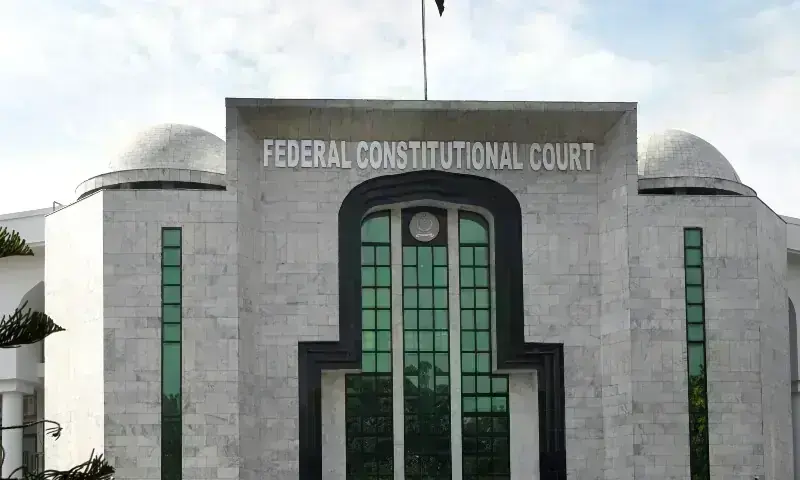
On Sept 16, the Federal Constitutional Court (FCC) set that judgement aside without substantively engaging with this evidence or the high court’s careful appraisal of it.
asserted
Court → set → it
Harassment under the 2010 workplace harassment law, it declared, “is only restricted to conduct which is sexual in nature”.
asserted
which → declare → nature
Even by that narrow test, the conduct proved was plainly sexual.
asserted
conduct → prove → test
Before the high court, the officers never contended it fell short of harassment.
asserted
it → contend → harassment
Why does the FCC confine harassment to sex?
asserted
FCC → confine → sex
The Act’s title and preamble speak of ‘harassment’, not ‘sexual harassment’, and anchor it in the right to dignity.
asserted
title → speak → dignity
Nor does ‘sexual’ mean only the act of sex; it also means relating to the sexes, or to gender.
asserted
it → mean → gender
The Supreme Court said so on review in Nadia Naz, through Justice Ayesha Malik; “sexually demeaning attitudes” means demeaning a person because of their sex.
asserted
attitudes → say → sex
Yale’s Vicki Schultz has shown that much workplace harassment has nothing to do with desire; it belittles women and signals they do not belong.
asserted
they → show → women
And the 2022 amendment, ignored altogether, covers gender discrimination “which may or may not be sexual in nature”.
uncertain
which → ignore → nature
Courts elsewhere agree.
asserted
Courts → agree → ?
The US supreme court held in Oncale that harassment need not be motivated by desire; Canada and India root it in equality and dignity.
asserted
Canada → hold → equality
India’s law lists “sexually coloured remarks”, exactly what was proved, and the 2021 Nadia Naz judgement the FCC relies on quoted that very provision.
asserted
FCC → list → provision
ILO Convention 190 treats gender-based harassment, including sexual harassment, as one wrong.
asserted
Convention → treat → wrong
This is where a constitutional court should begin.
asserted
court → begin → ?
Article 14 declares the dignity of man inviolable, and the Act’s own preamble rests on it.
asserted
preamble → declare → it
A constitutional court’s first duty is to read statutes through fundamental rights and expand their frontiers, not shrink them.
asserted
duty → read → them
A woman made to name drawings of private parts before her colleagues has had her dignity violated by any measure.
asserted
dignity → make → measure
Constitutional courts are judged not by the powers they claim but by the rights they protect.
uncertain
they → judge → rights
Our Supreme Court had already arrived there.
asserted
Court → arrive → ?
In Uzma Naveed (2022) and Muhammad Din (2025), both of which I authored, it held that harassment is not confined to the act of sex and that dignity is absolute and non-negotiable.
asserted
dignity → author → sex
The FCC dismisses Muhammad Din in one sentence, “with due respect”, ignores Uzma Naveed, and leans instead on the 2021 Nadia Naz judgement the Supreme Court set aside on review.
asserted
Court → dismiss → review
In Haji Adam, decided by the same author the same day, substantial passages reappear word for word; it even names the bank case’s witnesses as the Pemra complainant’s.
asserted
it → decide → complainant
That raises a serious question whether each record received independent judicial consideration.
asserted
record → raise → consideration
Judgements of the Supreme Court delivered before the 27th Amendment bound every court under Article 189.
asserted
Judgements → deliver → Article
The amendment operates prospectively: it makes the FCC’s decisions binding from now on, but it does not erase nearly eight decades of constitutional jurisprudence.
asserted
it → operate → jurisprudence
Having inherited the Supreme Court’s constitutional jurisdiction, the FCC inherited the law declared under it.
asserted
FCC → inherit → it
If it doubts that law, the doctrine of precedent requires reasoned reconsideration by a larger bench, not a three-member bench’s single sentence.
asserted
doctrine → doubt → bench
Even the FCC’s own test, set this March, forbids precedent being “ignored and disregarded in silence”.
asserted
precedent → set → silence
It was created by the 27th Amendment, rushed through a parliament whose own mandate remains clouded by the disputed elections of February 2024, and carved out of a functioning Supreme Court for reasons never convincingly explained.
asserted
mandate → create → reasons
Britain, the US, India, Canada and Australia entrust constitutional questions to a single apex court, and for good reason: splitting the apex invites conflict and political engineering.
asserted
splitting → entrust → conflict
South Africa moved the other way in 2013, making its constitutional court the apex court in all matters.
asserted
court → move → matters
Its first bench was chosen by the president on the prime minister’s advice, bypassing the Judicial Commission, with no published criteria or open assessment of merit.
asserted
bench → choose → merit
Such a court must earn confidence through its work.
asserted
court → earn → work
A judgement rendered without hearing the attorney general or appointing an amicus (even the high court had one), and thin on scholarship and constitutional understanding, does not earn it.
asserted
court → render → it
Nor does the price: salaries above the Supreme Court’s until that court was raised to match, generous staff allowances, and three more years of tenure
asserted
court → do → tenure
Not a single woman sits on the FCC, a conspicuous absence in a harassment case.
asserted
woman → sit → case
…and 12 more, not listed.
 The Aporia