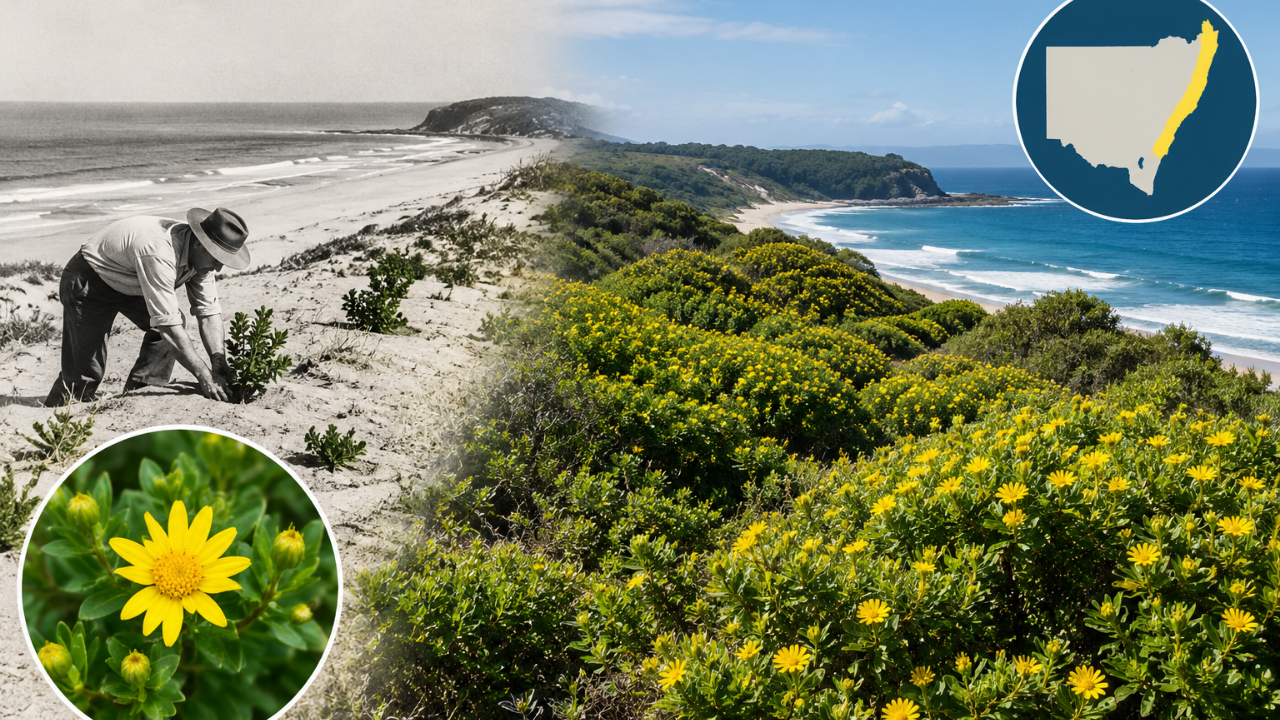
A plant introduced with a practical purpose along the New South Wales (NSW) coast eventually became a major environmental weed.
asserted
plant → introduce → coast
South African bitou bush was deliberately planted along the NSW coastline between 1946 and 1968 to help stabilise sand dunes, according to the NSW Environment and Heritage department.
uncertain
bush → plant → department
The fast-growing shrub later spread rapidly and is now found along 46% of the state's coastline, with some infestations extending up to 10 kilometres inland.
asserted
infestations → grow → coastline
What was once used to control shifting sand has since become a threat to native coastal vegetation and wildlife, prompting long-running efforts to contain and remove it.
asserted
used → use → it
A plant brought in to stabilise dunes
Bitou bush, scientifically known as Chrysanthemoides monilifera subsp. rotundata, is native to South Africa.
asserted
bush → bring → Africa
NSW Environment and Heritage says it is thought to have initially reached Australia in ship ballast before later being deliberately used for dune stabilisation.
asserted
it → say → stabilisation
Its deliberate planting along the NSW coast began in 1946 and continued through 1968.
asserted
planting → begin → 1968
The plant was valued because it grew quickly and could help hold loose coastal sand in place.
uncertain
it → value → place
Historical government documents also record its use to stabilise and revegetate dunes affected by coastal sand mining.
asserted
documents → record → mining
Planting took place at a number of coastal locations, including Ballina, Byron Bay, Crescent Head, Iluka, Lake Munmorah, Port Macquarie, Redhead, The Entrance and Tweed Heads.
asserted
Planting → take → Ballina
The same characteristics that made bitou bush useful for stabilisation, however, also helped it become difficult to control once it established beyond planted areas.
asserted
it → make → areas
How bitou bush spread
Once established along the coastline, bitou bush spread through a combination of deliberate planting and natural expansion.
asserted
bush → spread → planting
The NSW government now records it along 46% of the state's coastline, with the north coast particularly heavily affected.
asserted
coast → record → coastline
In some locations, the shrub has moved as far as 10 kilometres inland.
asserted
shrub → move → kilometres
Bitou bush is capable of growing rapidly and forming dense stands.
asserted
bush → grow → stands
Rather than simply occupying empty spaces, it can move into existing coastal plant communities and create thick shrub layers.
That expansion has changed the character of some dunes, headlands and other coastal habitats.
asserted
expansion → occupy → dunes
Earlier government assessments described an even wider distribution at different points in time, reflecting differences in surveys, definitions and assessment periods.
asserted
assessments → describe → surveys
A NSW Scientific Committee determination in 1999, for example, reported the weed on 90% of the state's sandy coast.
asserted
determination → report → coast
The current NSW Environment and Heritage data shows the figure as 46% of the state's coastline.
asserted
data → show → coastline
Native plants and animals face pressure
asserted
plants → face → pressure
The main environmental concern is not simply the presence of an introduced shrub but what happens when it becomes dominant.
asserted
it → introduce → shrub
According to NSW Environment and Heritage, bitou bush invades coastal heathlands, grasslands, woodlands and forests.
uncertain
bush → accord → heathlands
It can form dense stands that replace native plants and alter habitats used by native animals.
asserted
that → form → animals
Infestations can also smother vegetation communities found on sand dunes and headlands.
asserted
Infestations → smother → dunes
The NSW Bitou Threat Abatement Plan identified 157 native plant species, three plant populations and 24 ecological communities as being at risk from bitou bush and boneseed invasion.
asserted
Plan → identify → invasion
The plan also identified 24 native animal species potentially threatened by the spread of the weeds.
asserted
plan → identify → weeds
Because of these impacts, the NSW Scientific Committee has listed the invasion of native plant communities by bitou bush and boneseed as a key threatening process affecting native plants and animals.
asserted
Committee → list → plants
Efforts now focus on containment and restoration
Managing the weed is now a long-term conservation task.
asserted
Managing → focus → weed
Bitou bush and the related South African plant boneseed were collectively listed as Weeds of National Significance in 2000.
asserted
bush → list → 2000
NSW has also developed a Threat Abatement Plan that directs control towards sites where removing the weed can provide the greatest benefit to threatened species and ecological communities.
asserted
removing → develop → species
The approach involves more than simply removing individual plants.
asserted
approach → involve → plants
Control programmes involve government agencies, local authorities, community groups, Aboriginal groups, land managers and bush regenerators.
asserted
programmes → involve → agencies
The NSW plan identifies 169 priority sites, alongside northern and southern containment zones intended to limit further spread and protect important native vegetation.
asserted
plan → identify → vegetation
Under the NSW Biosecurity Act 2015, specific requirements also apply to bitou bush management.
asserted
requirements → apply → management
In areas north of Cape Byron and south of Point Perpendicular, eradication is required, while the central coastal distribution is managed through containment measures.
asserted
distribution → require → measures
The history of bitou bush shows how a species introduced to solve one environmental problem can create another when it spreads beyond its intended role.
asserted
it → show → role
Decades after it was planted to stabilise NSW sand dunes, the shrub has become widespread enough to require coordinated control, with restoration efforts now aimed at giving native coastal ecosystems space to recover.
asserted
efforts → plant → space
 The Aporia