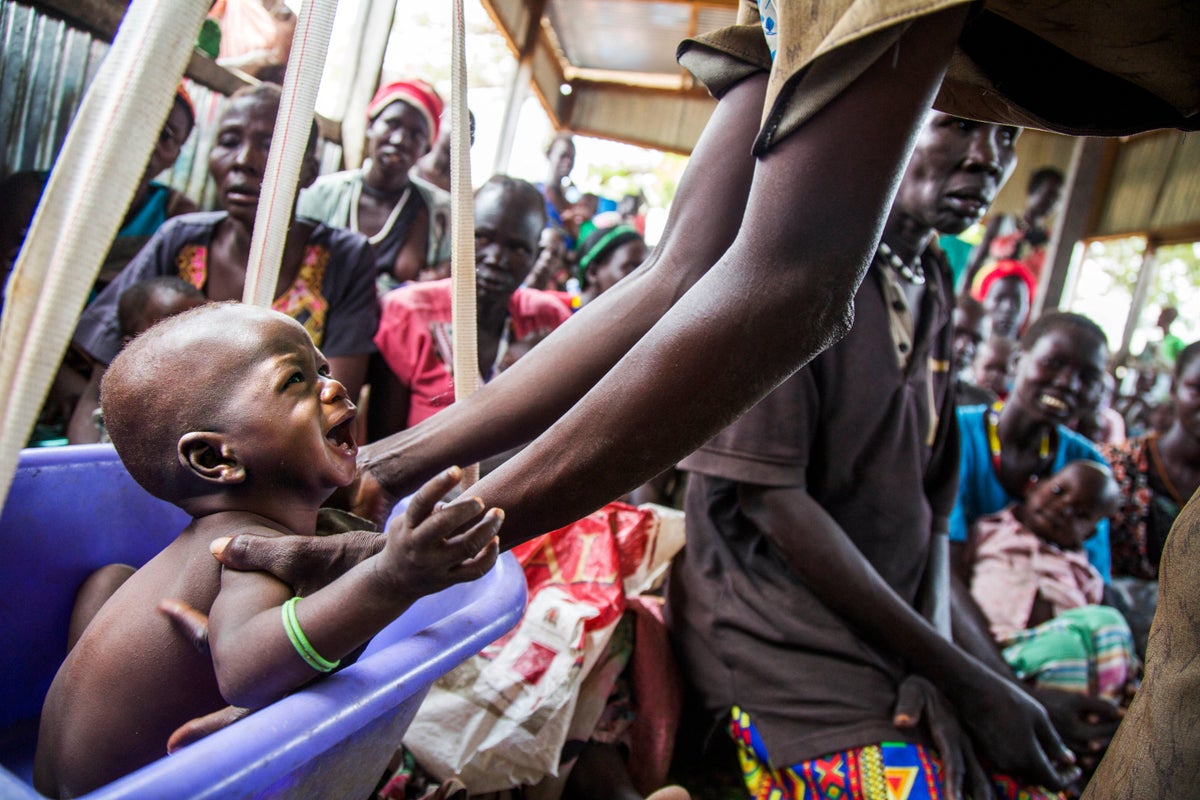
Basa Christine Samson, from South Sudan, decided that to help end the string of maternal deaths she had witnessed among her friends and family, she needed to become a midwife.
“There was a lot of maternal death in the community I live in,” she tells The Independent.
asserted
she → decide → Independent
After training in midwifery, Basa worked in hospitals, in the community, and now in a healthcare facility run by the International Rescue Committee humanitarian organisation.
asserted
Basa → train → organisation
Although she finds the work rewarding – “once you see the mother and baby are alive and well, you are very joyful,” she says – the challenges are endless.
asserted
challenges → find → ?
“You're looking at your patient, and you know you can't provide her with the correct equipment,” she said.
asserted
she → look → equipment
“Because of the funding shortages, we have faced challenges with supplies.
asserted
we → face → supplies
We don't have catheters; we don't have sterile gloves.
asserted
we → have → gloves
Sometimes the lights go out when there is no fuel, and we work in darkness and use torches.
asserted
we → go → torches
These challenges, and many more, help to explain why there is a shortage of midwives throughout Africa.
asserted
challenges → help → Africa
EQUAL, a multi-country research consortium generating evidence on effective approaches to deliver life-saving maternal and newborn health care in countries affected by conflict, recently found that there is a global midwife shortage up to 980,000, and that Africa needing half of those.
asserted
Africa → generate → those
The continent is home to 19 per cent of the world’s women of reproductive age but carries 46 per cent of the global midwife shortage.
asserted
continent → carry → shortage
“The 2025 State of the World's Midwifery Report for East and Southern Africa reported an increase from 2.5 to 3.2 midwives per 10,000 population, but this remains well below the global average of 4.4per 10,000,” Shatha Elnakib, an assistant research professor at Johns Hopkins Bloomberg School of Public Health, tells The Independent.
asserted
Elnakib → report → Independent
“We really need to accelerate progress; the gains are too modest and fragile.”
asserted
gains → need → progress
Elnakib says too few midwives in Africa are being trained due to insufficient training capacity, that the ones who are trained are finding it difficult to get jobs, and once jobs are found, “low salaries, burnout, unsafe working conditions, limited professional support, and insecurity push many midwives out of the workforce.”
In conflict-zones throughout Africa – including South Sudan, parts of the eastern Democratic Republic of Congo, Sudan, Mali, and Burkina Faso – the picture for midwives, and in turn for mothers and babies, is even more bleak.
asserted
picture → say → mothers
“Conflict zones sit at the extreme end of a shortage that's already severe continent-wide,” Dr Caroline Tatua, Regional Health Lead at International Rescue Committee, says.
asserted
Tatua → sit → Committee
“Insecurity is a big challenge,” Viola Kiden, a midwife working in conflict-torn South Sudan for the past three years tells The Independent.
asserted
Kiden → work → Independent
“Sometimes the mothers don't come early enough because movement at night is difficult, and by the time they arrive they have complications or are in an advanced stage and we have to try to manage and save them.
asserted
we → come → them
It’s not only mothers and their babies midwives have to safely manage in the middle of conflict zones; midwives in these areas are desperately trying to keep themselves safe as well.
asserted
midwives → ’ → themselves
“Picture this,” Dr Tatua says, describing a typical day for a midwife in a conflict zone.
asserted
Tatua → picture → zone
“The roads are too dangerous or too damaged, so there is no ‘send her to hospital’ option.
asserted
roads → be → hospital
The power cuts out mid-delivery.
asserted
power → cut → ?
Patients don’t arrive until they’re in danger and experiencing life-threatening complications, so the midwife is doing emergencies, not just routine births.
asserted
midwife → arrive → emergencies
She’s working completely alone, with no colleague to consult mid-crisis or debrief with if a mother or a baby doesn’t survive.
asserted
mother → work → -
”
Working conditions are grim – but there are more systemic reasons fewer and fewer midwives are working in conflict zones.
asserted
midwives → be → zones
Healthcare facilities have been attacked and/or destroyed, leaving midwives without safe workplaces.
asserted
facilities → attack → workplaces
Midwives have reported they have been specifically targeted by militants as a military strategy (sometimes being kidnapped).
asserted
they → report → strategy
Along with thousands of others fleeing, midwives themselves are displaced from conflict zones, unable to continue working in their home countries.
asserted
midwives → flee → countries
Insecurity blocks deployment of midwives, with governments and NGO’s unable to safely deploy staff in active conflict areas.
asserted
governments → block → areas
International funding cuts have depleted resources in war-torn countries, disrupting midwifery training, salaries, and essential commodity and equipment supply chains.
asserted
cuts → deplete → training
But it isn’t conflict that creates the midwifery gap.
asserted
that → create → gap
“It detonates an existing one,” says Dr Tatua.
asserted
Tatua → detonate → one
And the gap is leaving midwives in conflict zones “overwhelmed, isolated, and under supported,” Dr Tatua continues.
asserted
Tatua → leave → zones
“Those are the words that come up again and again when you talk to midwives working in conflict-affected areas.
asserted
you → come → areas
But many feel invisible — sidelined by policy, without the formal recognition their clinical judgment actually deserves.
asserted
judgment → feel → recognition
”
Something has to be done to train and retain midwives, Elnakib of Johns Hopkins University, says, otherwise, “midwives will continue leaving the profession, or choose not to work in conflict-affected areas; the workforce will shrink, and women and babies will continue to die from preventable causes.”
asserted
women → have → causes
To train, deploy, and retain midwives, Elnakib says, governments need to strengthen employment pathways, improve deployment systems, and provide financial and security incentives for working in conflict-affected areas.
asserted
governments → train → areas
“Midwives need better salaries, hazard pay, security escorts, safe accommodation, better lighting and fencing around facilities, improved working conditions, and systematic mental health support rather than ad hoc or one-off interventions,” she adds.
asserted
she → need → interventions
Dr Tatua agrees, suggesting that “without adequate security and safe access, nothing else matters,” and that local governments, NGOs and local communities can work to ensure this for midwives and patients.
asserted
governments → agree → midwives
She also says that community-based service modalities such as mobile clinics and outreach teams “make a difference” when it comes to care because they bring midwives to displaced populations instead of expecting people to make it to a facility that “may have been bombed or too dangerous to reach.”
uncertain
people → say → facility
Enos Walela, a nurse midwife working in one of these mobile units in the Kakuma Refugee Camp in Kenya, tells The Independent that the greatest present need is for well-stocked supplies.
asserted
need → work → supplies
“There was a time we were out of drugs for postpartum haemorrhage for almost a week,” he said.
asserted
he → be → week
…and 6 more, not listed.
 The Aporia