In 1963, vaccine researcher Dr Maurice Hilleman was working to develop a safe and effective vaccine against mumps when his five-year-old daughter, Jeryl Lynn, developed the disease.
asserted
daughter → work → disease
One night, Jeryl Lynn woke Hilleman and showed him her swollen cheeks, a characteristic sign of mumps.
asserted
Lynn → wake → mumps
He then swabbed her throat to collect a sample of the virus and drove it to his laboratory.
asserted
He → swab → laboratory
Hilleman was the chief virologist at Merck Research Laboratories in the 1960s and had set out to create a mumps vaccine.
asserted
Hilleman → set → vaccine
At the time, mumps was considered a common childhood illness, and many parents underestimated its dangers.
asserted
parents → consider → dangers
According to the Smithsonian’s National Museum of American History, scientists had already tried to develop a vaccine, but earlier attempts had problems.
uncertain
attempts → accord → problems
Some vaccines caused too many mumps symptoms, while others did not provide enough immunity.
asserted
others → cause → immunity
Jeryl Lynn’s infection gave Hilleman a chance to try a different approach.
asserted
infection → give → approach
He suspected that he needed to work with another strain of the virus.
asserted
he → suspect → virus
After collecting the sample from his daughter, he began trying to weaken the virus, a process known as attenuation.
asserted
he → collect → attenuation
The aim was to make the virus weak enough that it would not cause mumps, while still allowing it to produce immunity.
asserted
it → make → immunity
Hilleman achieved this by introducing the virus to generations of chicken embryo cells.
asserted
Hilleman → achieve → cells
With each generation, the virus changed.
asserted
virus → change → generation
It became better at attacking the chick cells and less able to attack human cells.
asserted
It → become → cells
The resulting vaccine strain was officially named the Jeryl Lynn Strain, after the child whose infection provided the original virus sample.
asserted
infection → result → sample
From Jeryl Lynn’s infection to a vaccine
Human testing showed that the Jeryl Lynn Strain vaccine could produce strong immunity without causing the disease in vaccinated children.
uncertain
vaccine → show → children
The work then moved towards clinical use, including a remarkable connection within the Hilleman family.
asserted
work → move → family
Jeryl Lynn herself could not benefit directly from the vaccine that carried her name.
uncertain
that → benefit → name
Her younger sister, Kirsten Jeanne Hilleman, did.
asserted
sister → do → ?
In 1966, Kirsten was immunised with the investigational vaccine.
asserted
Kirsten → immunise → vaccine
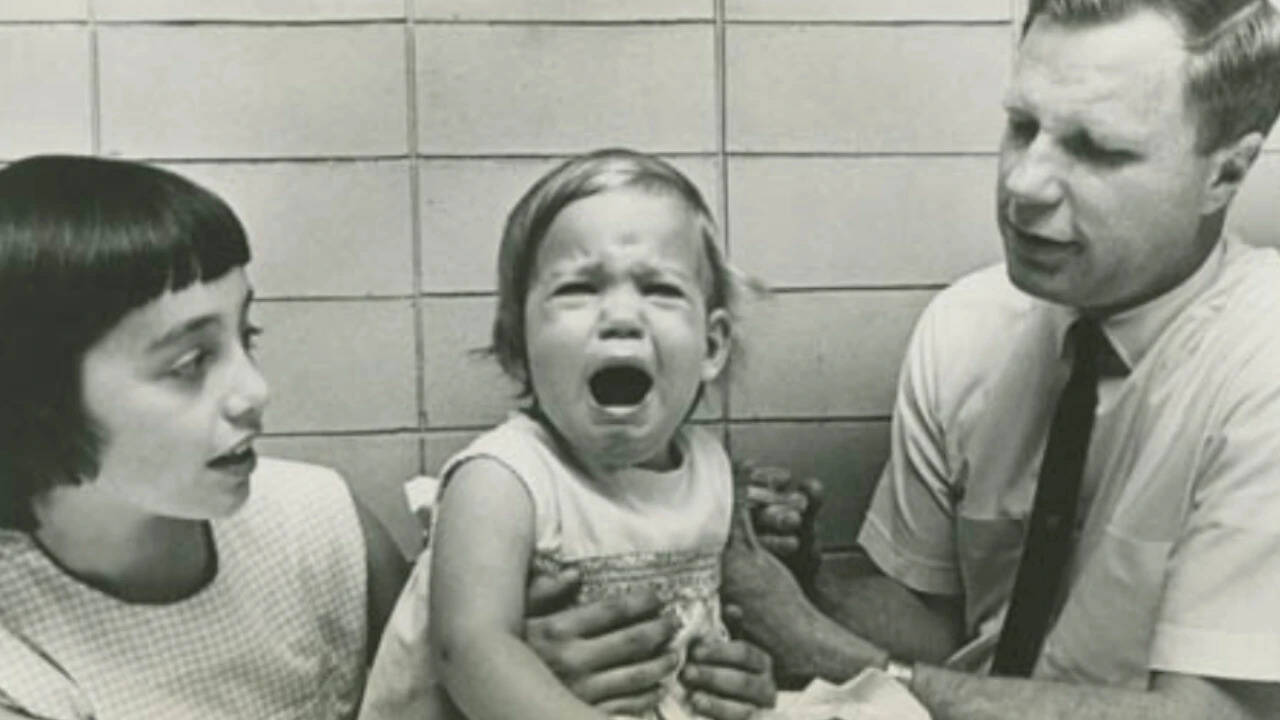
A photograph from that year shows Jeryl Lynn comforting her younger sister as Kirsten received the vaccine from Dr Robert Weibel.
asserted
Kirsten → show → Weibel
The Smithsonian says the vaccine was developed from the virus collected from Jeryl Lynn’s mumps infection.
asserted
vaccine → say → infection
Its collection also includes vials of the investigational vaccine used to immunise Kirsten.
asserted
collection → include → Kirsten
In 1967, the US Food and Drug Administration approved Merck’s mumps vaccine.
asserted
Administration → approve → vaccine
The vaccine developed by Hilleman remains in use today and is still derived from the Jeryl Lynn strain.
asserted
vaccine → develop → strain
The Smithsonian also notes that doctors began administering the Jeryl Lynn Strain mumps vaccine to the American public in early 1968.
asserted
doctors → note → 1968
Why the mumps vaccine mattered
The vaccine was developed against a disease that could cause more than the familiar swelling of the jaw and cheeks.
uncertain
that → matter → jaw
Most people who contract mumps recover fully, but the disease can also lead to serious and sometimes permanent complications.
asserted
disease → contract → complications
These include inflammation of the testicles and ovaries, encephalitis, which is swelling of the brain, meningitis, which is infection of the tissue around the brain and spinal cord, seizures and deafness.
asserted
which → include → brain
Before vaccination, mumps was also a significant cause of acquired deafness in childhood in the United States.
asserted
mumps → acquire → States
The Smithsonian noted that the disease was once so common that it was often treated as a normal part of growing up, even though it could have serious consequences.
uncertain
it → note → consequences
The museum marked 50 years of mumps vaccination in America in 2018.
asserted
museum → mark → 2018
It described how the vaccine helped make the swollen cheeks associated with mumps a thing of the past for many Americans.
asserted
cheeks → describe → Americans
The change was also reflected in popular culture.
asserted
change → reflect → culture
The Smithsonian holds two Norman Rockwell prints from around 1972 that were commissioned by Merck Research Laboratories to celebrate vaccination and the changing American experience of childhood disease.
asserted
that → hold → disease
One of the works shows a family having to cancel a fishing trip after their son develops mumps.
asserted
son → show → mumps
The virus sample was kept for decades
asserted
sample → keep → decades
The story of the Jeryl Lynn Strain did not end with the vaccine’s development.
asserted
story → end → development
The Smithsonian later acquired an object connected to the preservation of the virus stock used for vaccine production.
asserted
Smithsonian → acquire → production
The museum acquired a shiny stainless-steel 15-litre canister that had stored part of the frozen Jeryl Lynn virus “seed stock”.
asserted
that → acquire → stock
…and 7 more, not listed.
 The Aporia