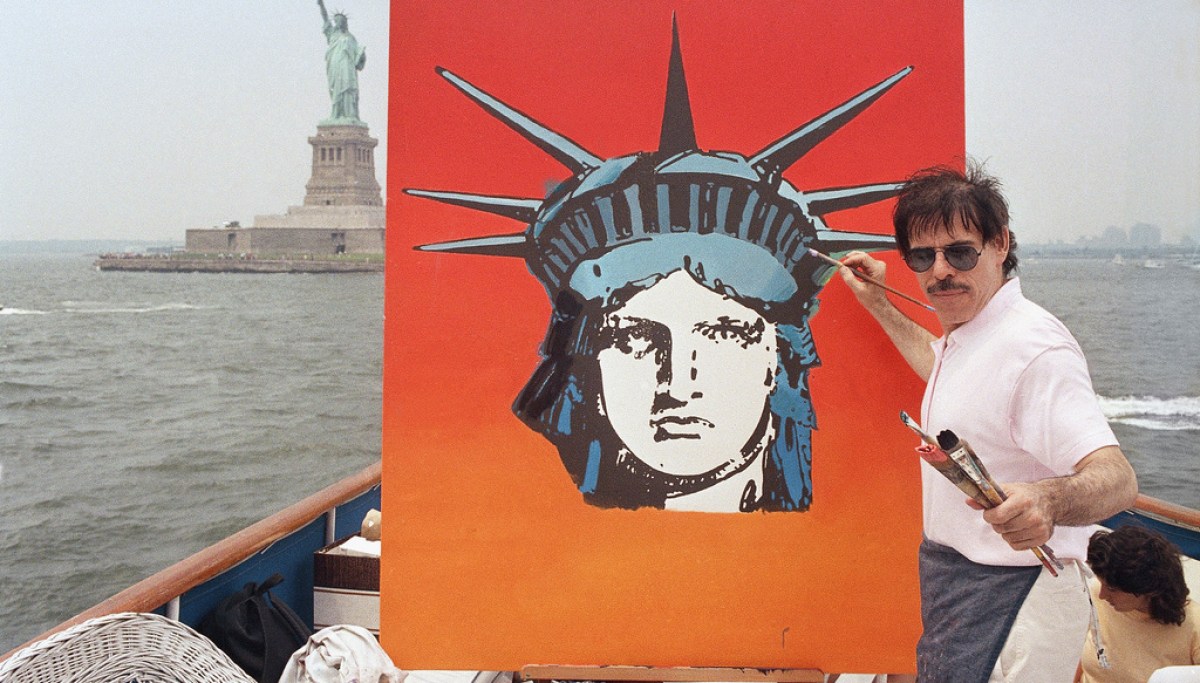
Photo via Washington Examiner

Warhol was a genius for using assistants. Why was Peter Max called a fraud?

Read the original at Washington Examiner ↗
Cite

Wargotz, E., & Wargotz, C. A. L. L. (2026, October 4). Warhol was a genius for using assistants. Why was Peter Max called a fraud? Washington Examiner. https://www.washingtonexaminer.com/op-eds/4740342/peter-max-studio-assistants-warhol-double-standard/

Dated when The Aporia collected the article, usually within hours of publication. Check the original for its exact date and byline.

Washington Examiner · collected 2026-10-04 · by Eric Wargotz, Cheryl-Ann Lee-Llacer Wargotz

Quick Summary

Peter Max, a pioneering American artist of the 1960s known for his vibrant "flower power" era designs, died at age 88 in Manhattan on September 14, 2026. The article revisits an earlier New York Times exposé alleging that assistants painted many of Max's works during his later years, undermining their value. However, the piece argues this critique is flawed because it relies solely on administrative evidence without objective visual comparison between early and late works by independent experts. It also points out that historical art masters like Leonardo da Vinci routinely used assistants to complete works attributed entirely to them, challenging the notion of individual artistic isolation in creating masterpieces.
Written by AI on 2026-10-04, from this article's own text only (the story summary below draws on all the coverage).

AI analysis

Story summary

Peter Max, born in Berlin to a Jewish family that fled Nazi Germany, became an iconic American artist known for his vibrant, psychedelic artwork of the 1960s. He died at age 88 on September 14, 2026, after battling advanced dementia. The debate over Max's legacy intensified following investigative reports by the New York Times suggesting that assistants completed many of his artworks during his later years when he was frail and ill. This revelation has cast doubt on the authenticity and financial value of some of Max’s works created in recent decades. Critics argue that such claims undermine the artist's creative integrity and suggest a fraudulent operation, while supporters contend these accusations distort Max's significant contributions to American pop culture in the 1960s.

Written for “Artists Controversy” on 2026-11-01, grounded in this article and the 0 other(s) covering the same event.

Story

📰 Artists Controversy
Entertainment · 1 article(s) covering the same event.

Compared with similar articles

Nothing to compare against. No article is close enough to this one for the pipeline to have linked or judged the pair.
How this article was measured signals, leaning charts, publisher record, byline, topics and claims

Signals How these are calculated →

Claims extracted
60
sentences that state something as happening or true
Uncertain
0%
0 of 60 hedged ("reportedly", "may", "according to")
Leaning
Leans left
of the writing, not the subject · beta estimate
Publisher signals
70/100
Washington Examiner's corrections and hedging, across everything collected from it. Not a measure of accuracy.
Outlets on this story
1
Entertainment
Same framing elsewhere
1
articles that frame the event the way this one does
Analyzed 2026-10-04 · how these are computed

How this is being covered How these are calculated →

Article leaning vs. publisher reliability
Source leaning vs. consistency

Publisher

Washington Examiner · 3879 article(s) · 7 correction(s) detected
Running correction rate · 7 correction(s)

Who wrote this

Eric Wargotz
45 article(s) here · 1 carrying a prediction
🔮 MAGA has become the central pillar holding up the modern Right, meaning its exit would pull down the entire architecture.
2026-10-31 · assertive framing · MAGA won the party. It just lost the math
🔮 The timing of this rapidly unfolding development could not be more dangerous.
🔮 But right now, all these conflicting voices in his ear, the domestic polling, and the foreign pressure might just be clouding his judgment.
🔮 A highly active, independent 85-year-old with multiple risk factors might experience significant, long-term survival benefits from continuous lipid management.
🔮 When we — whether ordinary citizens or high-level officials — flirt with systemic collapse simply because we despise the current administration, we play with a fire that will consume everyone.
🔮 National surveys published by the Pew Research Center Climate Pessimism Study document that roughly 60% of Americans express deep anxiety that global actors will fail to mitigate the worst environmental impacts due to political division.
2026-10-09 · assertive framing · The climate war’s dumbest lie: Jobs vs. nature
🔮 If your only window into the American soul is the nightly cable news broadcast, you would assume we are a nation completely irreconcilable, locked in a permanent cultural cold war.
🔮 Meanwhile, Trump boldly cut through the bureaucratic panic, signaling that the White House has no appetite for heavy-handed domestic regulations that would cripple our edge and stating that our primary guardrails remain the rule of law and the Department of Justice.
🔮 When we look at this disparity under the microscope, we find that it is neither a failure of individual willpower nor a consequence of an isolated genetic pool.
🔮 Every single time I hit “send” on a new draft, a cynical voice in my head asks the exact same questions: Will the editor accept this, as they’re overwhelmed with tons of these a day?
Also by Eric Wargotz
MAGA won the party. It just lost the math
2026-10-31 · Washington Examiner
Nothing else under this byline is closely related to this article, so these are simply their most recent.
All 45 articles by Eric Wargotz →
Cheryl-Ann Lee-Llacer Wargotz
2 article(s) here · 1 carrying a prediction
🔮 The critics omitted this step because the results would have disrupted their narrative.
Also by Cheryl-Ann Lee-Llacer Wargotz
Nothing else under this byline is closely related to this article, so these are simply their most recent.

Topics

American Berlin Germany Jewish Nazi

Subjects

Max PERSON · 6× Warhol PERSON · 3× American NORP · 2× Berlin GPE · 1× Germany GPE · 1× Jewish NORP · 1× Nazi NORP · 1× New York GPE · 1× Peter Max PERSON · 1× Peter Max Finkelstein PERSON · 1×

Narrative

This mirrors the famous institutional collapse covered by Hyperallergic on the Warhol Authentication Board, which faced fierce antitrust lawsuits after being accused of arbitrarily rejecting valid screenprints to artificially drive up prices for the estate.
framing: assertive · carried by 1 article(s) · first seen 2026-10-04
🔮 The critics omitted this step because the results would have disrupted their narrative.
2026-10-04 · Washington Examiner
Warhol was a genius for using assistants. Why was Peter Max called a fraud? · assertive framing

Claims (60 extracted, 0 hedged)

He was born in Berlin to a Jewish family that fled Nazi Germany when he was an infant. asserted
he → bear → Germany
He immigrated to New York as a teenager in 1953, became a naturalized U.S. citizen, and spent his entire adult life and career in the United States. asserted
He → immigrate → States
Max basically invented the look of the “flower power” era with his wildly bright colors and cosmic designs — think neon rainbows, planets, stars, and psychedelic flowers. asserted
Max → invent → rainbows
Sadly, Max died in Manhattan on Sept. 14, 2026, at age 88, after struggling for years with advanced dementia. asserted
Max → die → dementia
His death renewed a long-standing art world debate. asserted
death → renew → debate
For decades, Max’s cosmic, Day-Glo imagery served as a visual soundtrack to American optimism. asserted
imagery → serve → optimism
Yet, the conversation surrounding his legacy remains heavily anchored to past media exposés. asserted
conversation → surround → exposés
Most notably, an investigative report by the New York Times alleged that the artist’s studio operated an assembly line where assistants painted works for a frail artist to sign. asserted
artist → allege → works
The media’s narrative presents a simple conclusion. asserted
narrative → present → conclusion
Because Max utilized assistants to complete canvases during his later years, the financial and aesthetic value of his late-career catalog is fundamentally compromised. asserted
value → utilize → catalog
This critique is built on a flawed premise and must be rejected on two distinct fronts. asserted
critique → build → fronts
First, the investigation failed to employ empirical methods of art evaluation. asserted
investigation → fail → evaluation
Critics built their case on administrative timelines and studio logistics rather than the visual evidence of the art itself. asserted
Critics → build → art
To objectively prove a decline in aesthetic value, an investigation must conduct a rigorous, blind, side-by-side comparison. asserted
investigation → prove → comparison
Investigators should have selected a control group of works entirely hand-painted by Max in his youth. asserted
Investigators → select → youth
They should have placed them adjacent to late-stage, studio-assisted pieces. asserted
They → place → pieces
Independent art historians, appraisers, and technical experts should have been brought into a room blindly. asserted
historians → bring → room
Without signatures or production dates visible, they should have been asked to separate the master’s solo hand from the assistants’ brushstrokes. asserted
they → ask → brushstrokes
The critics omitted this step because the results would have disrupted their narrative. asserted
results → omit → narrative
Second, the media’s critique ignores the reality that the solitary artist working in total isolation is a modern myth. asserted
artist → ignore → isolation
Since the beginning of recorded art history, the world’s greatest masters have employed apprentices and studio assistants to execute their visions. asserted
masters → employ → visions
During the Renaissance, masters such as Leonardo da Vinci, Michelangelo, and Rembrandt operated large workshops. asserted
masters → operate → workshops
Assistants routinely ground pigments, painted backgrounds, laid down base coats, and completed secondary figures. asserted
Assistants → grind → figures
Yet, the final works were explicitly issued under the master’s name and studio. asserted
works → issue → name
The art world has accepted this for centuries because the intellectual ownership, composition, and direction belonged entirely to the master. asserted
ownership → accept → master
To see the double standard of these modern critics, one only needs to draw a direct comparison to the undisputed king of pop art: Andy Warhol. asserted
one → see → art
Warhol explicitly embraced mass production, commercial silk-screening, and assembly-line mechanics in his studio, famously documented in The Factory. asserted
Warhol → embrace → Factory
He frequently did not touch the physical canvas at all, leaving it to his assistants to run the screens and pull the ink. asserted
He → touch → ink
As The Andy Warhol Museum notes, Warhol’s career intentionally adapted the tools of the advertising industry into a system in which mass production was itself the art form. asserted
production → note → which
Yet, the art establishment celebrates Warhol’s collaborative studio production as a stroke of conceptual genius, and his pieces command tens of millions at auction. asserted
pieces → celebrate → auction
In contrast, Max utilized a very similar workshop model, employing graphic design principles and using assistants to apply base coats and execute layouts under his direction. asserted
Max → utilize → direction
Yet, institutional critics weaponize this standard pop art practice to devalue Max’s legacy. asserted
critics → weaponize → legacy
If studio assistance inherently devalues an artwork, then the market must systematically downgrade the collections of Warhol, Jeff Koons, and Damien Hirst. asserted
market → devalue → Warhol
All of these artists operated large-scale production studios where the principal artist rarely touched a physical paintbrush. asserted
artist → operate → paintbrush
This double standard is even more glaring when examined through the lens of existing regulatory and commercial law. asserted
standard → examine → law
Under the Uniform Commercial Code and federal intellectual property frameworks, the legal definition of artistic authorship does not require an artist to lay down every stroke of paint. asserted
definition → require → paint
An artwork is legally authentic if it is executed under the artist’s explicit authorization, direction, and supervision, culminating in their definitive signature. asserted
it → execute → signature
As art legal expert Luke Nikas noted during the initial studio disputes, Max’s creative control and trademark colors met every established legal and commercial standard of authorship. asserted
control → note → authorship
Furthermore, a significant portion of the public confusion stems from a regulatory paradox surrounding the secondary market. asserted
portion → stem → market
Many of the disputed late-career Max pieces were sold via cruise-ship art auctions. asserted
Many → dispute → auctions
…and 20 more, not listed.

💬Give feedback
🕘History 🎫Support