Photo via Times of India

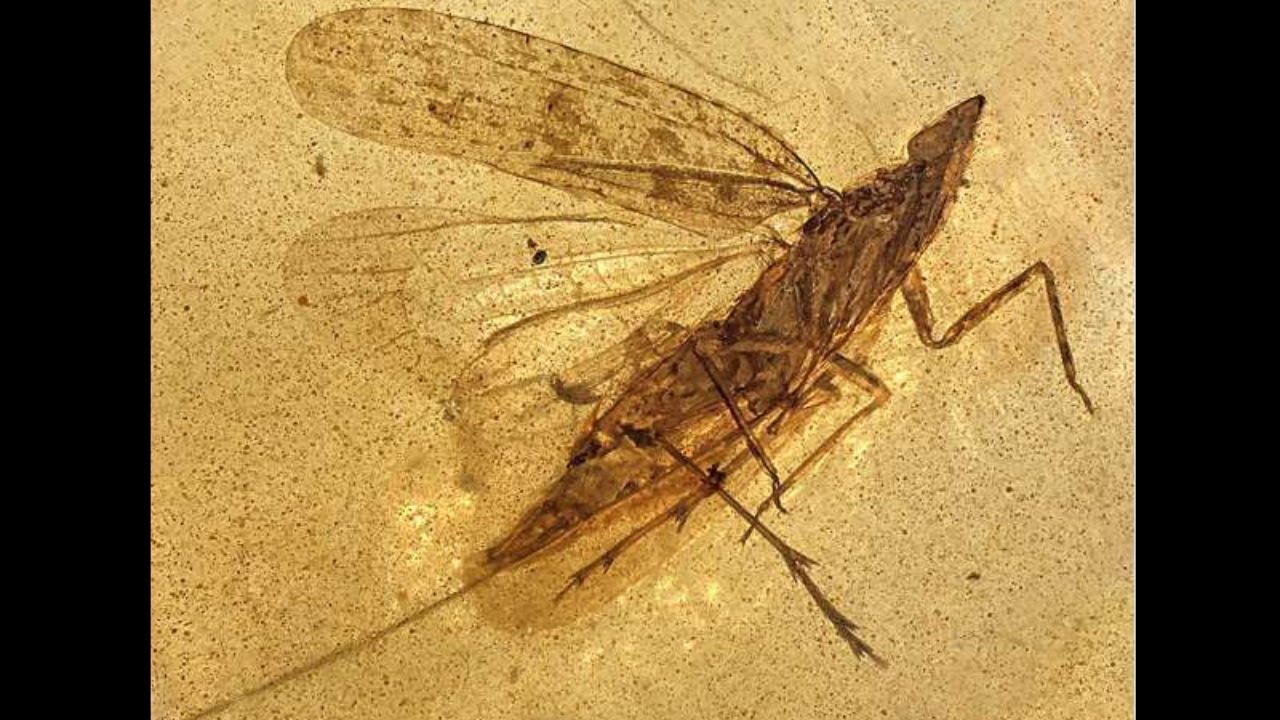
13 insects in 99-million-year-old amber reveal new species with mouthpart nearly twice its body length

Read the original at Times of India ↗
Cite

TOI Science Desk. (2026, October 6). 13 insects in 99-million-year-old amber reveal new species with mouthpart nearly twice its body length. Times of India. https://timesofindia.indiatimes.com/science/archaeology/scientists-examined-13-insects-trapped-in-99-million-year-old-amber-and-identified-a-new-species-whose-flexible-mouthpart-reached-nearly-twice-its-body-length-possibly-letting-it-probe-deep-into-tree-bark-for-sap/articleshow/134730191.cms

Dated when The Aporia collected the article, usually within hours of publication. Check the original for its exact date and byline.

Times of India · collected 2026-10-06 · by TOI Science Desk

Quick Summary

Researchers from the School of Zoology and The Steinhardt Museum of Natural History discovered 13 insect fossils, including a new species named Cretodorus noonoo, in 99-million-year-old amber from Myanmar. This ancient insect has mouthparts nearly twice its body length, adapted for reaching food sources deep inside tree bark crevices. High-resolution scans revealed that these elongated and flexible mouthparts were structurally complex and unique compared to modern insects, suggesting an evolutionary adaptation no longer seen today.
Written by AI on 2026-10-06, from this article's own text only (the story summary below draws on all the coverage).

AI analysis

Story summary

Researchers from the School of Zoology and The Steinhardt Museum of Natural History have identified 13 new insect specimens found in 99-million-year-old amber extracted from Kachin, Myanmar. These insects belong to an ancient family called Neazoniidae and represent a previously unknown species named Cretodorus noonoo, or 'Noo-Noo'. The most striking feature of Noo-Noo is its exceptionally long mouthparts, nearly twice the length of its body, which likely allowed it to access food deep within tree bark. This unique evolutionary adaptation has no clear modern equivalent among insects today. Additionally, there's no evidence suggesting that these ancient insects played a role in pollination, despite examining numerous fossils for signs of pollen accumulation on their bodies. The study was published in the journal Insects.

Written for “Ancient Amber Insects Discovery” on 2026-11-03, grounded in this article and the 0 other(s) covering the same event.

Story

📰 Ancient Amber Insects Discovery
Science · 1 article(s) covering the same event.

Compared with similar articles

Nothing to compare against. No article is close enough to this one for the pipeline to have linked or judged the pair.
How this article was measured signals, leaning charts, publisher record, byline, topics and claims

Signals How these are calculated →

Claims extracted
28
sentences that state something as happening or true
Uncertain
18%
5 of 28 hedged ("reportedly", "may", "according to")
Leaning
not political
takes no side on a contested political question
Publisher signals
59/100
Times of India's corrections and hedging, across everything collected from it. Not a measure of accuracy.
Outlets on this story
1
Science
Same framing elsewhere
1
articles that frame the event the way this one does
Analyzed 2026-10-06 · how these are computed

How this is being covered How these are calculated →

Article leaning vs. publisher reliability
Source leaning vs. consistency

Publisher

Times of India · 3996 article(s) · 3 correction(s) detected
Running correction rate · 3 correction(s)

Who wrote this

TOI Science Desk
308 article(s) here · 1 carrying a prediction
🔮 Researchers are continuing to examine daily measurements to determine whether temperatures will climb further.
🔮 According to Reuters reporting by Will Dunham, a new study published in the journal Spixiana documents more than 90 Bangka slow lorises identified between 2015 and 2025.
🔮 “Normally, my job is quite monotonous, so I wanted to create something that would entertain people, turning my ‘serious’ job into something fun,” he said in a Guinness World Records news release.
🔮 The subsequent collision between the two galaxy clusters may then have compressed the cloud or re-energised its particles, causing it to shine more brightly in radio wavelengths once again.
🔮 The mathematicians at the University of California, Davis, argue that the answer may already lie within Einstein’s own equations and that an invisible form of energy may not be needed at all.
🔮 The work will be carried out by the West Tennessee River Basin Authority, which is preparing a plan to restore the river and the land around it.
🔮 Cornell University scientists have developed genetically engineered tomato plants that turn red-purple when nitrogen becomes scarce, giving farmers a visible warning that crops may need fertiliser.
🔮 By studying these crystals and other mineral grains, scientists could establish the meteorite's age and identify later changes caused by water.
🔮 Centuries later, bronze objects found in Scandinavia would preserve chemical signatures consistent with the metals produced at this Spanish site, offering evidence of connections that may have crossed much of Europe.
🔮 Deposited impurities and staining may also have contributed, while low temperatures and humidity could cause the fabric to crack.
Wire or desk byline, not an individual reporter.
Also by TOI Science Desk
Nothing else under this byline is closely related to this article, so these are simply their most recent.
All 308 articles by TOI Science Desk →

Topics

Kachin Myanmar Noo-Noo The Steinhardt Museum of Natural History the School of Zoology

Subjects

Kachin GPE · 1× Myanmar GPE · 1× The Steinhardt Museum of Natural History ORG · 1× the School of Zoology ORG · 1×

Narrative

This is not merely an insect previously unknown to science, but an animal that developed an evolutionary solution with almost no modern equivalent: a long, flexible and durable feeding organ that likely enabled it to reach food deep within tree bark," said Dr. Leonidas-Romanos Davranoglou of the School of Zoology, one of the study authors.
framing: assertive · carried by 1 article(s) · first seen 2026-10-06
🔮 Moreover, despite examining numerous fossils, the researchers found no convincing evidence of pollen accumulating on their bodies, a sign that would have indicated a role as pollinators.

Claims (28 extracted, 5 hedged)

Not much in the world has survived to be known as old as the dinosaurs, but when it comes to a recently discovered insect species, the statement holds true. asserted
statement → survive → species
Some 99 million years ago, a tiny insect belonging to a previously unknown species became trapped in tree resin. asserted
insect → belong → resin
The resin hardened and turned into amber; the fossil preserved within it has now led a team of researchers from the School of Zoology and The Steinhardt Museum of Natural History to identify and describe a new species named Cretodorus noonoo, or 'Noo-Noo'. asserted
fossil → harden → species
The researchers examined insect fossils belonging to Neazoniidae, an ancient family of planthoppers, including 13 specimens preserved in Kachin amber from Myanmar. asserted
researchers → examine → Myanmar
The study published in the journal Insects asserted
study → publish → Insects
, also revealed an extraordinary biological adaptation that characterised Noo-Noo and its close relatives, exceptionally long and flexible mouthparts that were twice the length of their body. asserted
that → reveal → body
The researchers believe that this unusual structure enabled the insects to reach food sources that were inaccessible to insects with more rigid mouthparts, deep inside cracks and crevices in tree bark. asserted
that → believe → bark
In their modern relatives, the mouthparts are structured like a simple needle, allowing them to pierce plant tissues and suck fluids from them. asserted
them → structure → them
Unique mouthparts that no longer exist The ancient insects examined were found to possess extremely elongated mouthparts, the surface of which was densely covered with transverse folds. asserted
surface → exist → folds
Using high-resolution micro-computed tomography, the researchers were able to reconstruct their internal structure. asserted
researchers → use → structure
The scans showed that the folds were not merely external ornamentation but part of the structure itself. asserted
folds → show → structure
They likely gave the mouthparts flexibility while preventing them from kinking or collapsing, much like a bendy drinking straw or a corrugated flexible hose. asserted
They → give → straw
In some of the preserved fossils, the mouthparts were preserved in a bent position. asserted
mouthparts → preserve → position
Because the amber froze the insects in place when they became trapped in the resin, the researchers view this as further evidence that the mouthparts were also flexible during the insects' lifetimes. asserted
mouthparts → freeze → lifetimes
Such a structure is unknown among their living relatives today, pointing to an ancient evolutionary solution that has since disappeared. asserted
that → live → solution
The mouthparts of "Noo-Noo" pointed backwards and functioned as a piercing-and-sucking system that, like the mouthparts of their modern relatives, was less suitable for feeding on nectar. asserted
that → point → nectar
Moreover, despite examining numerous fossils, the researchers found no convincing evidence of pollen accumulating on their bodies, a sign that would have indicated a role as pollinators. asserted
that → examine → pollinators
According to an explanation proposed by the researchers, these insects were specialists in sucking sap from trees. uncertain
insects → accord → trees
Their long, flexible mouthparts could have snaked through narrow cracks in the bark and guided the piercing organs toward the deep vascular tissues. uncertain
mouthparts → snake → tissues
At the tip was another unusual feature: a structure with two grooved lobes that likely opened during feeding, helping to anchor the mouthpart to the walls of the crack, much like a wall anchor expanding inside a drilled hole. asserted
anchor → open → hole
The forests and insects of the time The researchers' discovery may also have broader significance for the understanding of Cretaceous forests. uncertain
discovery → have → forests
Long or corrugated feeding structures appeared in several unrelated insect groups during this period, raising the possibility that forests rich in thick-barked trees provided an advantage for insects capable of reaching deeper tissues. asserted
forests → corrugate → tissues
The study notes that resin-producing forests of the Cretaceous period were also associated with evidence of recurrent fires and that trees in fire-prone environments often develop thicker bark. asserted
trees → note → bark
The researchers cautiously suggest that such conditions may have created ecological opportunities for unique feeding strategies, ones that are almost entirely absent among planthoppers today. uncertain
that → suggest → planthoppers
"The discovery of 'Noo-Noo,' a new species that lived approximately 99 million years ago, gives us an extraordinary glimpse into the insect world of the age of the dinosaurs. asserted
that → live → dinosaurs
This is not merely an insect previously unknown to science, but an animal that developed an evolutionary solution with almost no modern equivalent: a long, flexible and durable feeding organ that likely enabled it to reach food deep within tree bark," said Dr. Leonidas-Romanos Davranoglou of the School of Zoology, one of the study authors. asserted
Davranoglou → develop → authors
"The fact that similar structures appeared in several insect groups during the Cretaceous period suggests that ancient forests created ecological conditions and opportunities very different from those we know today. uncertain
we → appear → those
The discovery of a new species like this is therefore not simply the addition of another name to the tree of life, but another piece of the puzzle that enables us to reconstruct what ecosystems looked like and how they functioned tens of millions of years ago," they added. asserted
they → enable → years

💬Give feedback
🕘History 🎫Support