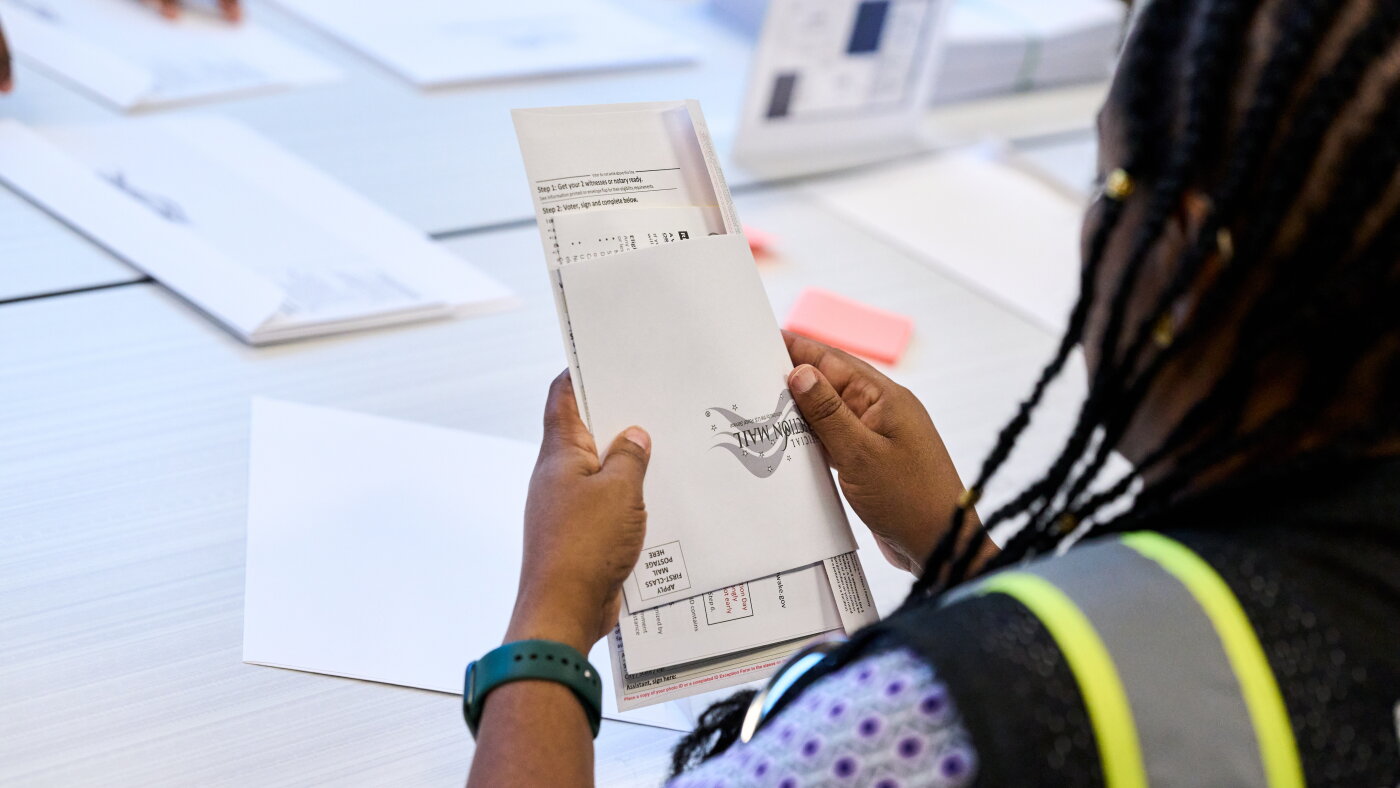
Photo via Mother Jones

California’s Mail Ballot System Excludes Disabled Voters, Court Rules

Read the original at Mother Jones ↗
Cite

Hurwitz, S. (2026, October 6). California’s Mail Ballot System Excludes Disabled Voters, Court Rules. Mother Jones. https://www.motherjones.com/politics/2026/10/californias-mail-ballot-system-excludes-disabled-voters-court-rules/

Dated when The Aporia collected the article, usually within hours of publication. Check the original for its exact date and byline.

Mother Jones · collected 2026-10-06 · by Sophie Hurwitz

Quick Summary

A federal court ruled on October 3 that California's requirement for voters to sign and return mail ballots on paper violates the rights of disabled voters who cannot do so independently. The case, California Council of the Blind v. Weber, highlights how current rules exclude blind or low-vision individuals from voting privately and confidentially. Plaintiffs like Christopher Gray, a San Francisco resident, argue that they need alternative methods to return their ballots without assistance. The court did not mandate immediate changes but gave California until October 19 to propose new protocols, likely delaying implementation until the next election cycle.
Written by AI on 2026-10-06, from this article's own text only (the story summary below draws on all the coverage).

AI analysis

Story summary

A federal court ruled on October 3 that California’s requirement for voters with print disabilities to sign and return mail ballots on paper violated their rights. The ruling in California Council of the Blind v. Weber benefits disabled voters but won’t likely affect current elections until the next election cycle, as ballots have already been mailed out. Since 2021, California has sent ballots to all registered voters for statewide and local elections; however, those with print disabilities must request an electronic link to fill out their ballot online, then print it, place it in an envelope, seal it, and return it non-electronically—often impractical for many blind individuals who lack printers. Christopher Gray, a plaintiff from San Francisco County, stated he cannot vote independently under the current system due to his blindness. The court has given California until October 19 to propose new voting protocols that accommodate disabled voters more effectively.

Written for “Mail Ballot Access Dispute” on 2026-11-01, grounded in this article and the 0 other(s) covering the same event.

Story

📰 Mail Ballot Access Dispute
Politics · 1 article(s) covering the same event.

Compared with similar articles

This article reads leans left and hedges 14% of its claims. Each row says how that neighbour differs.
NPR
⚖️ Leans left Hedges 5 of 26 claims Outlet record 60/100
“Article A discusses a court ruling regarding California's mail ballot system and disabled voters, while Article B addresses concerns about postmark dates affecting the validity of mailed ballots. These are different topics within the broader context of election systems.”
How this article was measured signals, leaning charts, publisher record, byline, topics and claims

Signals How these are calculated →

Claims extracted
21
sentences that state something as happening or true
Uncertain
14%
3 of 21 hedged ("reportedly", "may", "according to")
Leaning
Leans left
of the writing, not the subject · beta estimate
Publisher signals
95/100
Mother Jones's corrections and hedging, across everything collected from it. Not a measure of accuracy.
Outlets on this story
1
Politics
Same framing elsewhere
1
articles that frame the event the way this one does
Analyzed 2026-10-06 · how these are computed

How this is being covered How these are calculated →

Article leaning vs. publisher reliability
Source leaning vs. consistency

Publisher

Mother Jones · 427 article(s) · 0 correction(s) detected
No corrections detected for this publisher. That may mean careful reporting, or simply that nothing has been checked.

Who wrote this

Sophie Hurwitz
45 article(s) here · 1 carrying a prediction
🔮 She demanded that El-Sayed publicly disavow it as a precondition for appearing at an event with him on Sunday; it is not clear whether the event will go forward.
🔮 The share of America’s GDP contingent on data center buildout is now somewhere between 2 percent and 4 percent; total investment in the industry through 2032 is predicted to sit in the neighborhood of $10 trillion, per a recent Brookings Institution report.
🔮 Americans, meanwhile, are paying the price—the median US household has spent $856 more at the gas pump than they otherwise would have since the war started.
🔮 In a global labor action of record scale, dockworkers in 22 countries will strike on Friday to protest the use of their ports for arms exports.
2026-10-29 · assertive framing · A Global Port Strike Could Freeze $2 Billion in Freight
🔮 Similar claims date back to at least 2021, when viral videos began to circulate asserting that the holes would be used for tampering during that year’s gubernatorial recall election.
🔮 Best known for her work advocating for farmworker rights, Huerta co-founded with Cesar Chávez in 1962 the organization that would eventually become the United Farm Workers, and organized protests and walkouts pushing for laws and labor practices to protect the immigrant communities who worked in the fields, including winning them the right to organize unions in California.
2026-10-28 · assertive framing · Dolores Huerta Made Farmworkers Impossible to Ignore
🔮 His words echoed Donald Trump’s Islamophobia from the day prior, when Trump called Michigan Senate candidate Abdul El-Sayed a “jihadist” and argued that electing him would mean so much terrorism “you cannot even have Christmas.”
2026-10-27 · assertive framing · Vance Accuses El-Sayed of “Anti-White Racial Hate”
🔮 “You could see how scared people were to just consider being pregnant in the state of Missouri,” she said.
🔮 Their justification: Democratic candidate Mary Peltola, who served as Alaska’s House representative from 2022 to 2025, is running against two men named Dan Sullivan, and that could be pretty confusing for voters.
🔮 It’s no surprise, then, that weapons-tech entrepreneurs—being wealthy and ostentatious—would get in on the designer-dog market.
Also by Sophie Hurwitz
Nothing else under this byline is closely related to this article, so these are simply their most recent.
All 45 articles by Sophie Hurwitz →

Topics

Braille California California Council of the Blind Democracy Docket San Francisco County

Subjects

California GPE · 4× Gray PERSON · 3× California Council of the Blind ORG · 1× Christopher Gray PERSON · 1× Democracy Docket ORG · 1× Sallie Kim PERSON · 1× San Francisco County GPE · 1× Weber ORG · 1×

Narrative

The state of California now has until October 19 to propose a new vote-by-mail protocol, and since California ballots have already been mailed out, any changes made likely will not take effect until the next election cycle.
framing: assertive · carried by 1 article(s) · first seen 2026-10-06
🔮 And that’s only one of the obstacles they might face under the current vote-by-mail rules.
2026-10-06 · Mother Jones
California’s Mail Ballot System Excludes Disabled Voters, Court Rules · assertive framing

Claims (21 extracted, 3 hedged)

A federal court struck down a California rule that required voters to sign and return vote-by-mail ballots on paper, rather than doing so electronically. asserted
that → strike → paper
The ruling in California Council of the Blind v. Weber, announced October 3, is a victory for disabled voters—but it probably won’t change things much until the next election cycle. asserted
it → announce → cycle
Since 2021, California has mailed ballots to all registered voters for all statewide and local elections. asserted
California → mail → elections
Voters with print disabilities—those who are blind or low-vision, or whose physical disabilities prevent them from marking a paper ballot—can request a link to vote electronically. asserted
disabilities → prevent → link
After filling out their ballot on a computer, they must print it, put it in an envelope, seal the envelope, and return it “through non-electronic means.” asserted
they → fill → means
This is complicated by the fact that many blind people don’t own printers, because they have no use for them. asserted
they → complicate → them
And that’s only one of the obstacles they might face under the current vote-by-mail rules. uncertain
they → ’ → rules
Under the current system, as he wrote in a 2024 court declaration, he is unable to vote without assistance. asserted
he → write → assistance
He could theoretically vote using a virtual vote-by-mail ballot, which he can fill out unassisted using his own assistive technology, including a Braille-equipped computer. uncertain
he → vote → computer
But printing the ballot, finding where to sign it, signing it, putting it in an envelope, sealing it, and returning it without assistance is not possible for him. asserted
printing → print → him
“Because of the lack of an accessible method of returning my ballot by mail, when I vote I must forgo my right to vote confidentially and privately,” Gray wrote. asserted
Gray → return → right
During the 2022 general elections, Gray ended up paying an assistant to help him fill out his ballot—but in doing so, he was forced to give up that privacy and independence. asserted
he → end → privacy
He also gave up his certainty that his ballot had been submitted at all. asserted
ballot → give → certainty
“Though I trusted my reader, I could not independently confirm they accurately marked my ballot and mailed it on my behalf,” he said. uncertain
he → trust → behalf
The vote-by-mail program, as it stands, discriminates against voters who cannot return their ballots without assistance, he and the other plaintiffs argued. asserted
he → vote → assistance
“I want to vote in a private and independent manner just as voters without print disabilities are able to do in my state,” Gray wrote. asserted
Gray → want → state
“I will be able to do so only if alternative accessible options for returning a vote-by-mail ballot are available to me.” asserted
options → do → me
The court ruled that the current vote-by-mail system does exclude some disabled voters, and “denies them meaningful access to the vote by mail program,” as Magistrate Judge Sallie Kim wrote. asserted
Kim → rule → program
The court, however, did not specify a resolution. asserted
court → specify → resolution
The state of California now has until October 19 to propose a new vote-by-mail protocol, and since California ballots have already been mailed out, any changes made likely will not take effect until the next election cycle. asserted
changes → have → cycle
As Democracy Docket has reported, “32 states allow for electronic absentee ballot return for certain voters, with 13 of these states providing a specific carveout for voters with disabilities.” asserted
13 → report → disabilities

💬Give feedback
🕘History 🎫Support