Photo via Times of India

Scientists found a new magnetic mineral in Chang’e-6 Moon samples, preserved inside impact-glass particles

Read the original at Times of India ↗
Cite

TOI Science Desk. (2026, October 6). Scientists found a new magnetic mineral in Chang’e-6 Moon samples, preserved inside impact-glass particles. Times of India. https://timesofindia.indiatimes.com/science/space/scientists-found-a-magnetic-mineral-never-before-seen-naturally-in-moon-samples-change-6-brought-the-material-back-from-the-lunar-surface-where-it-survived-inside-tiny-impact-glass-particles/articleshow/134692891.cms

Dated when The Aporia collected the article, usually within hours of publication. Check the original for its exact date and byline.

Times of India · collected 2026-10-06 · by TOI Science Desk

Quick Summary

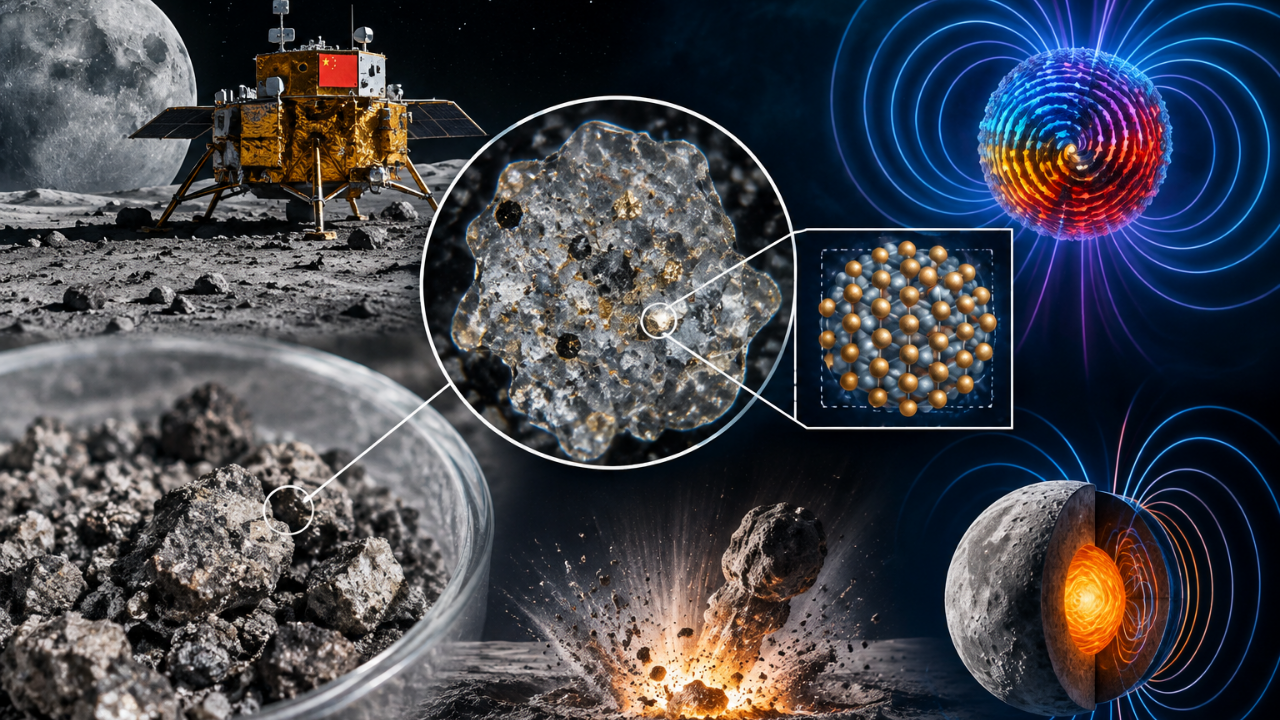
Scientists analyzing samples from China’s Chang’e-6 mission have identified a new magnetic mineral called γ-Fe inside impact-glass particles on the Moon. Published in PNAS on September 16, the study led by Professor Haifeng Du reveals that this form of metallic iron can preserve magnetic signals, potentially recording ancient lunar magnetic conditions. The researchers used advanced microscopy techniques to find numerous nanoscale iron particles, with γ-Fe being dominant, suggesting it may serve as a microscopic fossil for studying the Moon's past magnetic history.
Written by AI on 2026-10-06, from this article's own text only (the story summary below draws on all the coverage).

AI analysis

Story summary

Scientists analyzing Chang'e-6 lunar soil samples collected by China’s lunar mission have discovered a new magnetic mineral called γ-Fe, published in the Proceedings of the National Academy of Sciences (PNAS) on September 16. This nanoscale iron, found inside tiny impact-glass particles, could serve as a microscopic fossil for the Moon's ancient and powerful magnetic field, dating back 4.25 billion years. The discovery, led by researchers from the Chinese Academy of Sciences and the High Magnetic Field Laboratory (HFIPS), suggests that these unusual conditions created by lunar impacts may help scientists better understand the Moon’s long-lost magnetic history.
Written for “Moon Samples Magnetic Findings” on 2026-11-04, grounded in this article and the 1 other(s) covering the same event.

Story

📰 Moon Samples Magnetic Findings
Science · 2 article(s) covering the same event. See how they differ ↓

Compared with similar articles

This article reads unscored and hedges 30% of its claims. Each row says how that neighbour differs.
How this article was measured signals, leaning charts, publisher record, byline, topics and claims

Signals How these are calculated →

Claims extracted
23
sentences that state something as happening or true
Uncertain
30%
7 of 23 hedged ("reportedly", "may", "according to")
Leaning
not political
takes no side on a contested political question
Publisher signals
59/100
Times of India's corrections and hedging, across everything collected from it. Not a measure of accuracy.
Outlets on this story
2
Science
Same framing elsewhere
1
articles that frame the event the way this one does
Analyzed 2026-10-06 · how these are computed

How this is being covered How these are calculated →

Article leaning vs. publisher reliability
Source leaning vs. consistency

Publisher

Times of India · 4073 article(s) · 4 correction(s) detected
Running correction rate · 4 correction(s)

Who wrote this

TOI Science Desk
308 article(s) here · 1 carrying a prediction
🔮 Researchers are continuing to examine daily measurements to determine whether temperatures will climb further.
🔮 According to Reuters reporting by Will Dunham, a new study published in the journal Spixiana documents more than 90 Bangka slow lorises identified between 2015 and 2025.
🔮 “Normally, my job is quite monotonous, so I wanted to create something that would entertain people, turning my ‘serious’ job into something fun,” he said in a Guinness World Records news release.
🔮 The subsequent collision between the two galaxy clusters may then have compressed the cloud or re-energised its particles, causing it to shine more brightly in radio wavelengths once again.
🔮 The mathematicians at the University of California, Davis, argue that the answer may already lie within Einstein’s own equations and that an invisible form of energy may not be needed at all.
🔮 The work will be carried out by the West Tennessee River Basin Authority, which is preparing a plan to restore the river and the land around it.
🔮 Cornell University scientists have developed genetically engineered tomato plants that turn red-purple when nitrogen becomes scarce, giving farmers a visible warning that crops may need fertiliser.
🔮 By studying these crystals and other mineral grains, scientists could establish the meteorite's age and identify later changes caused by water.
🔮 Centuries later, bronze objects found in Scandinavia would preserve chemical signatures consistent with the metals produced at this Spanish site, offering evidence of connections that may have crossed much of Europe.
🔮 Deposited impurities and staining may also have contributed, while low temperatures and humidity could cause the fabric to crack.
Wire or desk byline, not an individual reporter.
Also by TOI Science Desk
Nothing else under this byline is closely related to this article, so these are simply their most recent.
All 308 articles by TOI Science Desk →

Topics

HFIPS PNAS the Hefei Institutes of Physical Science the High Magnetic Field Laboratory the Proceedings of the National Academy of Sciences

Subjects

HFIPS ORG · 2× CAS ORG · 1× Haifeng Du PERSON · 1× Long Li PERSON · 1× PNAS ORG · 1× the Chinese Academy of Sciences ORG · 1× the Hefei Institutes of Physical Science ORG · 1× the High Magnetic Field Laboratory ORG · 1× the Proceedings of the National Academy of Sciences ORG · 1×

Narrative

Found inside tiny impact-glass particles, the nanoscale iron can preserve a stable magnetic signal, potentially acting like a microscopic fossil of the Moon’s long-lost magnetic field, as per the findings published in the Proceedings of the National Academy of Sciences (PNAS) on September 16.
framing: mixed · carried by 1 article(s) · first seen 2026-10-06
🔮 "This tiny magnetic fossil may help us better understand the Moon's ancient magnetic history," said Dr. Long Li from HFIPS, a member of the team.

Claims (23 extracted, 7 hedged)

About 4.25 billion years ago, the Moon possessed a powerful core dynamo with a field strength comparable to or even exceeding modern Earth's. asserted
Moon → possess → Earth
This magnetic field, generated by circulating molten metal, completely shut down as the interior cooled and core crystallisation ceased, leaving the Moon without a global magnetic field in the present. asserted
crystallisation → generate → present
While it no longer generates a global magnetic field, traces of its ancient magnetism still remain locked inside lunar soil and rocks. asserted
traces → generate → soil
Scientists have been studying these magnetic minerals preserved in the soil in order to reconstruct how the Moon's magnetic environment changed over time. asserted
environment → study → time
Researchers analysing metallic iron inside impact glass from Chang'e-6 lunar soil have now identified a previously unknown magnetic mineral in natural Moon samples. asserted
Researchers → analyse → samples
They have identified it as a form of metallic iron called γ-Fe. asserted
They → identify → iron
Found inside tiny impact-glass particles, the nanoscale iron can preserve a stable magnetic signal, potentially acting like a microscopic fossil of the Moon’s long-lost magnetic field, as per the findings published in the Proceedings of the National Academy of Sciences (PNAS) on September 16. asserted
iron → find → September
The study was led by Professor Haifeng Du of the High Magnetic Field Laboratory at the Hefei Institutes of Physical Science (HFIPS) of the Chinese Academy of Sciences (CAS). asserted
study → lead → Sciences
"This tiny magnetic fossil may help us better understand the Moon's ancient magnetic history," said Dr. Long Li from HFIPS, a member of the team. uncertain
Li → help → team
A rare iron phase hidden in lunar glass To examine the samples, the researchers used focused ion beam preparation, transmission electron microscopy, and chemical analysis. asserted
researchers → hide → preparation
These techniques revealed numerous nanoscale iron particles embedded throughout the glassy material. asserted
techniques → reveal → material
Closer examination showed that some of the particles consisted of face-centred cubic γ-Fe. asserted
some → show → Fe
In fact, γ-Fe was the dominant form of iron in the two impact-glass samples studied. asserted
Fe → study → samples
As the material cools, it typically changes into another form known as α-Fe. asserted
it → cool → Fe
The researchers found evidence that the unusual conditions produced by impacts on the Moon may allow γ-Fe to survive at the lunar surface. uncertain
Fe → find → surface
They proposed that several factors could help stabilise the structure, including small amounts of carbon and other elements, the rapid cooling of molten material created during an impact, and protection from the surrounding glassy matrix. uncertain
factors → propose → matrix
The team also used off-axis electron holography to investigate the magnetic behaviour of individual γ-Fe nanoparticles. asserted
team → use → nanoparticles
They found that relatively large γ-Fe particles could form a stable single-vortex magnetic state. uncertain
particles → find → state
The particles also retained a consistent magnetic response when exposed to an external magnetic field. asserted
particles → retain → field
This stability suggests that γ-Fe could act as a previously unrecognised recorder of magnetic information in lunar material, holding clues to conditions that existed in the moon's past. uncertain
that → suggest → past
A magnetic past This discovery has broadened the known variety of magnetic minerals found in lunar samples. asserted
discovery → broaden → samples
Since γ-Fe and α-Fe form under different conditions and behave differently magnetically, each could potentially record information from separate stages of lunar impact events. uncertain
each → form → events
According to scientists, future research is required to determine exactly how much these minerals can reveal about the moon's ancient magnetic field and how it evolved over time. uncertain
it → accord → time
💬Give feedback
🕘History 🎫Support