Photo via The Sydney Morning Herald

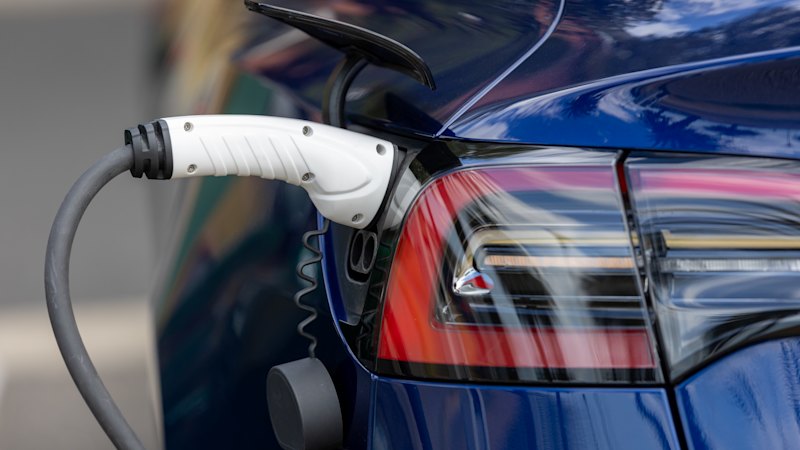
Tesla and power giants revolt against Australia’s ‘EV charger tax’

Read the original at The Sydney Morning Herald ↗
Cite

Toscano, N. (2026, October 6). Tesla and power giants revolt against Australia’s ‘EV charger tax’. The Sydney Morning Herald. https://www.smh.com.au/business/consumer-affairs/tesla-and-power-giants-revolt-against-australia-s-ev-charger-tax-20261007-p613a1.html?ref=rss&utm_medium=rss&utm_source=rss_feed

Dated when The Aporia collected the article, usually within hours of publication. Check the original for its exact date and byline.

The Sydney Morning Herald · collected 2026-10-06 · by Nick Toscano

Quick Summary

Tesla and major Australian power companies are protesting against a plan that would add costs related to public electric vehicle (EV) charger installation onto all household electricity bills, regardless of whether the households own an EVs. The proposed scheme allows monopoly power-grid owners to install up to 14,000 chargers on existing infrastructure over five years, with 70% of the costs recovered through increased electricity bills for all customers and the federal government covering the rest. Critics argue this could impose unfair financial burdens on households already facing higher living costs, while also potentially stifling competition from private charging networks.
Written by AI on 2026-10-06, from this article's own text only (the story summary below draws on all the coverage).

AI analysis

Story summary

Tesla and over a dozen major Australian energy companies, including AGL, EnergyAustralia, Engie, and Evie Networks, have united against a government proposal that would charge all electricity consumers for the installation of public EV chargers. This plan allows monopoly power-grid owners to install 14,000 EV chargers on existing infrastructure, but the companies argue this will unfairly burden households with higher costs for uncertain benefits. Under the trial approved by the Australian Energy Market Commission (AEMC), these grid owners can recover 70% of installation costs through regulated charges added to electricity bills. With EVs now accounting for one in four new vehicle sales in Australia, the companies are concerned about the potential impact on consumers who do not own an electric vehicle.

Written for “Tesla EV Charger Tax” on 2026-11-03, grounded in this article and the 0 other(s) covering the same event.

Story

📰 Tesla EV Charger Tax
Technology · 1 article(s) covering the same event.

Compared with similar articles

This article reads unscored and hedges 8% of its claims. Each row says how that neighbour differs.
ABC News (AU)
Hedges 4 of 39 claims Outlet record 68/100
“Article A discusses a controversy over EV charger costs and industry backlash, while Article B focuses on issues with EV charging infrastructure in remote parts of Western Australia.”
How this article was measured signals, leaning charts, publisher record, byline, topics and claims

Signals How these are calculated →

Claims extracted
24
sentences that state something as happening or true
Uncertain
8%
2 of 24 hedged ("reportedly", "may", "according to")
Leaning
withheld
no quote in the article backed the model's score
Publisher signals
61/100
The Sydney Morning Herald's corrections and hedging, across everything collected from it. Not a measure of accuracy.
Outlets on this story
1
Technology
Same framing elsewhere
1
articles that frame the event the way this one does
Analyzed 2026-10-06 · how these are computed

How this is being covered How these are calculated →

Article leaning vs. publisher reliability
Source leaning vs. consistency

Publisher

The Sydney Morning Herald · 5927 article(s) · 15 correction(s) detected
Running correction rate · 15 correction(s)

Who wrote this

Nick Toscano
15 article(s) here · 1 carrying a prediction
🔮 Mining giant Fortescue Metals Group has warned a protracted stand-off with Beijing over the price of Australia’s biggest export commodity, iron ore, may force it to curtail production at its huge mines across the Pilbara if the deadlock does not break soon.
🔮 “Everyone, regardless of their role or seniority, is expected to meet the standards set by our values,” the spokesperson said.
🔮 Labor last week introduced its long-awaited domestic gas-reservation bill to parliament, which would compel the nation’s largest liquefied natural gas exporters to set aside up 20 per cent of their annual export volumes for local customers from 2028.
🔮 An international mining giant has taken its $38 billion pursuit of Australia’s largest gold producer directly to local investors, offering them the muscle to build a globally competitive gold behemoth and hoping their pressure will help force the board to the negotiating table.
🔮 Worries about the volatile situation in the Middle East are threatening to override hopes that a deal between US President Donald Trump and Russian President Vladimir Putin to partially ease the US ban on Russian diesel could help relieve tightening supplies and lower prices ahead of the US midterm elections.
🔮 The decision to allow a massive NSW coal mine to run until 2045 will be fought in court, legal experts predict, after the High Court struck down a separate approval for failing to grapple with the climate impact of Australian coal being burned in foreign power plants.
🔮 Approval for a major coal mine expansion has been declared invalid by the High Court in a decision that will force NSW planning authorities to reckon with emissions from Australian coal burnt overseas.
🔮 Under the trial, they will be allowed to recover 70 per cent of the costs through regulated charges paid by all electricity consumers on their power bills, with the federal government footing the remainder.
🔮 The war in the Middle East is delivering a huge windfall for Australian gas exporters, as new figures suggest soaring prices could add $23 billion to their combined revenue this year and reverse what was expected to be a period of decline.
🔮 Fuel giant Ampol has struck a deal to acquire one of Australia’s most extensive electric-vehicle charging networks, a move that will more than triple the number of charging bays it owns just as local sales of battery-powered cars surge to record highs.
Also by Nick Toscano
Nothing else under this byline is closely related to this article, so these are simply their most recent.
All 15 articles by Nick Toscano →

Topics

AEMC AGL Australian EnergyAustralia Tesla

Subjects

AEMC ORG · 6× Australian NORP · 3× AGL ORG · 2× Tesla ORG · 2× Anna Collyer PERSON · 1× EnergyAustralia ORG · 1× Engie ORG · 1× Evie Networks ORG · 1× Stephanie Bashir PERSON · 1× the Australian Energy Market Commission ORG · 1×

Narrative

In a joint letter to local authorities, the electric car giant and more than a dozen industry players – including AGL, EnergyAustralia, Engie and private charge-point operators like Evie Networks – are warning that a recent decision allowing monopoly power-grid owners to expand into the EV-charging market risks saddling households with higher costs for uncertain benefits.
framing: assertive · carried by 1 article(s) · first seen 2026-10-06
🔮 Under the trial, they will be allowed to recover 70 per cent of the costs through regulated charges paid by all electricity consumers on their power bills, with the federal government footing the remainder.
2026-10-06 · The Sydney Morning Herald
Tesla and power giants revolt against Australia’s ‘EV charger tax’ · assertive framing

Claims (24 extracted, 2 hedged)

Tesla and some of the largest Australian power companies have united to fight a controversial plan to pass the cost of building public EV chargers onto all households through electricity bill increases, even if or those who do not own an EV. asserted
who → unite → EV
In a joint letter to local authorities, the electric car giant and more than a dozen industry players – including AGL, EnergyAustralia, Engie and private charge-point operators like Evie Networks – are warning that a recent decision allowing monopoly power-grid owners to expand into the EV-charging market risks saddling households with higher costs for uncertain benefits. asserted
owners → include → benefits
The clash comes as booming sales of EVs, which now account for one in four new vehicles sold across the country, are piling pressure on governments and the industry to urgently scale up public charging infrastructure to keep pace with demand. asserted
which → come → demand
To accelerate the rollout of kerbside chargers, Australian power distributors – owners of the grid’s poles-and-wires infrastructure – have secured preliminary approval from the Australian Energy Market Commission (AEMC) to mount 14,000 EV chargers on existing power poles in regional blackspots and other areas underserved by private companies. asserted
distributors → accelerate → companies
Under the trial, they will be allowed to recover 70 per cent of the costs through regulated charges paid by all electricity consumers on their power bills, with the federal government footing the remainder. asserted
government → allow → remainder
The AEMC estimates the initiative will add $1 a year to people’s bills over a five-year period – an increase it argues is outweighed by the broader economic and environmental benefits. asserted
it → estimate → benefits
“Having weighed all factors, the commission is satisfied the program’s likely benefits outweigh its costs to consumers, given its targeted and time-limited design,” AEMC chair Anna Collyer. asserted
benefits → weigh → design
“Lessons learned from the trial program will inform future commission decisions regarding EV infrastructure. asserted
Lessons → learn → infrastructure
However, energy retailers and private charging networks are demanding greater scrutiny of the program’s assumed costs and wider benefits. asserted
retailers → demand → costs
In the joint letter to the AEMC, they expressed concerns that the true bill for consumers could escalate beyond the estimated $1 annual charge and impose unfair burden on households already struggling with rising living costs, and said the commission’s own analysis had been unable to confirm whether each network-owned charger would lead to 1.5 to 3.8 new EV purchases – the number needed to justify the cost. uncertain
charger → express → cost
Their submission also argued that allowing government-regulated grid monopolies into the market will distort competition by undermining the private operators risking their own capital to build competing networks. asserted
allowing → argue → networks
Stephanie Bashir, founder of consultancy Nexa Advisory, which organised the letter, said the signatories supported the rollout of more EV charging. asserted
signatories → organise → charging
But the need for more chargers did not “establish a case for electricity networks to own them or for every electricity customer to help pay for them”, she said. asserted
she → establish → them
“This is potentially like an EV tax on electricity bills,” Bashir said. asserted
Bashir → say → bills
“People who cannot afford an EV, do not own a car or will never use these chargers would still contribute through their electricity bills – the AEMC must explain why that is justified.” asserted
that → afford → bills
Tesla, one of the world’s biggest EV makers, said a network operator’s job was to build, run and maintain the shared grid, “not to own, control, or rollout the batteries, chargers and other equipment sitting in people’s homes and driveways”. asserted
job → say → homes
“Networks should set the table, so competitive markets can do their work - they should not pull up a chair and play, while also owning the table, writing the rules for who gets a seat, and acting as umpire,” it said. asserted
it → set → umpire
AGL, the second-largest Australian power retailer, echoed those concerns, stressing that it was important for the rollout to deliver the best outcomes for customers at the lowest possible cost, and that the case for network ownership had “not yet been established”. asserted
case → echo → ownership
“The AEMC’s proposal would require all electricity consumers to fund charging infrastructure through their electricity bills, even those who may never use the service,” the spokesperson said. uncertain
spokesperson → require → service
“Allowing monopoly network businesses to lead the rollout risks higher costs and weaker service outcomes. asserted
businesses → allow → costs
Australia’s network companies such as Ausgrid, CitiPower, Powercor, and Essential Energy, said in a submission earlier this year that waiving “ring-fencing” rules and allowing them to enter the competitive public-charging market would help ensure greater access for those unable to charge EVs at home because they lived in apartments or did not have off-street parking. asserted
they → say → parking
“We do not have enough accessible, affordable public charging,” said Energy Networks Australia, an industry group. asserted
Australia → have → charging
“By enabling distribution networks to install, own and maintain kerbside electric vehicle charging using existing infrastructure, such as power poles, we can deliver faster, more affordable, and more widespread access to charging where people need it.” asserted
people → enable → it
The Business Briefing newsletter delivers major stories, exclusive coverage and expert opinion. asserted
newsletter → deliver → stories

💬Give feedback
🕘History 🎫Support