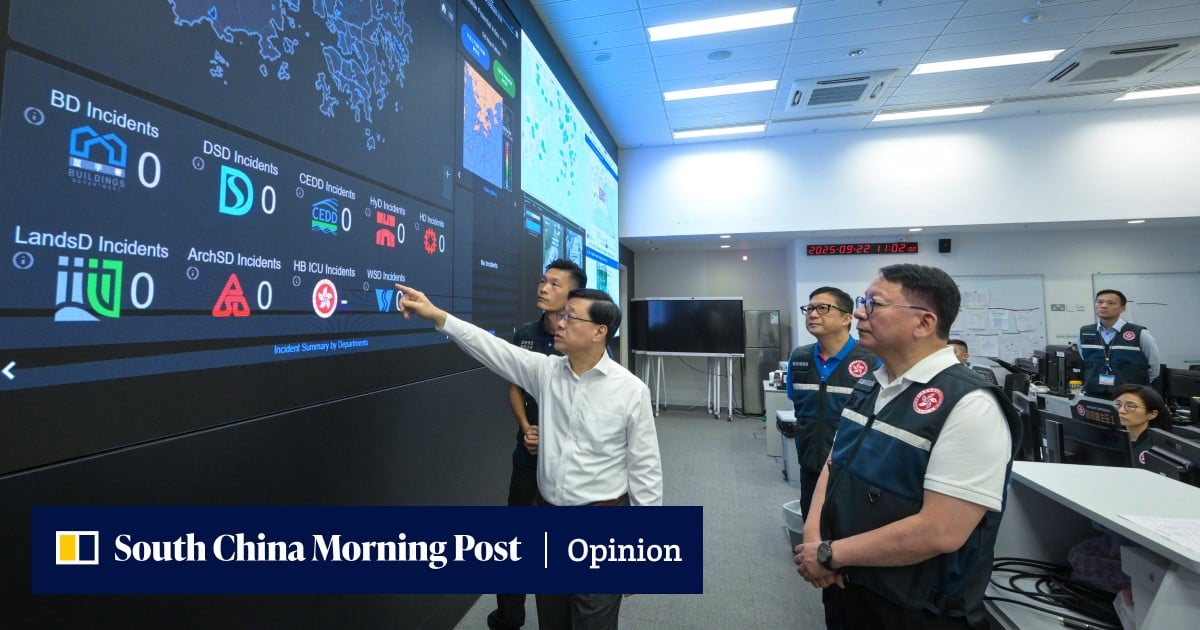
Photo via South China Morning Post

Hong Kong’s AI city brain must understand how people really speak

Read the original at South China Morning Post ↗
Cite

Wen, Z. (2026, October 7). Hong Kong’s AI city brain must understand how people really speak. South China Morning Post. https://www.scmp.com/opinion/hong-kong-opinion/article/3369697/hong-kongs-ai-city-brain-must-understand-how-people-really-speak?utm_source=rss_feed

Dated when The Aporia collected the article, usually within hours of publication. Check the original for its exact date and byline.

South China Morning Post · collected 2026-10-07 · by Zhisheng Wen

Quick Summary

John Lee Ka-chiu, Hong Kong's Chief Executive, proposes an "AI city brain" system aimed at integrating data across various sectors like transportation and emergency services to improve risk management and service coordination. However, the article highlights a critical concern: for such a system to be effective, it must account for the multilingual nature of communication in Hong Kong, where residents commonly switch between Cantonese, Mandarin, English, and other languages within conversations. This linguistic diversity is presented as one of Hong Kong's strengths rather than an obstacle.
Written by AI on 2026-10-07, from this article's own text only (the story summary below draws on all the coverage).

AI analysis

Story summary

Hong Kong's Chief Executive John Lee Ka-chiu has proposed an "AI city brain" initiative aimed at integrating data from various sectors such as transport, public works, environmental monitoring, and emergency response to enhance service coordination and risk management. However, a key challenge highlighted is the need for this system to comprehend the diverse linguistic landscape of Hong Kong, where residents frequently switch between Cantonese, Mandarin, and English within conversations. The author argues that this multilingual flexibility is one of Hong Kong’s strengths rather than a barrier, emphasizing the importance of an AI city brain understanding and accommodating such communicative diversity to be truly effective in serving the city's population.
Written for “Hong Kong AI Initiative” on 2026-10-31, grounded in this article and the 0 other(s) covering the same event.

Story

📰 Hong Kong AI Initiative
Technology · 1 article(s) covering the same event.

Compared with similar articles

Nothing to compare against. No article is close enough to this one for the pipeline to have linked or judged the pair.
How this article was measured signals, leaning charts, publisher record, byline, topics and claims

Signals How these are calculated →

Claims extracted
5
sentences that state something as happening or true
Uncertain
20%
1 of 5 hedged ("reportedly", "may", "according to")
Leaning
not political
takes no side on a contested political question
Publisher signals
64/100
South China Morning Post's corrections and hedging, across everything collected from it. Not a measure of accuracy.
Outlets on this story
1
Technology
Same framing elsewhere
1
articles that frame the event the way this one does
Analyzed 2026-10-07 · how these are computed

How this is being covered How these are calculated →

Article leaning vs. publisher reliability
Source leaning vs. consistency

Publisher

South China Morning Post · 3467 article(s) · 6 correction(s) detected
Running correction rate · 6 correction(s)

Who wrote this

Zhisheng Wen
2 article(s) here · 1 carrying a prediction
🔮 They might also involve language use and how it shapes our views of the future
🔮 An integrated system linking data across transport, public works, environmental monitoring and emergency response could help Hong Kong manage risks more proactively and coordinate services more effectively.
Also by Zhisheng Wen
Nothing else under this byline is closely related to this article, so these are simply their most recent.

Topics

Hong Kong Hong Kong’s

Subjects

Hong Kong GPE · 2× Hong Kong’s GPE · 1× John Lee Ka-chiu PERSON · 1×

Narrative

People like myself move between Cantonese, Mandarin, English and other linguistic resources every day, often within a single conversation.
framing: assertive · carried by 1 article(s) · first seen 2026-10-07
🔮 An integrated system linking data across transport, public works, environmental monitoring and emergency response could help Hong Kong manage risks more proactively and coordinate services more effectively.
2026-10-07 · South China Morning Post
Hong Kong’s AI city brain must understand how people really speak · assertive framing

Claims (5 extracted, 1 hedged)

An integrated system linking data across transport, public works, environmental monitoring and emergency response could help Hong Kong manage risks more proactively and coordinate services more effectively. uncertain
Kong → integrate → services
It also raises a critical question: can a city brain truly understand a city if it does not understand how its people communicate? asserted
people → raise → city
People like myself move between Cantonese, Mandarin, English and other linguistic resources every day, often within a single conversation. asserted
People → move → conversation
This is not a problem to be solved. asserted
This → solve → ?
The city’s advantage lies in its biliterate and trilingual population. asserted
advantage → lie → population
💬Give feedback
🕘History 🎫Support