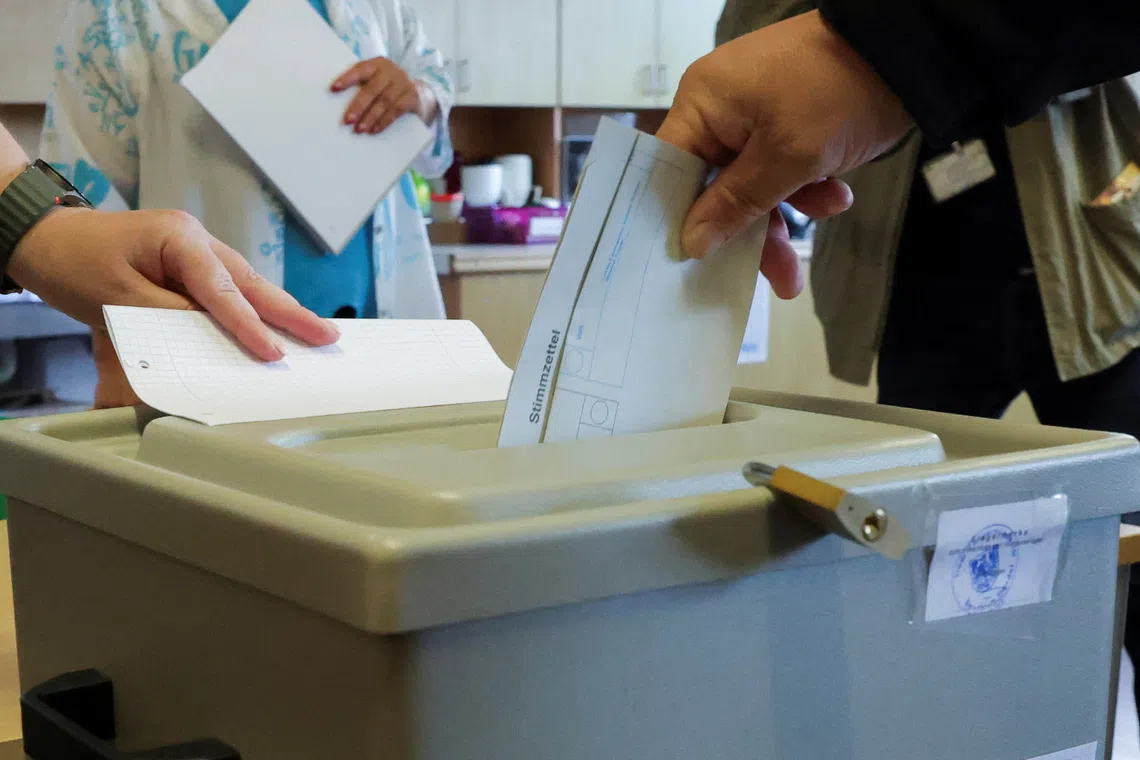
Photo via New York Post

Right-wing AfD party notches historic win in Germany: ‘We are going to see explosive growth’

Read the original at New York Post ↗
Cite

Reyes, R. (2026, September 6). Right-wing AfD party notches historic win in Germany: ‘We are going to see explosive growth’. New York Post. https://nypost.com/2026/09/06/world-news/right-wing-afd-party-notches-historic-win-in-germany-we-are-going-to-see-explosive-growth/

Dated when The Aporia collected the article, usually within hours of publication. Check the original for its exact date and byline.

New York Post · collected 2026-09-06 · by Ronny Reyes

Quick Summary

The right-wing Alternative for Germany (AfD) party won a historic victory in the Saxony-Anhalt state election on Sunday, securing 44.5% of the vote and leaving Chancellor Friedrich Merz's Christian Democratic Union party with 18.5%. The AfD's co-leader Alice Weidel predicted "explosive growth" for her party across East Germany and at the federal level. According to projections, the AfD would win between 39 and 41 seats in the state parliament, but would still be short of an absolute majority. The election result is seen as a vote of no confidence in the federal government by Marcel Fratzscher, president of the German Institute for Economic Research.
Written by AI on 2026-09-07, from this article's own text only (the story summary below draws on all the coverage).

AI analysis

Story summary

In an upcoming Sunday election, Germany's far-right party, Alternative for Germany (AFD), is poised to win control of the eastern state of Saxony-Anhalt, a position it hasn't held since World War II. AFD’s lead candidate, Ulrich Siegmund, has gained significant traction by addressing concerns like immigration and Russia normalization through social media platforms such as TikTok. Polls suggest AFD could secure around 44% of the vote, more than double its previous performance in 2016. Should AFD achieve an outright victory, it would control state resources, aiming to implement policies including separate classrooms for refugees and a reduced focus on Germany's Nazi past. This historic shift raises concerns about emboldening far-right influence across Germany, with implications for national politics beyond the regional level.

Written for “German Far Right Election Gains” on 2026-10-31, grounded in this article and the 63 other(s) covering the same event.

Story

📰 German Far Right Election Gains
Politics · 64 article(s) covering the same event. Compare every outlet's account →

Compared with similar articles

This article reads leans right and hedges 13% of its claims. Each row says how that neighbour differs.
The Guardian
Hedges 5 of 48 claims Outlet record 66/100
South China Morning Post
⚖️ Leans right Hedges 3 of 6 claims Outlet record 64/100
The Independent
⚖️ Leans strongly right further right than this Hedges 6 of 37 claims Outlet record 59/100
The Straits Times
⚖️ Leans left further left than this Hedges 3 of 10 claims Outlet record 66/100
CBC News
⚖️ Leans right Hedges 7 of 49 claims Outlet record 74/100
The Independent
⚖️ Leans left further left than this Hedges 3 of 23 claims Outlet record 59/100
National Post
Hedges 2 of 28 claims Outlet record 60/100
Times of India
⚖️ Leans right Hedges 9 of 26 claims Outlet record 59/100
Washington Examiner
⚖️ Leans left further left than this Hedges 6 of 39 claims Outlet record 70/100
TIME
⚖️ Leans left further left than this Hedges 7 of 57 claims Outlet record 59/100
How this article was measured signals, leaning charts, publisher record, byline, topics and claims

Signals How these are calculated →

Claims extracted
15
sentences that state something as happening or true
Uncertain
13%
2 of 15 hedged ("reportedly", "may", "according to")
Leaning
Leans right
of the writing, not the subject · beta estimate
Publisher signals
66/100
New York Post's corrections and hedging, across everything collected from it. Not a measure of accuracy.
Outlets on this story
64
Politics
Same framing elsewhere
1
articles that frame the event the way this one does
Analyzed 2026-09-07 · how these are computed

How this is being covered How these are calculated →

Article leaning vs. publisher reliability
Source leaning vs. consistency

Publisher

New York Post · 15411 article(s) · 35 correction(s) detected
Running correction rate · 35 correction(s)

Who wrote this

Ronny Reyes
64 article(s) here · 1 carrying a prediction
🔮 Netanyahu’s Likud party will retain the most seats in the Knesset, with Likud and his allies looking to secure 54 seats, according to preliminary results — down from the 60 he currently holds.
🔮 Prime Minister Benjamin Netanyahu trailed opposition leader Gadi Eisenkot in the Israeli election Tuesday, according to exit polls — but neither bloc appeared set to win enough seats to secure a clear majority.
🔮 The acceleration is evidence that Iran will not abandon its nuclear ambition despite ongoing peace talks with the US, retired four-star Gen. Jack Keane told Fox News.
🔮 Israeli-Arabs could sway the balance of power in Israel’s general elections next week as the country’s two major parties are predicted to fall short of a majority in the Knesset.
🔮 Brinksman would go on to hold top secret security clearance while working as an employee of a US government agency and later as a systems developer private contractor working for the same agency, prosecutors said.
🔮 Flora attended a mandatory court appearance on Saturday, with the wrestler set to return for a follow-up hearing next Monday, TMZ reported.
🔮 But the US blockade on Iran’s ports has prevented Tehran from replenishing its supplies, which shrunk to below 1 million barrels by Oct. 5 and is now virtually gone, according to the Kpler maritime analyst firm. “There’s no more oil to discharge to China anymore,” Homayoun Falakshahi, head of crude-oil analysis at Kpler, told the Wall Street Journal.
🔮 Local authorities will be alerted,” the alert read.
🔮 Aid flow from the European Union remains volatile after Slovakia and Hungary announced earlier this week that they would not participate in the bloc’s push to provide a nearly $80 billion aid package to Ukraine.
🔮 The goal is to get a peace deal that will favor the Kremlin, but also for Russia, China and the US to establish spheres of influence around the world, a former Moscow intelligence officer with knowledge of the talks told the Journal.
Also by Ronny Reyes
Nothing else under this byline is closely related to this article, so these are simply their most recent.
All 64 articles by Ronny Reyes →

Topics

AfD Christian Democratic Union German Germany Saxony-Anhalt

Subjects

AfD ORG · 8× Merz PERSON · 3× German NORP · 2× Germany GPE · 2× Saxony-Anhalt GPE · 2× Alternative for Germany ORG · 1× Christian Democratic Union ORG · 1× Elon Musk PERSON · 1× Friedrich Merz PERSON · 1× Saxony GPE · 1×

Narrative

The right-wing party’s co-leader, Alice Weidel, hailed the turnout as a “historic” result for her group as she vowed that Merz’s party would never win another election again. “We are going to see explosive growth across all of East Germany — and at the federal level, too,” she told public broadcaster ZDF.
framing: assertive · carried by 1 article(s) · first seen 2026-09-07
🔮 The right-wing party’s co-leader, Alice Weidel, hailed the turnout as a “historic” result for her group as she vowed that Merz’s party would never win another election again. “We are going to see explosive growth across all of East Germany — and at the federal level, too,” she told public broadcaster ZDF.

Claims (15 extracted, 2 hedged)

A right-wing German party scored a historic victory in a state election Sunday, dealing a blow to Chancellor Friedrich Merz’s conservative Christian Democratic Union party. asserted
party → score → party
Exit polls in the Saxony-Anhalt state election saw Alternative for Germany — an “extremist” party backed by Elon Musk — secure 44.5% of the vote for its candidates, with Merz’s CDU party only netting 18.5%, the ARD broadcaster reported. asserted
broadcaster → see → %
The right-wing party’s co-leader, Alice Weidel, hailed the turnout as a “historic” result for her group as she vowed that Merz’s party would never win another election again. “We are going to see explosive growth across all of East Germany — and at the federal level, too,” she told public broadcaster ZDF. asserted
she → hail → ZDF
But the national general-secretary of Merz’s party, Franziska Hoppermann, was defiant in opposing the strengthening party. asserted
secretary → oppose → party
It wants to leave the euro; that would be economic downfall. … asserted
that → want → euro
It works closely together with Russia, it wants a completely different social model,” Hoppermann said. asserted
Hoppermann → work → model
“We will not work with them.” asserted
We → work → them
Either way, Marcel Fratzscher, president of the German Institute for Economic Research, told Reuters, “This election result is, above all, a vote of no confidence in the federal government.” asserted
result → tell → government
The AfD is pro-Russia and anti-migration and supports such thing as the banning of rainbow flags in schools. asserted
AfD → support → schools
Still it remains to be seen if the party will be able to create its own government in the state, as most other parties have ruled out joining an AfD-led coalition. asserted
parties → remain → coalition
Projections of Sunday’s election suggest the AfD would win between 39 and 41 seats of Saxony-Anhalt’s 82-seat state parliament That still leaves the AfD just short of absolute majority, although much further ahead of other parties. The left-wing populist Sahra Wagenknecht Alliance (BSW), a potential AfD coalition partner, could make AfD governance possible if it clears the threshold to grab a seat. uncertain
it → suggest → seat
The right-wing party remains a controversial group in Germany, with the country’s domestic intelligence service dubbing the group as “right-wing extremist,” a classification that the AfD rejects. asserted
AfD → remain → that
No right-wing party has ever won control of a single German state since World War II. asserted
party → win → II
Voter turnout in Saxony-Anhalt was particularly high at an estimated 78%. asserted
turnout → estimate → %
Saxony-Anhalt has the sixth smallest population in the country at just 2.1 million people, with only 7.9% identifying as foreigners, among the smallest percentages in all of Germany, according to national data. uncertain
% → have → data
💬Give feedback
🕘History 🎫Support