Photo via Times of India

3,000-year-old horse buried inside ancient Egyptian fortress may have been a chariot animal

Read the original at Times of India ↗
Cite

TOI Science Desk. (2026, October 7). 3,000-year-old horse buried inside ancient Egyptian fortress may have been a chariot animal. Times of India. https://timesofindia.indiatimes.com/science/archaeology/3000-year-old-horse-buried-inside-ancient-egyptian-fortress-may-have-been-a-chariot-animal-rare-discovery-ramesses-ii-and-libyan-prisoner-tablets-also-found/articleshow/134752425.cms

Dated when The Aporia collected the article, usually within hours of publication. Check the original for its exact date and byline.

Times of India · collected 2026-10-07 · by TOI Science Desk

Quick Summary

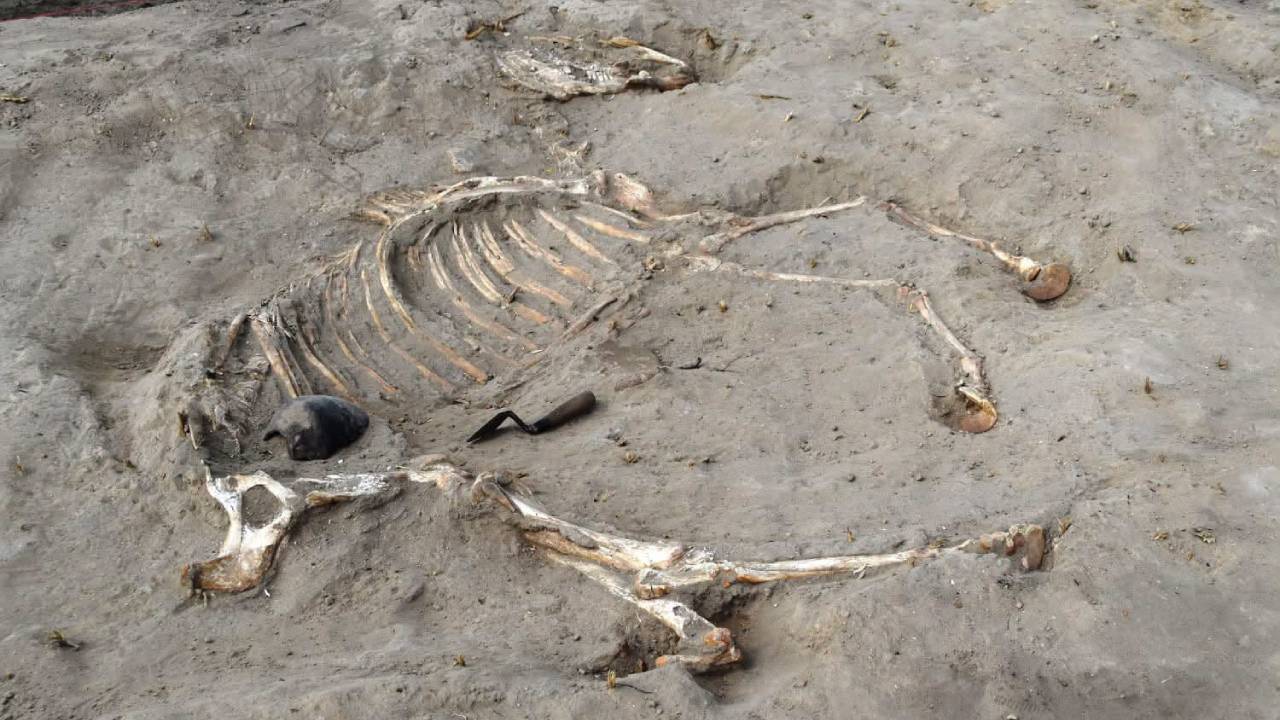
Archaeologists in Egypt’s Lake District have found the 3,000-year-old remains of a young horse buried inside Abqaa’, an ancient military fortress from the New Kingdom period (1550 to 1070 B.C.). The horse was likely used for military purposes, as evidenced by pieces of its harness found near the burial site. Experts suggest that this rare discovery provides new insights into the cultural and strategic importance of horses in ancient Egyptian warfare and defense against Libyan groups.
Written by AI on 2026-10-07, from this article's own text only (the story summary below draws on all the coverage).

AI analysis

Story summary

Archaeologists in Egypt uncovered the remains of a 3,000-year-old horse inside an ancient military fortress in Abqaa’, located in the western Nile Delta. The fortress dates back to around 1550 to 1070 B.C., during the New Kingdom period, and was built as part of Egypt’s defense against hostile Libyan groups. According to the Egypt Ministry of Tourism and Antiquities, this young male horse was buried with pieces of its harness nearby, indicating it may have been used in military activities such as chariot pulling. The deliberate burial suggests a ceremonial significance, highlighting the cultural importance of horses in ancient Egyptian warfare.

Written for “Ancient Egyptian Horse Burial” on 2026-10-30, grounded in this article and the 0 other(s) covering the same event.

Story

📰 Ancient Egyptian Horse Burial
Science · 1 article(s) covering the same event.

Compared with similar articles

Nothing to compare against. No article is close enough to this one for the pipeline to have linked or judged the pair.
How this article was measured signals, leaning charts, publisher record, byline, topics and claims

Signals How these are calculated →

Claims extracted
31
sentences that state something as happening or true
Uncertain
26%
8 of 31 hedged ("reportedly", "may", "according to")
Leaning
not political
takes no side on a contested political question
Publisher signals
59/100
Times of India's corrections and hedging, across everything collected from it. Not a measure of accuracy.
Outlets on this story
1
Science
Same framing elsewhere
1
articles that frame the event the way this one does
Analyzed 2026-10-07 · how these are computed

How this is being covered How these are calculated →

Article leaning vs. publisher reliability
Source leaning vs. consistency

Publisher

Times of India · 3707 article(s) · 2 correction(s) detected
Running correction rate · 2 correction(s)

Who wrote this

TOI Science Desk
295 article(s) here · 1 carrying a prediction
🔮 She explored whether an inexpensive device could capture airborne genetic material and support the detection of bacterial pathogens.
🔮 This control may help it maintain its orientation and move along a narrow path without losing its bearings.
🔮 The university says the sculpture will subsequently go on permanent display at its Turner Museum of Glass.
🔮 By bringing together nature, wellness facilities and educational spaces, Winter Garden aimed to create a setting where visitors could exercise, learn about nutrition and gardening, and spend time outdoors.
🔮 Also discovered was a 4,500-year-old humanoid idol, which archaeologists hope will help shed light on the cultural traditions of the region.
🔮 When garlic mustard spreads across the forest floor, other plants may struggle to obtain the resources they need to survive.
🔮 The train delay that could not have happened in 1841 The mystery originated in an account published anonymously in the scientific journal Nature on October 5, 1871.
🔮 A late-night snack may do more than add extra calories to your day.
🔮 The work offers a glimpse of such a future, where living organisms could become an active part of the robotic systems.
🔮 A centuries-old archaeological puzzle at Westminster Abbey in London may finally be nearing a resolution, with new research suggesting that a skeleton discovered inside a Roman stone coffin belonged to a medieval abbot rather than the Roman-era man named on its inscription.
Wire or desk byline, not an individual reporter.
Also by TOI Science Desk
Nothing else under this byline is closely related to this article, so these are simply their most recent.
All 295 articles by TOI Science Desk →

Topics

Egypt Egyptian Libyan Live Science Meshwesh

Subjects

Egypt GPE · 12× Egyptian NORP · 7× Libyan NORP · 4× Merneptah PERSON · 4× Live Science ORG · 3× Ramesses II PERSON · 3× Meshwesh NORP · 2× Ministry of Tourism and Antiquities ORG · 2× Abqaa’ GPE · 1× Lonneke Delpeut PERSON · 1×

Narrative

Archaeologists in Egypt have uncovered the carefully buried remains of a horse dating back around 3,000 years inside an ancient military fortress in the western Nile Delta, a rare discovery that is offering new clues about the role and cultural importance of horses in ancient Egyptian warfare.
framing: mixed · carried by 1 article(s) · first seen 2026-10-07
🔮 Archaeologists also discovered pieces of its harness near the remains, suggesting that it may have been used to pull a chariot or participated in other military activities.

Claims (31 extracted, 8 hedged)

Archaeologists in Egypt have uncovered the carefully buried remains of a horse dating back around 3,000 years inside an ancient military fortress in the western Nile Delta, a rare discovery that is offering new clues about the role and cultural importance of horses in ancient Egyptian warfare. asserted
that → uncover → warfare
The horse was discovered at the archaeological site of Abqaa’, in Egypt’s Lake District. asserted
horse → discover → District
The fortress dates to the New Kingdom period, around 1550 to 1070 B.C., and was built to protect Egypt’s western frontier from hostile Libyan groups. asserted
fortress → date → groups
According to Egypt’s Ministry of Tourism and Antiquities, the horse was a young, medium-sized male. uncertain
horse → accord → Tourism
Archaeologists also discovered pieces of its harness near the remains, suggesting that it may have been used to pull a chariot or participated in other military activities. uncertain
it → discover → activities
Horse burial may have been ceremonial The circumstances of the discovery indicate that the horse was deliberately buried rather than simply abandoned at the site. uncertain
horse → indicate → site
Egyptian authorities said the burial was likely ceremonial, suggesting the animal may have held considerable value. uncertain
animal → say → value
Experts unaffiliated with the excavation told Live Science that the discovery is particularly significant because complete horse remains from Pharaonic Egypt are uncommon. asserted
remains → tell → Egypt
Lonneke Delpeut, a researcher at the University of Vienna who has studied ancient Egyptian horses, described the find to Live Science as an “amazing find.” asserted
who → study → find
She noted that archaeologists know of ancient Egyptian horse stables, including those at Pi-Ramesses, but actual horse remains are much harder to find. asserted
remains → note → Ramesses
Delpeut cautioned against definitively labeling the animal a “war horse,” explaining that there is no clear definition of the term in the context of ancient Egypt. asserted
animal → caution → Egypt
However, she said the evidence indicates that it was certainly a chariot horse. asserted
it → say → ?
Horses transformed transportation and warfare in ancient Egypt, making an animal associated with a military fortress potentially particularly valuable. asserted
animal → transform → fortress
Fortress was built to guard Egypt’s western frontier Egypt’s ancient Abqaa’ fortress offers new clues about military life and border defenses during the New Kingdom period. asserted
fortress → build → period
The discovery provides insight into the strategic importance of Abqaa’. asserted
discovery → provide → Abqaa
The fortress was established during the New Kingdom, when Egypt maintained a series of defensive installations along its western frontier. asserted
Egypt → establish → frontier
The region faced threats from various Libyan groups, including the Meshwesh, with whom ancient Egypt frequently came into conflict. asserted
Egypt → face → conflict
Archaeologists found a tablet depicting a Libyan prisoner. asserted
Archaeologists → find → prisoner
According to the Egyptian ministry, the man’s clothing identifies him as a member of the Meshwesh tribe. uncertain
clothing → accord → tribe
The prisoner is shown with his hands tied behind his back and his body bent forward, a posture that represented submission. asserted
that → show → submission
Ramesses II and Merneptah inscriptions discovered asserted
inscriptions → discover → ?
Excavations also uncovered tablets linked to Ramesses II, Merneptah and a Libyan prisoner. asserted
Excavations → uncover → II
The excavation also uncovered inscriptions associated with two major New Kingdom pharaohs. asserted
excavation → uncover → pharaohs
One hieroglyphic tablet bears the name of Ramesses II, who ruled Egypt from approximately 1279 to 1213 B.C. A second tablet mentions Merneptah, who ruled from approximately 1213 to 1203 B.C. asserted
who → bear → B.C.
The inscription compares Merneptah’s strength to that of Seth, the ancient Egyptian god associated with the desert and storms. asserted
inscription → compare → desert
Together, the discoveries provide evidence of the fortress’s role during a period when Egypt was defending its borders while projecting military power beyond them. asserted
Egypt → provide → them
Experts say horse could reveal more about ancient warfare Carolyn Willekes, an expert on ancient horses at Mount Royal University in Canada, told Live Science that well-preserved horse remains can provide valuable information about the life of an individual animal. uncertain
remains → say → animal
The apparent intentional burial is particularly intriguing because it could reveal more about how ancient Egyptians viewed and valued horses. uncertain
Egyptians → reveal → horses
The nearby harness fittings could also help researchers understand the animal’s use, while scientific analysis of the skeleton may potentially provide additional information about its age, health and working life. uncertain
analysis → help → age
The excavation was carried out by an archaeological team from Egypt’s Ministry of Tourism and Antiquities. asserted
excavation → carry → Tourism
For researchers, the discovery is significant not only because of the horse’s age but because it combines rare skeletal remains, military equipment and a carefully arranged burial inside a fortress built on one of ancient Egypt’s contested frontiers. asserted
it → combine → frontiers

💬Give feedback
🕘History 🎫Support