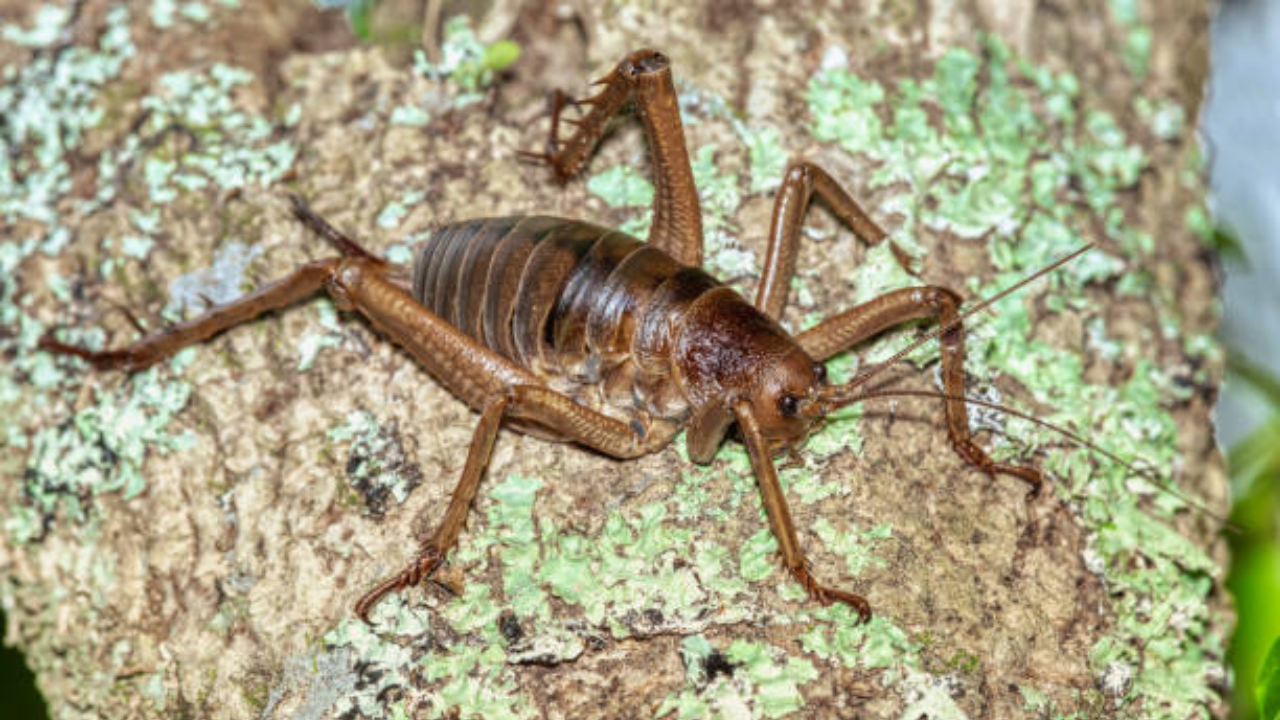
Photo via New York Post

‘Entirety of your hand’: World’s heftiest and most horrifying insect brought back from extinction — it’s heavier than a mouse

Read the original at New York Post ↗
Cite

Cost, B. (2026, October 7). ‘Entirety of your hand’: World’s heftiest and most horrifying insect brought back from extinction — it’s heavier than a mouse. New York Post. https://nypost.com/2026/10/07/science/worlds-heaviest-insect-brought-back-from-the-brink/

Dated when The Aporia collected the article, usually within hours of publication. Check the original for its exact date and byline.

New York Post · collected 2026-10-07 · by Ben Cost

Quick Summary

Dr. Chris Green from New Zealand’s Department of Conservation reports that the wētāpunga, the world's heaviest insect weighing up to 35 grams (as much as a sparrow or mouse), has been successfully reintroduced into the wild after extensive conservation efforts. Over 11,000 of these giant crickets were released onto predator-free islands and mainland sanctuaries since 2010, reversing their endangered status to "Threatened—Nationally Increasing." The breeding program involved innovative husbandry techniques that enabled the survival and thriving of this once-nearly extinct species.
Written by AI on 2026-10-07, from this article's own text only (the story summary below draws on all the coverage).

AI analysis

Story summary

Once on the brink of extinction, the wētāpunga, known as the world's heaviest insect, is making a comeback thanks to a successful breeding program in New Zealand. Dr. Chris Green, an honorary research associate at New Zealand’s Department Of Conservation, co-authored a report in the New Zealand Journal of Zoology detailing the conservation efforts that led to the release of over 11,000 wētāpunga into the wild. Adult females can weigh up to 71 grams, heavier than a mouse, and their body length reaches up to 4 inches with a leg span of eight inches. The breeding program, carried out by experts at Butterfly Creek and Auckland Zoo, involved innovative techniques like feeding nymphs fresh foliage, fish flake protein, and leaf litter. This recovery effort marks a significant conservation achievement for the species, which was once widespread across New Zealand's North Island but nearly extinct due to habitat destruction by settlers.

Written for “Giant Extinct Insect Rediscovered” on 2026-11-05, grounded in this article and the 0 other(s) covering the same event.

Story

📰 Giant Extinct Insect Rediscovered
Science · 1 article(s) covering the same event.

Compared with similar articles

This article reads unscored and hedges 6% of its claims. Each row says how that neighbour differs.
Times of India
Hedges 4 of 32 claims Outlet record 59/100
“The articles describe the overall recovery effort of the wētāpunga but do not focus on a single specific incident or release event; they cover different aspects of the broader conservation program.”
How this article was measured signals, leaning charts, publisher record, byline, topics and claims

Signals How these are calculated →

Claims extracted
18
sentences that state something as happening or true
Uncertain
6%
1 of 18 hedged ("reportedly", "may", "according to")
Leaning
not political
takes no side on a contested political question
Publisher signals
66/100
New York Post's corrections and hedging, across everything collected from it. Not a measure of accuracy.
Outlets on this story
1
Science
Same framing elsewhere
1
articles that frame the event the way this one does
Analyzed 2026-10-07 · how these are computed

How this is being covered How these are calculated →

Article leaning vs. publisher reliability
Source leaning vs. consistency

Publisher

New York Post · 17197 article(s) · 36 correction(s) detected
Running correction rate · 36 correction(s)

Who wrote this

Ben Cost
37 article(s) here · 1 carrying a prediction
🔮 Grice theorized that the “manganese mineralization” may have helped stabilize or replicate the delicate cell structures during fossilization, reshaping our understanding of molecular longevity.
🔮 Andrew Jones, project head and founder of Noah’s Ark Scans, told the Daily Mail that they’ve discovered both charred and uncharred wood nearly 30 feet underground, which could potentially be “the charred remains of Noah’s Ark.”
🔮 Due to their negligence, officials said the hikers would have to foot their own rescue bill, which could range from $1,000 to $20,000 depending on the cost, according to the Boston Globe.
🔮 They couldn’t slow its roll.
🔮 Mummies might not curse defilers from the afterlife, but that doesn’t mean you should display their remains, apparently.
🔮 The company’s investigators reportedly discovered a glitch that allowed them to access pages from over 6,800 links Muse had created so users could share pages with each other, Ars Technica reported.
🔮 In their final post before their death, the duo could be seen taking to the streets on a wheeled contraption.
🔮 The 78-year-old Nobel Prize winner notably stepped down from Google in 2023 over fears that the tech could manufacture killer robots capable of exterminating humanity.
🔮 Despite logging onto the Apple Store app “the moment it opened,” it reportedly glitched out and they couldn’t press buy.
🔮 That means that high-latitude nations like the UK, Canada, and Norway will face the greatest solar storm risk between December and February.
Also by Ben Cost
Nothing else under this byline is closely related to this article, so these are simply their most recent.
All 37 articles by Ben Cost →

Topics

Auckland Zoo Department Of Conservation New Zealand’s RNZ the New Zealand Journal of Zoology

Subjects

Green PERSON · 2× New Zealand’s GPE · 2× Auckland Zoo ORG · 1× Chris Green PERSON · 1× Department Of Conservation ORG · 1× Guardian ORG · 1× RNZ ORG · 1× the New Zealand Journal of Zoology ORG · 1×

Narrative

To bring the thick crickets back from the brink, experts at Butterfly Creek and Auckland Zoo had to rely on novel husbandry techniques, including feeding the nymphs fresh foliage, fish flake protein and leaf litter, the Guardian reported. They were also able to rear large numbers of the cumbersome crickets by keeping them in communal mesh cages.
framing: assertive · carried by 1 article(s) · first seen 2026-10-07
🔮 “The size of adult females would sit nicely on the entirety of your hand,” exclaimed Green.

Claims (18 extracted, 1 hedged)

Once on the brink of extinction, the world’s heaviest insect — the wētāpunga — is staging a remarkable comeback thanks to an extraordinary breeding program. asserted
insect → stag → program
“This species was endangered at the start of the program, it is now not endangered – it is recovering,” Dr. Chris Green, an honorary research associate at New Zealand’s Department Of Conservation, told RNZ. asserted
Green → endanger → RNZ
He co-authored a report in the New Zealand Journal of Zoology describing the conservation campaign, which culminated in the release of over 11,000 of these colossal creepy crawlies into the wild. asserted
which → co → wild
It’s safe to say they’ve made a big return. asserted
they → ’ → return
Also known as the Little Barrier Island giant wētā, this colossal cricket tips the scales at up to 35 grams — heavier than a sparrow or a mouse — while a pregnant female clocked in at a record 71 grams. asserted
female → know → grams
“The size of adult females would sit nicely on the entirety of your hand,” exclaimed Green. asserted
Green → sit → hand
These behemoth bugs, which belong to the cricket or grasshopper family, can also grow to 4 inches long boast a maximum leg span of eight inches. asserted
grow → belong → inches
Giant wetas once scuttled across all of New Zealand’s North Island, before they were nearly wiped out by settlers, who cut down their forests and introduced cats and rats. asserted
who → scuttle → cats
By the 1990s, the chonky critters had vanished from NZ’s mainland with the only remaining wild population residing on Hauturu/Little Barrier Island. asserted
population → vanish → Island
To bring the thick crickets back from the brink, experts at Butterfly Creek and Auckland Zoo had to rely on novel husbandry techniques, including feeding the nymphs fresh foliage, fish flake protein and leaf litter, the Guardian reported. They were also able to rear large numbers of the cumbersome crickets by keeping them in communal mesh cages. asserted
They → bring → cages
When the wetas were big enough to fend for themselves, the conservationists started releasing them into the wild with the inaugural translocation occurring in 2010. asserted
translocation → fend → 2010
Since then, 11,214 wētāpunga have been set in loose in predator-free islands and two fenced sanctuaries on mainland NZ. asserted
wētāpunga → set → NZ
What’s more, they’ve established successful breeding populations spanning multiple generations. asserted
they → ’ → generations
During one survey of their new habitat, researchers reported finding 28.5 insects per person per hour of searching, compared to just 1.4 on the Little Barrier Island. asserted
researchers → find → Island
The program was so successful that, in 2022, the species was downgraded from “Endangered” to “Threatened —Nationally Increasing,” meaning these jumbo Jiminies are seeing a colossal second-coming. asserted
Jiminies → downgrade → coming
“The future of wētāpunga is looking bright,” said Dr. Green, who hopes they can replicate the success with other endangered species. asserted
they → look → species
“By documenting this amazing conservation success story, we can share valuable knowledge on husbandry, release methods, and population persistence,” he declared. asserted
he → document → husbandry
“There are many more critically endangered invertebrates that could benefit from similar programs, for example the Canterbury knobbled weevil (Hadramphus tuberculatus) and several native stag beetle species.” uncertain
that → be → example

💬Give feedback · no sign-in needed

No sign-in needed for now. Your note is sent without a name, so it cannot be answered.

🕘History 🎫Support