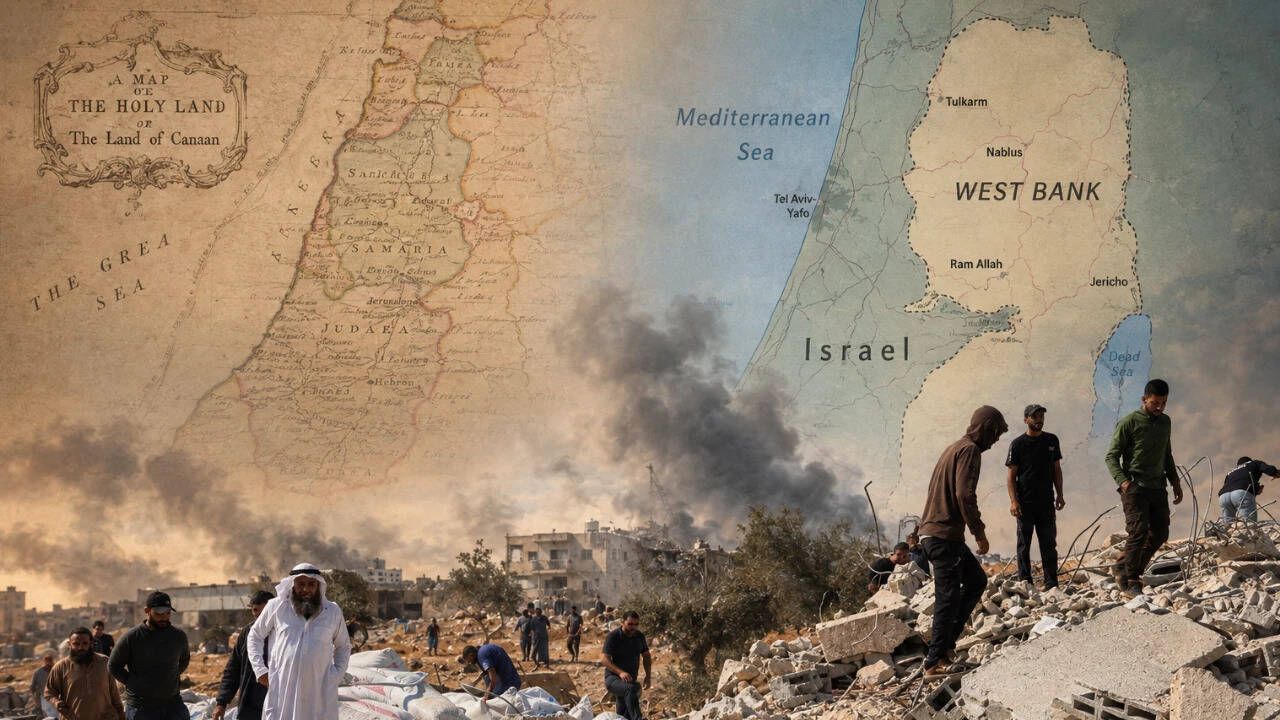
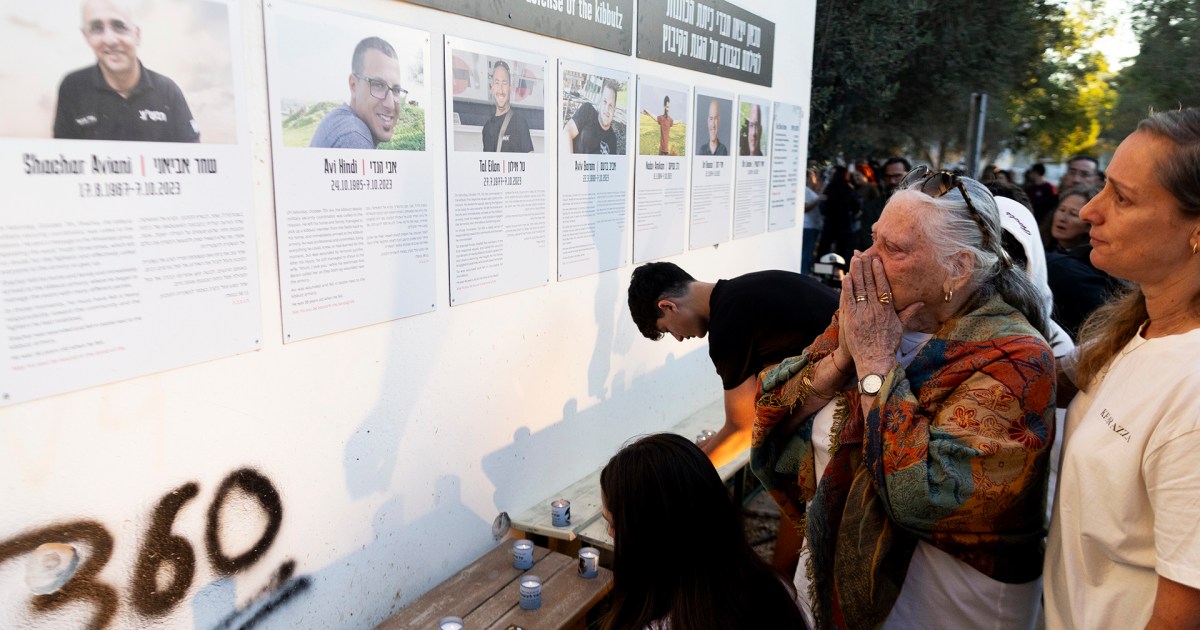
Photo via Times of India

From the 'Promised Land' to October 7 - the origin story of Israel-Palestine conflict

Read the original at Times of India ↗
Cite

Mahajan, T. (2026, October 7). From the 'Promised Land' to October 7 - the origin story of Israel-Palestine conflict. Times of India. https://timesofindia.indiatimes.com/world/middle-east/the-backstory-from-the-promised-land-to-october-7-the-origin-story-of-israel-palestine-conflict/articleshow/134764883.cms

Dated when The Aporia collected the article, usually within hours of publication. Check the original for its exact date and byline.

Times of India · collected 2026-10-07 · by Trisha Mahajan

Quick Summary

The article examines the historical roots of the Israel-Palestine conflict, focusing on the biblical narrative that describes the "Promised Land" given to Abraham by God, which includes present-day Israel and Palestinian territories. It highlights how this ancient religious connection has been central to Jewish identity and memory for thousands of years, despite the diaspora, influencing modern political claims to the land since the establishment of the State of Israel in 1948.
Written by AI on 2026-10-07, from this article's own text only (the story summary below draws on all the coverage).

AI analysis

Story summary

Three years after October 7, 2023, the world continues to grapple with the profound impact of Hamas's attack on southern Israel. On that day, Palestinian fighters breached the Gaza border, killing more than 1,200 Israelis and taking 251 hostages into Gaza. The assault remains a defining moment in Israeli history, leading to significant changes in leadership and security policies.

In the lead-up to the attacks, Israelis were focused on internal politics rather than external threats. Following the massacre, Prime Minister Benjamin Netanyahu's government faced severe criticism but he remains in power despite overseeing what many consider the worst security failure in Israel’s history. The attack led to mass protests demanding the release of hostages and widespread global condemnation of Hamas.

The incident reshaped Israeli society and its approach to security, with leaders acknowledging that external threats were underestimated prior to October 7. Meanwhile, families like Sigal Manzuri continue to advocate for peace and remember their loved ones lost in the attacks, highlighting the human cost behind the statistics.

Written for “Oct 7 Attacks Anniversary” on 2026-11-02, grounded in this article and the 43 other(s) covering the same event.

Story

📰 Oct 7 Attacks Anniversary
Politics · 44 article(s) covering the same event. See how they differ ↓

Compared with similar articles

This article reads unscored and hedges 7% of its claims. Each row says how that neighbour differs.
Washington Examiner
⚖️ Leans strongly right Hedges 1 of 36 claims Outlet record 70/100
BBC News
Hedges 3 of 69 claims Outlet record 68/100
Al Jazeera
⚖️ Leans left Hedges 6 of 54 claims Outlet record 60/100
“The articles discuss different phases of the ongoing conflict: Article A focuses on the initial attack and its immediate aftermath, while Article B addresses the displacement and possessions left behind by Palestinians after the war began.”
Washington Examiner
Hedges 2 of 61 claims Outlet record 70/100
CBS News
Hedges 0 of 2 claims Outlet record 66/100
“While both articles discuss the Oct. 7, 2023 attacks and their aftermath, they cover different aspects: Article A focuses on broader regional conflicts influenced by those attacks, while Article B provides background and details specifically about the Oct. 7 attacks themselves.”
Washington Examiner
Hedges 0 of 24 claims Outlet record 70/100
“While both articles refer to the Hamas-led attack on Israel that occurred on Oct. 7, 2023, Article A focuses more on the subsequent celebrity involvement and discussions about the conflict, whereas Article B provides historical context and details about the original attack and its aftermath.”
Al Jazeera
⚖️ Leans strongly left Hedges 6 of 30 claims Outlet record 60/100
“While both articles discuss the major attack by Hamas on October 7, 2023, Article A focuses on three years of Israel's response to this event and the ongoing conflict, whereas Article B provides context and background leading up to the specific day of the attack.”
The Hindu
Hedges 0 of 22 claims Outlet record 60/100
“While both articles discuss the Hamas attack on October 7, 2023, and its aftermath, Article A focuses specifically on a commemoration three years later, while Article B provides a broader historical context for understanding the conflict.”
NBC News
Outlet record 60/100
“Article A focuses on commemorating a specific attack from three years prior, while Article B provides historical context and discusses the broader implications of that attack without focusing solely on the immediate event.”
The Guardian
Hedges 2 of 43 claims Outlet record 66/100
“While both articles discuss the Hamas attack on Israel that occurred three years prior (October 7, 2023), Article A focuses on commemorations and memories of that specific day, while Article B provides a broader historical context leading up to the event.”
How this article was measured signals, leaning charts, publisher record, byline, topics and claims

Signals How these are calculated →

Claims extracted
69
sentences that state something as happening or true
Uncertain
7%
5 of 69 hedged ("reportedly", "may", "according to")
Leaning
withheld
no quote in the article backed the model's score
Publisher signals
59/100
Times of India's corrections and hedging, across everything collected from it. Not a measure of accuracy.
Outlets on this story
44
Politics
Same framing elsewhere
1
articles that frame the event the way this one does
Analyzed 2026-10-07 · how these are computed

How this is being covered How these are calculated →

Article leaning vs. publisher reliability
Source leaning vs. consistency

Publisher

Times of India · 3890 article(s) · 2 correction(s) detected
Running correction rate · 2 correction(s)

Who wrote this

Trisha Mahajan
35 article(s) here · 1 carrying a prediction
🔮 Billionaire entrepreneur Elon Musk backed Republicans on Friday and warned that a Democratic sweep of the US House of Representatives, Senate and presidency in 2028 could lead to what he described as the “end of democracy in any meaningful sense of the word”, ahead of the November 3 midterm elections.
🔮 The White House on Thursday shared a video of violent protest scenes from France, claiming that the unrest could represent their future if they back the Democratic Party in the November 3 midterm elections.
🔮 The US Department of Justice said FBI and Immigration and Customs Enforcement (ICE) personnel will not serve as monitors during the November midterm elections, amid concerns from civil rights groups that the Trump administration’s plans for federal election oversight could intimidate voters.
🔮 “He is greatly appreciated and will be sorely missed,” she said, as quoted by AP.
🔮 The additional forces could help expand US military options, although their presence does not establish whether or when Trump will authorise another attack.
🔮 Jennifer Shuford, deputy director and chief medical officer of the US Centers for Disease Control and Prevention (CDC), is set to leave the Trump administration after next week's midterm elections, the Washington Post reported on Monday, citing sources.
🔮 US President Donald Trump said on Saturday that he may move the White House press corps to a different location, but dismissed the swirling rumours that he planned to restore a historic indoor swimming pool in place of the current press briefing room.
🔮 Authorities restricted a major march in Paris to the city’s southeastern edge, closed prominent museums and banned demonstrations in several cities to prevent a repeat of last weekend’s violence. Up to 70,000 police officers deployed Before the protests began, interior Minister Laurent Nuñez had said that up to 70,000 officers would be deployed nationwide, supported by helicopters, armoured vehicles and water cannons.
🔮 "While Bhandari was picking up his brand new luxury car and talking about how he couldn’t stop smiling, healthcare facilities had not received the vital PPE they needed at a time when demand was exponential and companies were millions of dollars out of pocket," he said.
🔮 The warning incorrectly placed the epicentre near the Kuril Islands and predicted seismic intensity of up to shindo 7, the highest level on Japan's seven-point seismic intensity scale, across areas stretching from Hokkaido to the Tokai region.
Also by Trisha Mahajan
Nothing else under this byline is closely related to this article, so these are simply their most recent.
All 35 articles by Trisha Mahajan →

Topics

Gaza Hamas Israel Jerusalem Jewish

Subjects

Jewish NORP · 15× Israel GPE · 8× Abraham PERSON · 6× God PERSON · 3× Jacob PERSON · 3× Jews NORP · 3× Gaza GPE · 2× Isaac PERSON · 2× Jerusalem GPE · 2× Palestine GPE · 2×

Narrative

Thus, many Palestinians and their descendants continue to demand the right to return to homes and properties from which they were displaced, while Palestinian national politics increasingly came to centre on self-determination and statehood. 1967: The land question becomes even more complicated Another major turning point came nearly two decades later.
framing: assertive · carried by 1 article(s) · first seen 2026-10-07
🔮 According to the Book of Genesis, God tells Abraham to leave his homeland and travel to a land that God will show him.

Claims (69 extracted, 5 hedged)

Three years ago, Israel experienced one of the deadliest days in its modern history. asserted
Israel → experience → history
Hamas and other Palestinian armed groups launched a large-scale attack from Gaza, crossing the border and attacking Israel during a music festival. asserted
Hamas → launch → festival
More than 1,200 people were killed and 251 people were taken hostage on October 7, 2023, according to the United Nations. uncertain
people → kill → Nations
The attack led Israel to launch a massive attack in Gaza that has since reshaped the region but remains unresolved. asserted
that → lead → region
The reasons include the history of the two much before October 7, starting with a “promised land”. asserted
reasons → include → land
In modern political and popular discourse, the Jewish connection to the land is said to be going back 3,000 years. asserted
connection → say → land
The figure refers to the history of the ancient Israelites and the long-standing Jewish religious connection to the land. asserted
figure → refer → land
It all begins with Abraham, a biblical patriarch, and the Jewish belief of the “Promised Land”. asserted
It → begin → Land
Abraham and the 'Promised Land' Abraham is one of the central figures in the Hebrew Bible and is regarded in Jewish tradition as the first of the three patriarchs of the Jewish people, followed by his son Isaac and grandson Jacob. asserted
Abraham → regard → son
According to the Book of Genesis, God tells Abraham to leave his homeland and travel to a land that God will show him. uncertain
God → accord → him
That land is subsequently identified in the biblical account as Canaan, an ancient name for a region encompassing parts of present-day Israel and the Palestinian territories, although biblical descriptions of its boundaries vary. asserted
descriptions → identify → boundaries
God then promises the land to Abraham's descendants. asserted
God → promise → descendants
This becomes the basis of the Jewish concept of the “Promised Land”. asserted
This → become → Land
For all the land which thou seest, to thee will I give it, and to thy seed for ever. asserted
I → seest → seed
The biblical story continues through Abraham's son Isaac and grandson Jacob, who is given the name Israel. asserted
who → continue → name
Thus, Jacob's descendants became known as the ‘Children of Israel’. asserted
descendants → know → Israel
The modern State of Israel was established only in 1948. asserted
State → establish → 1948
The biblical story belongs to an ancient religious tradition dating back thousands of years. asserted
story → belong → years
For centuries, however, the land remained central to Jewish religious memory. asserted
land → remain → memory
Even after Jews were dispersed across different parts of the world, prayers and religious traditions continued to focus on Jerusalem and the Land of Israel. asserted
prayers → disperse → Israel
For centuries, the Jewish connection to the Land of Israel remained deeply rooted in religion, history and identity. asserted
connection → remain → religion
Even after Jewish communities were dispersed across different parts of the world, Jerusalem and the land remained central to Jewish religious memory and prayer. asserted
Jerusalem → disperse → memory
By the late 19th century, that ancient connection began to take on a modern political form. asserted
connection → begin → form
Zionism emerged in Europe as a movement seeking Jewish national self-determination and a homeland for Jews, amid growing antisemitism and persecution. asserted
Zionism → emerge → antisemitism
And the territory at the centre of that movement was Palestine, which encompassed much of the land Jews regarded as their historic homeland. asserted
Jews → encompass → homeland
But Palestine was not an empty land waiting for a new population. asserted
Palestine → wait → population
It was home to a predominantly Arab population, including Muslims and Christians, as well as a longstanding Jewish community. asserted
It → include → Muslims
As Jewish immigration increased, particularly from Europe, two national movements increasingly came to see the same territory as their homeland: the Zionist movement seeking a Jewish national home, and Palestinian Arabs seeking political self-determination in the land where they lived. asserted
they → increase → land
That claim to the same territory would become the central question of the conflict that followed. uncertain
that → become → conflict
1917: Britain promises a Jewish national home The First World War transformed the region. asserted
War → promise → region
During the war, Britain fought the Ottoman Empire and eventually took control of the territory. asserted
Britain → fight → territory
In 1917, Britain issued the Balfour Declaration, expressing support for the establishment in Palestine of a “national home for the Jewish people”. asserted
Britain → issue → people
At the same time, the declaration said that nothing should be done to prejudice the civil and religious rights of the existing non-Jewish communities in Palestine. asserted
nothing → say → Palestine
For the Arab population of Palestine, however, the prospect of a Jewish national home in a territory where they were already the majority gave rise to concerns and opposition. asserted
they → give → concerns
Britain subsequently governed Palestine under a League of Nations mandate. asserted
Britain → govern → mandate
Jewish immigration increased, while relations between Jewish and Arab communities became increasingly tense and violent. asserted
relations → increase → communities
The UN proposes two states asserted
UN → propose → states
After the Holocaust and the devastation of European Jewry during World War II, international support for a Jewish state grew. asserted
support → grow → state
Britain eventually handed the Palestine question to the newly established United Nations. asserted
Britain → hand → Nations
In 1947, the UN proposed partitioning Palestine into two independent states - one Jewish and one Arab. asserted
UN → propose → states
…and 29 more, not listed.

💬Give feedback
🕘History 🎫Support